
The Feminist Interview Project, organized by CAA’s Committee on Women in the Arts, examines the practices of feminism by interviewing a range of scholars and artists. The project aims to preserve the living histories of feminist art practices, while interrogating and expanding the boundaries of what might be considered feminist. Throughout its interviews, this project reimagines the possibilities of feminist practice and feminist futures by exploring a diversity of perspectives and approaches to research. This collection of interviews aspires to critically examine the relationships between feminism, feminist art, and the lived realities of women, nonbinary and female-identified artists and scholars across the globe.
For our ongoing collaboration with Art Journal Open, the Feminist Interview Project is excited to present artist Allison Grant in conversation with art historian and curator Elizabeth S. Hawley. The two met for a conversation over Zoom on November 19, 2025.
Elizabeth S. Hawley: I’m speaking with Allison Grant, an artist, writer, curator, and Associate Professor of Photography at the University of Alabama. Her photographs address intersecting concerns around feminism, reproductive care, community solidarity, and environmental justice—much to delve into! Allison, I’ll first ask you to introduce yourself and give us an overview of how you came to your photographic practice.
Allison Grant: As you mentioned, I’m at the University of Alabama, and I live in Tuscaloosa. My artwork looks at environmental and social issues. I’m thinking about the possibilities of representing big issues—climate change, toxic contamination, reproductive justice—but also some of the difficulties that exist in doing that. These are broad and complex issues that exist in different ways globally, and one of the ways I’ve approached that is through thinking about the local and personal, and how I can connect with these issues in my own lived experience and inside of my community. And this intersects with many disciplines: ecology, feminism, queer theory, environmental science, human health.
The foundation for my work started when I was really young. I grew up in a house with acres of woods behind it in Cincinnati, Ohio, and I had this idyllic childhood where I would go outside and peek in foxholes, follow deer trails, and look up at the canopy of leaves, and I came to see ecology as this broad part of existence that in some ways intersected with me, and in some ways played out as its own force. Those earliest experiences really shaped me.
In high school, I discovered photography and I just fell in love with this medium. I went to the Columbus College of Art and Design in Columbus, Ohio, for my bachelor’s degree. I spent a lot of time while I was there thinking about my experience of being in place, what it meant to be connected to the land, to be a woman in these changing landscapes there and back home.
Then I pursued a graduate degree at Columbia College Chicago. During that time, I created a body of work called Unsoiled that looks at nature photography within visual culture—especially the idea of nature as serene and valuable for its appearance. I started to question how photographic conventions operated.
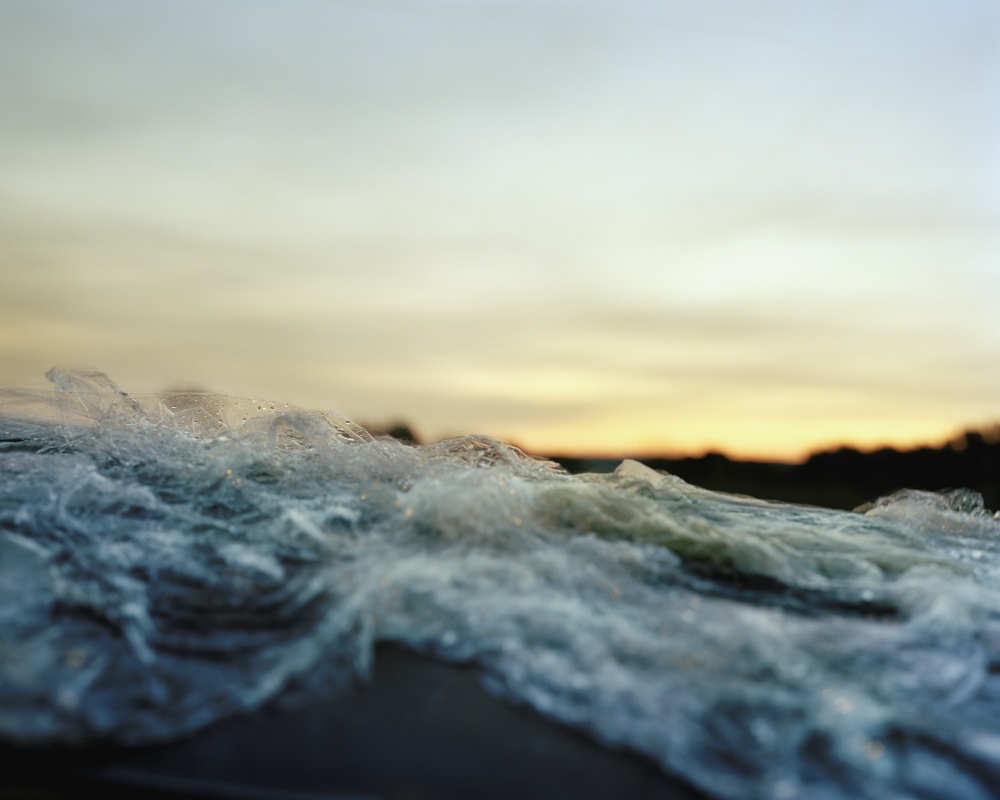
After graduating, I interned at the Museum of Contemporary Photography, and was hired as an education and curatorial employee there. I did that for ten years, and then felt, especially after I had my first daughter, that I just couldn’t be with my art practice as much as I wanted. I decided to look for full-time teaching positions that would give me space for creative activity. I ended up coming to the University of Alabama.
ESH: I’m glad you brought up the Unsoiled series, which is how I first came to your work when we were collaborating on the Borderwaters show, and I realized how aligned our interests are.
I’ll proceed with a standard Feminist Interview Project question: What is feminism to you?
AG: For me, it’s a language for processing and expressing a set of lived experiences that intersect with my identity and sense of self, but also exist outside of me, and the way the world has reflected back to me who I am in relationship to who I think of myself being. There are so many texts, artworks, songs, and poems that have helped me to see aspects of my lived experience, and to articulate them in ways that feel incredibly powerful. And for me, that is the most powerful part of feminism; it’s knowing other people have had similar experiences, gaining their brilliance in terms of articulating those things.
But I also think it’s politics, right? It’s a way of not just articulating, but also pushing against the ways that power structures or other forces have made it difficult to have self-determination for certain people. Part of that politics is always a form of listening, a type of empathetic understanding and collaboration. Not all experiences of gender are the same; listening to others, trusting their accounts of their sense of reality, and thinking about the ways gender intersects with other lived experiences is important in forming community and collaboration.
Bernice Johnson Reagon talks about a truly radical politics—coalitional politics—and feminism not being a home to its members.1 There’s this sense of belonging that one can get from understanding that other people have shared identity and experiences with them, but feminism is also a space of disagreement, conflict, challenging presumptions, and it’s always moving and shifting and changing around us. This idea that it’s not a home, it’s a place that’s meant to be uncomfortable sometimes, and that discomfort is a part of growth—and belonging is a part of growth, too—and that it offers many different experiences and ways of being in the world, is how I’ve thought about feminism in my own life.
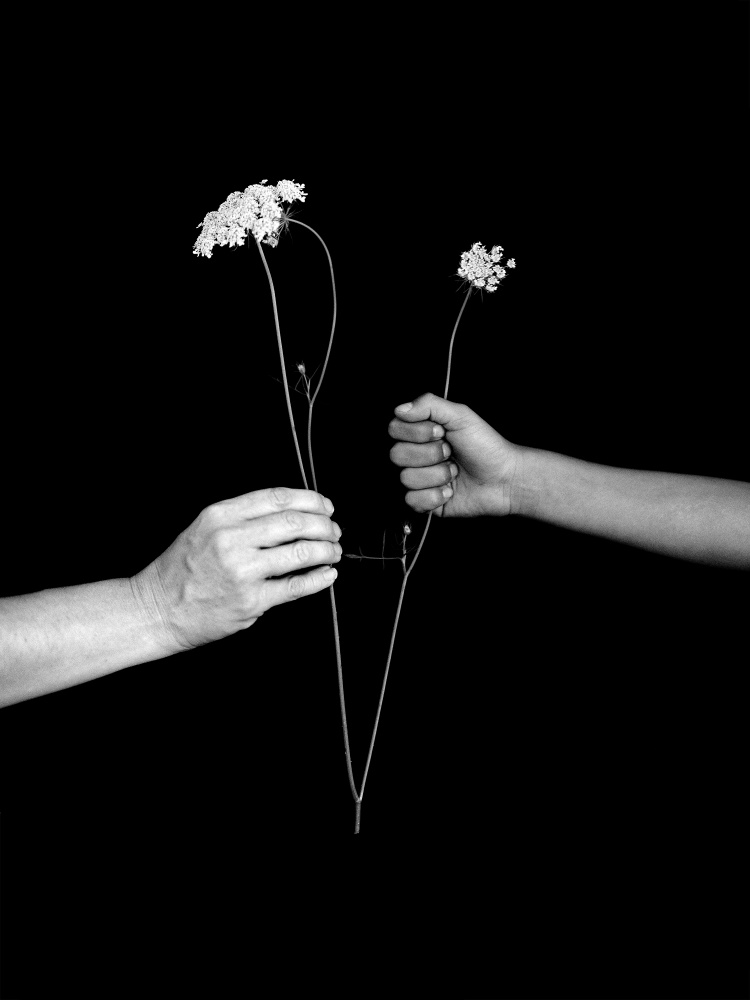
ESH: Ideas of collaboration, community, and challenge are a good segue into your recent and ongoing project, Holding Together. This series features the arms and hands of people holding plants historically used in reproductive care. Would you explain how this project started, how it’s going, and—I assume—how it’s going to continue?
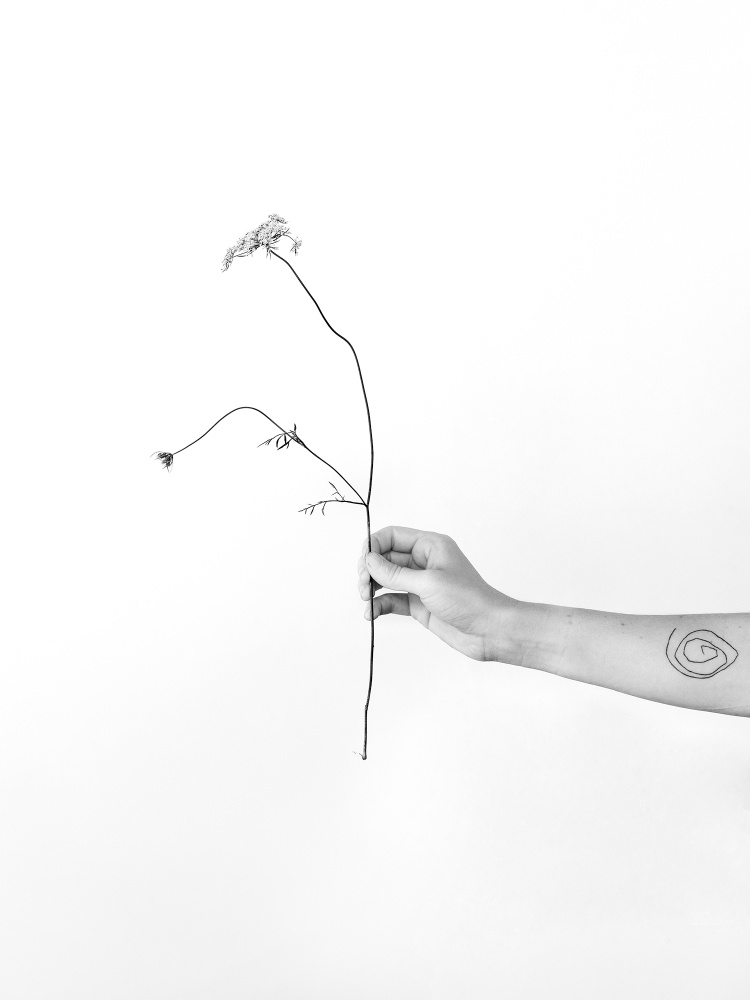
AG: I’m so glad you brought up the hands, because the community of people who show up in this work are so important—as or more important than the plants. This project was really formed inside of community from its conception. I was talking with a friend, Pete Halupka, a photographer and naturalist in Alabama. He mentioned that Queen Anne’s lace has been used historically as a type of birth control.
As soon as he said that, I could see this project immediately in my mind: people holding these flowers from Alabama. This was in 2024, before the Trump election, and there was a bill that had just been rejected: the Right to Contraception Act. Contraception is protected by a Supreme Court ruling, it’s not protected by law, and the intention of the proposed law was to enshrine protection so that a Supreme Court case couldn’t overturn it, which was a fear post-Roe.2 I started to imagine this world where these plants were the only resources that people in my state had. And I wanted to acknowledge this long and complicated history of people searching for the possibility of deciding if, when, and how they had children, and to think about this moment where we have so many powerful tools that make that possible, but we have a politics in certain places that withholds those modern tools. And I wanted to create this project that brought many different people together around this issue.3
ESH: The project started with you photographing women and people with uteruses holding Queen Anne’s lace. As it progressed, you started incorporating other botanicals. You’re also now photographing allies, so it’s not just women. Would you talk about this expansion of the project?
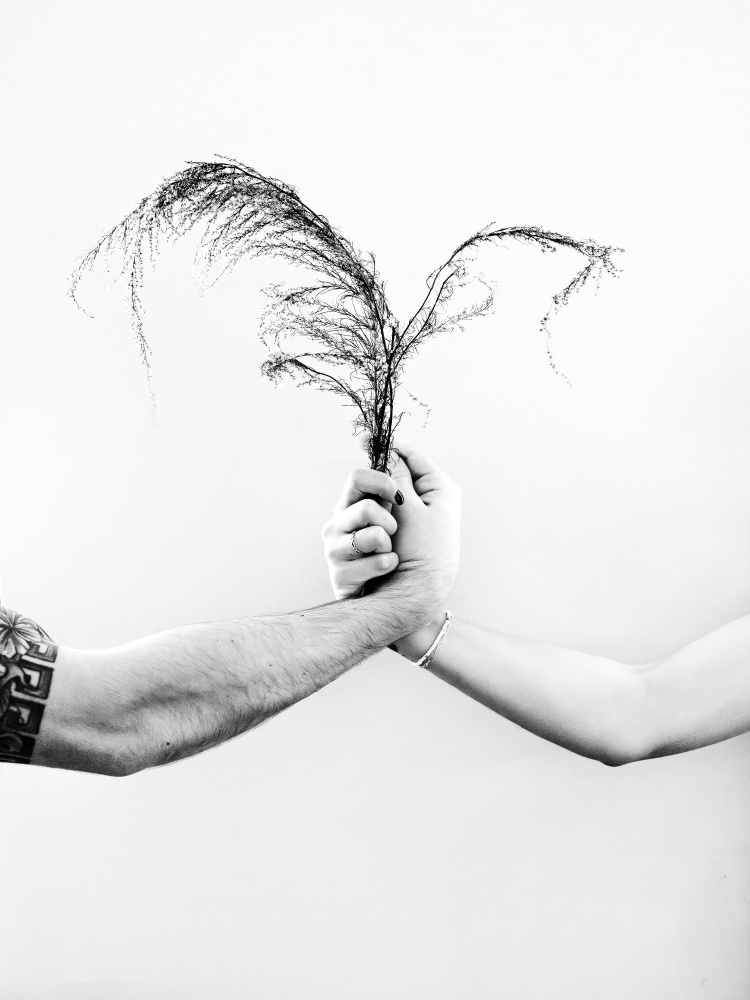
AG: As I researched Queen Anne’s lace—which is readily available in Alabama—I learned that there were all these other plants that had been used medicinally to induce abortion or as contraception. The potential to use those plants allowed me to pull from differing histories.
For example, I read Killing the Black Body by Dorothy Roberts.4 She discusses how enslaved women would use cotton root bark to prepare a tea to induce abortion. Cotton is a common plant in certain parts of Africa, so a lot of enslaved people came to the U.S. knowing how to prepare this recipe, and held that information pretty closely and didn’t share it with their captors or with white people. It was undertaken as a way for mothers to protect their children from being born into bondage; it was ultimately a compassionate way of resisting the enslavement of their children. I decided to expand and use these different botanicals because they gave a much broader view of how this history existed and how I might draw it into the present.
As for allies and others appearing, I made a picture featuring the hands of my daughter along with mine, and thought it was really powerful. Many of the people I’ve photographed who have children have talked about wanting to protect access to reproductive care for them. I also thought it was important to include men, partners, providers, etc. to represent that this is not just a “women’s issue” or an issue that only pertains to reproductive bodies. Lots of people work together collaboratively—sometimes at risk to their own livelihood, sometimes going against the law—to provide this type of access. I thought this was a way I could be more inclusive in terms of what it really takes and what it really means to have reproductive autonomy.
ESH: You always do such a deep dive into research in your projects. You mentioned Killing the Black Body—are there other texts you have found particularly useful?
AG: A text that has really changed the way I think about how culture influences abortion is John Riddle’s Eve’s Herbs: A History of Contraception and Abortion in the West.5 It looks at the ways different cultures historically have used herbal, medicinal treatments, in terms of contraception, abortion, and the general health of women and people with uteruses.
Another is Londa Schiebinger’s Plants and Empire.6 It’s about colonial bioprospecting and looks at a particular plant in the Caribbean that was used to induce abortion—the peacock flower. There are records of European bioprospectors finding and recording this knowledge, but the peacock flower was never exported. Schiebinger discusses the role of gender in the decision-making of what is valuable economically and socially, and the way these bioprospectors ignored this knowledge because it was coming from enslaved and Indigenous people, and because it was directed towards women, not necessarily towards the sort of capitalist ends that men tended to think are more important.
ESH: Can we talk about where you source the plants that appear in Holding Together? I know you have a kind of reproductive care garden going. Is that where you’re getting most of the plants now?
AG: Yeah, I have multiple places that I get things from, and I do have a reproductive garden. When I decided to expand this work, I started ordering seeds and plants, and they’re quite beautiful, and no one’s allowed to touch that part of my yard but me! But I also forage. One example is dogfennel. The photograph you and I made together contains dogfennel, which is a weed that just popped up in my yard. I was curious, and researching it led me to a website that details over one hundred and fifty types of plants that were used by Indigenous North Americans to induce abortion or for contraception.7 I’ve also photographed cotton, and I’ve gotten that from a local farmer who has very generously allowed me to pick from their fields.
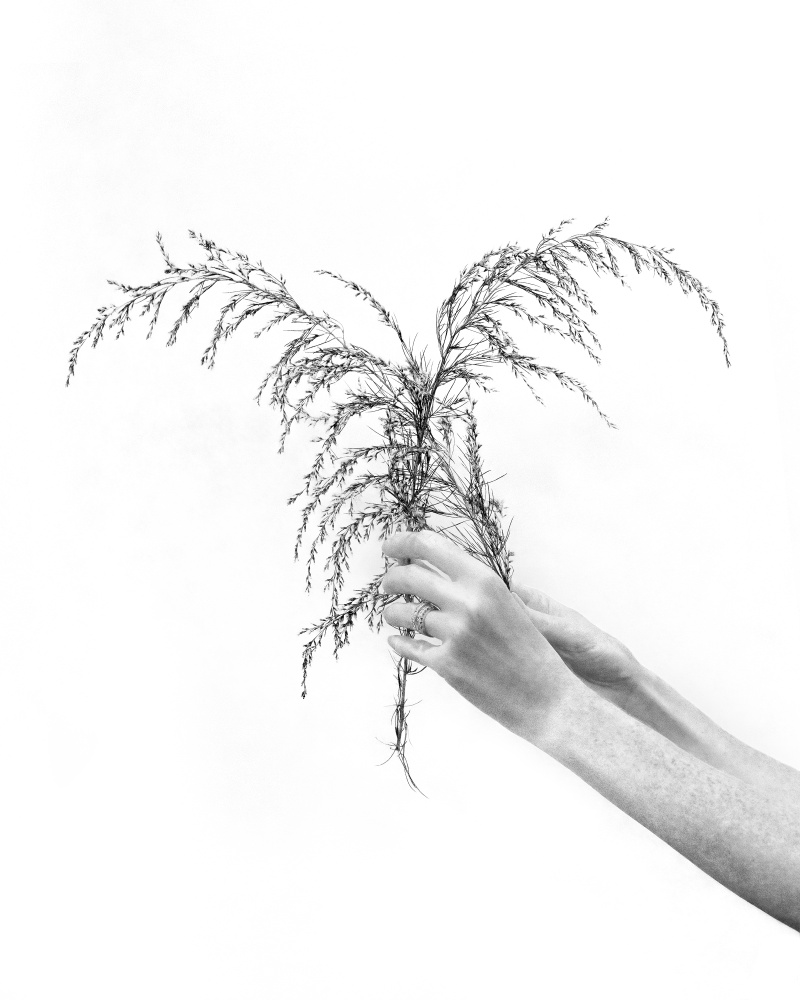
Sometimes selecting plants happens with intentionality for me; other times there’s just this way the landscape has opened up into a set of possibilities for learning about the world that I could never have anticipated.
ESH: How many plants have you used in the project at this point?
AG: Twelve or thirteen. Using plants as art materials—you have to be patient. A lot of the plants I want to photograph bloom biennially, so I have to wait two years before I can harvest them. There are some plants that I’m still waiting on.
I’ve also been thinking about integrating the question of IVF into the work, because there are medicinal plants that have historically been used to try to promote fertility. And there are also plants that are used to help balance hormone fluctuations during perimenopause and menopause.
ESH: Many possibilities! You have countless images for this series, and we’ve talked about how the project has expanded, and may continue to expand. I’m also interested to hear how you define Holding Together’s parameters and what would have to happen for you to consider it complete?
AG: This project, to me, is very timely, so I feel it’s important to put it out in the world before I know what its full parameters are. It’s really been a project that has been expanding for me since that first conversation about Queen Anne’s lace. One of the things that’s been really rewarding—and difficult, too—is that a lot of times when I photograph people, they’ll share intimate stories with me about their lived experiences of reproductive care. This has been such an amazing opportunity to listen and learn. I’ve thought about possibly integrating some of those stories into the project.
There’s also an international component to reproductive health. It’s not just Americans that deserve access to this treatment and care, and so I’ve been curious about going abroad and trying to look at these larger stories and figure out how they might bring broader perspectives to the work.
If legislation nationally codified abortion access into law, that would change the meaning of the work substantially. I don’t know if that would be the completion of the work, but it’s something I think about.
ESH: The intimate stories that people share—is that something you ask about or do you let your sitter take the lead on whether they want to share?
AG: This relates to how I take the pictures. Initially, I was photographing people I know, then I broadened out to other people. Even the people I know really well, we had never talked about this topic. But when you know you’re there to make art about reproductive issues, it can be a door that swings wide open in terms of sharing and saying: This is why I want to be a part of this project; this is what I want to do. So, this sharing happens with strangers, and with close friends.
I sometimes photograph at conferences and events; I take my camera and my plants on the road. People that I could never have expected wander into the project. I’ve also thrown parties where we gather and take these pictures, and sometimes conversations develop on the margins of me taking the photographs. As I finish, I’m able to join the ongoing conversation. This is one of the hopes I have for the work—that it might powerfully allow people to have these conversations inside of art galleries, because it has this way of bringing the topic to the floor.
ESH: You mention these works being in galleries—what is your goal for exhibiting or publishing these works and bringing them to audiences?
AG: It’s truly a collaborative project; I’m making it with others. The images themselves contain so much of the photographed person. Their gestures, way of being, creativity. In sharing the work, I think it’s important for multiple photographs to be on the wall, and a gallery or museum is a great space. I have gained so much from work that I see in galleries and museums that I carry out into the world and see differently. So, I always imagine my work there. But I also think I could do an installation on the street, or in a public space in a way that might be surprising, engaging with people who don’t visit museums and galleries.
I also want to find a way to further engagement beyond the gallery walls and the experience of the work itself. The U.S. mail has been such an important part of the way abortion access has been maintained in places where there are bans, because providers, at great risk to themselves, mail abortion pills to people via telehealth. I’ve wanted to acknowledge that, so I’ve been thinking about creating either a postcard book or placing postcards in the installation in some way where people could take them back out into the world.
ESH: This reminds me of Anthony Comstock’s nineteenth-century laws against obscene materials being sent through the mail, with anything to do with reproductive care labeled “obscene.” Thinking about mail art and how those fighting for reproductive justice have had to deal with these kinds of legal repressions for such a long time—that would be a very interesting continuation of this project.
You mentioned the personalities of the sitters coming out in the images, and when you look at them together, you see people’s jewelry, tattoos, nail polish, and the way they hold their hands. So, why black and white? Especially since color has been such an important part of your other major projects.
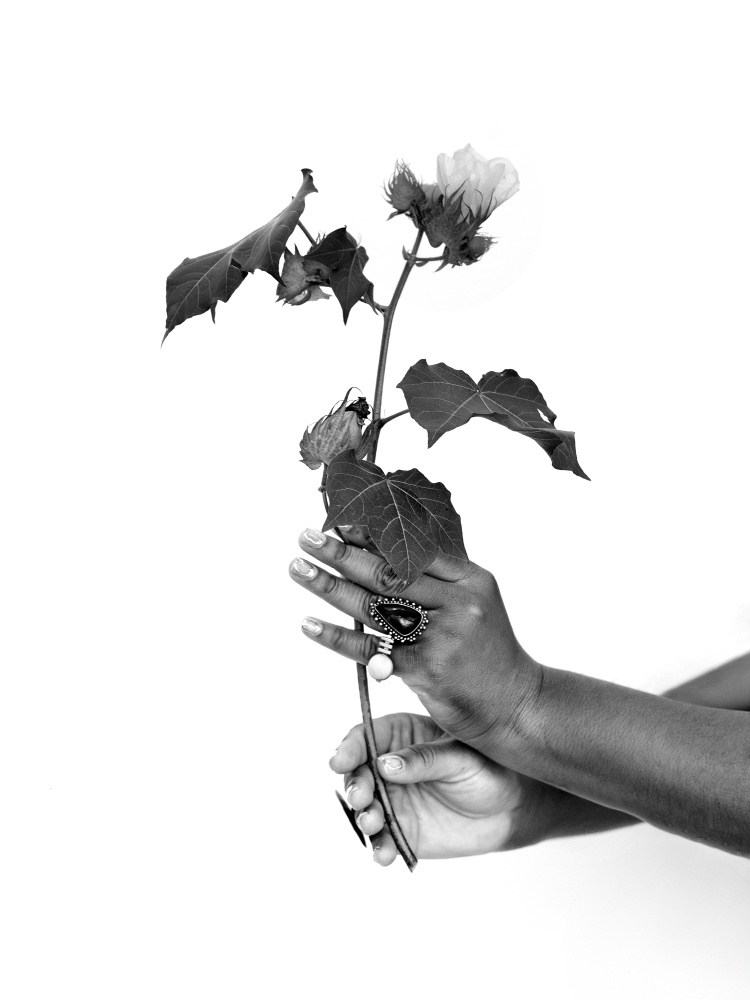
AG: I wanted the work to be in conversation with the history of recording and sharing information about botanicals. Historically, there are so many examples of people collecting plant samples and flattening them out and pressing them into books. Often, they are really splayed out so that you can see all the intricacies and details of the leaves. And botanical illustration is a little bit more three-dimensional but is still quite flat and really isolates the plant. I wanted my photographs to look a little bit like drawings or pressed plants, to reference the way that knowledge about these specimens has historically been passed through books and two-dimensional representations. In color, the photographs felt too dimensional.
I also didn’t want to be tethered to a lighting studio. The black and white still lets the personality of the people come out, but it also lets me travel with my camera and not be in a controlled environment. If the lighting is different, I can adjust the images and have a high degree of consistency—I think of this project a little bit like a typology—that I think is lost when the color shifts.
ESH: I see this series as a natural extension of your earlier project Within the Bittersweet, which includes images of various landscapes and vegetation of Tuscaloosa, and often features you and your children. As you put it in your artist statement, it’s “a dark pastoral narrative about raising my children amid concerns about the impacts of climate change and environmental contamination.”8 There seems to be a kind of ecofeminism to this series, and I’m thinking here especially of images like the one where you stand in this lush, green setting, gazing down at your young daughter as she nurses. Would you speak a bit on the connections between feminism, motherhood/parenthood, and environmental concerns?
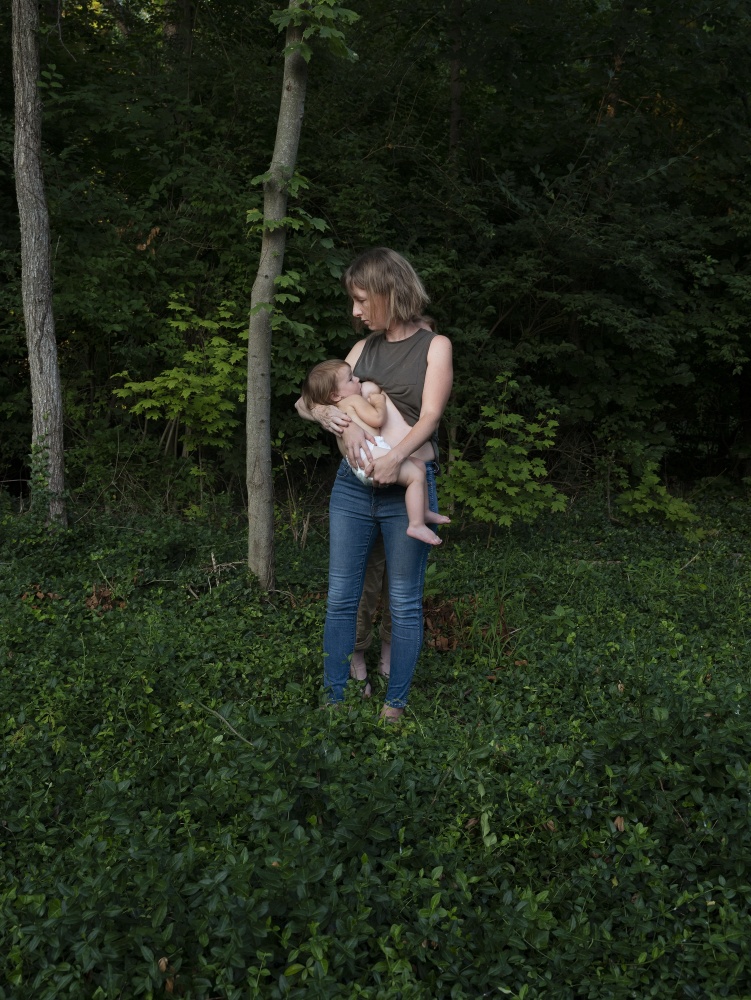
Allison Grant, As My Mother, So I, 2019. 30 x 40 in. Photograph provided by the artist. 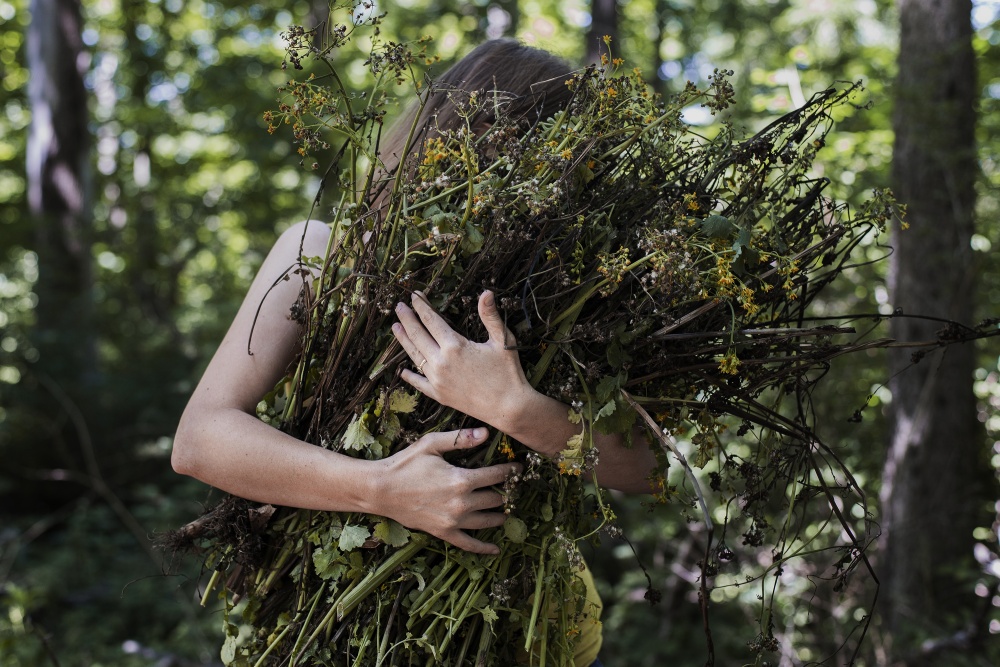
Allison Grant, Holding Half-dead Flowers, 2018. 30 x 22.5 in. Photograph provided by the artist.
AG: I’m so glad you brought that piece up. If you look closely, my mom is standing behind me. After my daughter was born, I was going through all these identity shifts, and I would hold this baby, and I would think about my mom holding me, and her mom holding her, and how that chain of care and labor and love and pain and difficulty extends all the way back through my ancestral past. There are all these events that led to this moment where I’m holding this baby, and if she decides to have a child of her own, she will become the next link in that chain going forward.
I was also motivated by how, after I had my daughter, climate change felt so piercing and close to me. I would think about her life, and where she would be in 2050, and how she might live past 2100, and these dates that we use as markers for climate change aligned with her life. What’s it going to be like if she has a child, and she’s thinking about the world that child’s going to inherit?
I also wanted to connect with the cyclical ways that you can think about life through biological processes, which is different than thinking about time as a linear progression, or charting it in relationship to climate change, which has been an upward trajectory in my lifetime. And I wanted to try to hold those two things in tension in the project.
All the photographs in that project are taken in within a one-hundred-mile radius of my house, except the one you mentioned. That one’s in the woods of my childhood home. So, it’s also about connecting to this place where my thinking about ecological topics is rooted.
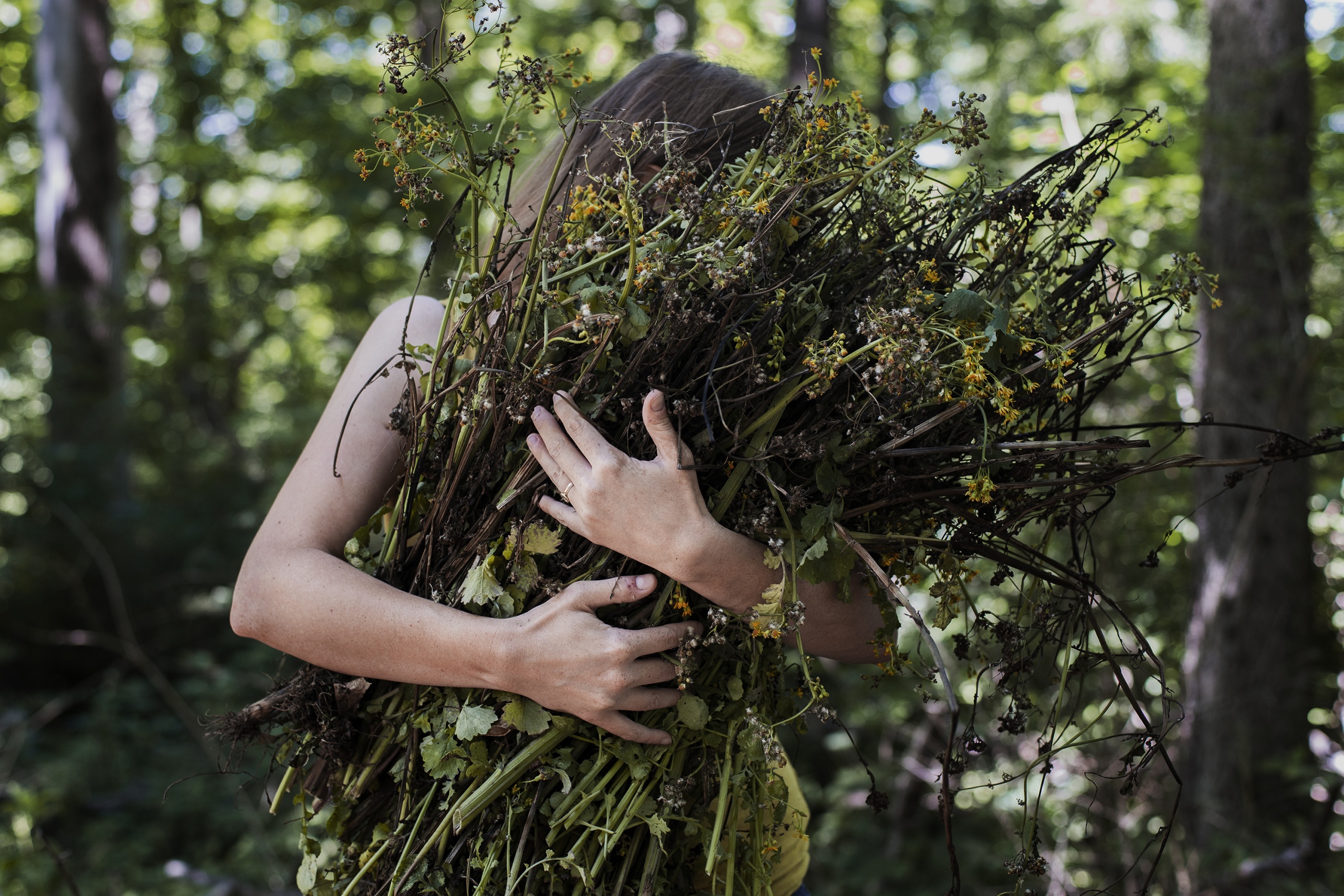
ESH: It’s interesting that you’re mentioning this rejection of the insistence on linear time, which is a very patriarchal, western way of conceptualizing time, and instead focusing on the cyclical regenerations that occur biologically. I’m thinking of your garden as well, and now I’m connecting this in my mind to your current project. And there seems to be some visual resonance between Within the Bittersweet and Holding Together images. I’m envisioning the photograph where you’re holding a massive bundle of weeds and wildflowers, and the plants obscure your face. The emphasis is on the hands and the plants, much as is the case in the Holding Together images. What do you make of this connection; is it something you were thinking about?
AG: Yes, and hands are an important part of many images in that series. That image in particular really gets at the way hands are a site where we interface with caring for or destroying things that surround us. To hold or touch is to know and to be connected in a different way, and using hands as the central focal point of the work emphasizes this idea of tenderness and care—or destruction. I’ve made some pictures for Holding Together where people have bent or ripped the flowers, or there’s a level of aggression there, too. I just think hands are this incredibly evocative part of the body that we typically don’t spend a lot of time looking at carefully and considering as a part of the extension of self out into the world.
ESH: I’m thinking now of the Within the Bittersweet image of your daughter’s hands at the bottom of a window. There’s something very intimate, but also sort of uncanny about that image.
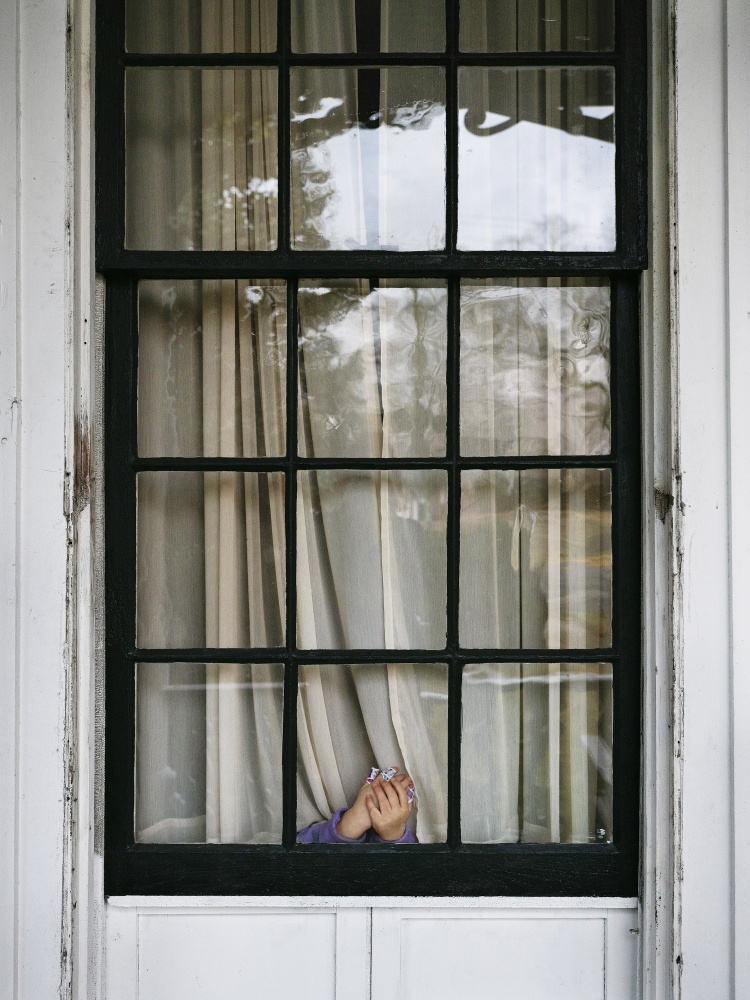
AG: We always imagine the face. We want to know who this person is and what they look like, and the face discloses so much of what we think, or what we are seemingly thinking. Just giving the hands leaves this level of mystery. You have to interpret the situation through a type of gesture that gives you some of the story, but not all of it. I often obscure parts of my pictures to try to make them feel unsettled—some other images in the series have dark areas that I think give a sense of uncertainty or read like an encroaching shadow of the future.
ESH: Now I’m thinking of the image in the series that shows your two daughters embracing, with angular shadows around them that look so ominous. I can’t help but think of the future of these girls—of so many girls and women—in the post-Dobbs period. Obviously, that’s not what you were thinking about when you took the photograph many years ago, but it takes on this new meaning, which is something that’s so powerful about photographs and other forms of art. They accrue meanings over time, and this image takes on this new heightened meaning in the context of reproductive care—and lack of care—that we are dealing with.
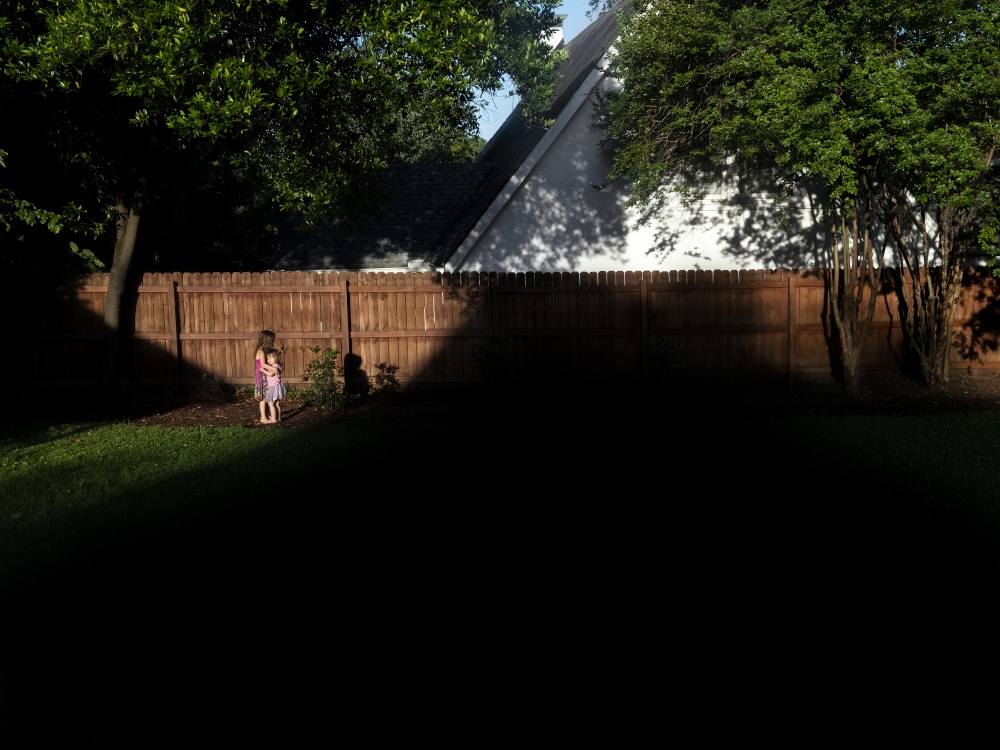
AG: Yeah, I think that’s absolutely there. I love work that can flex in terms of its meaning, because the world’s always changing, and it’s integral to have at least some flexibility, because these projects are happening over long periods of time, and the circumstances of how people think about them are shifting around them and with them. So, that’s a really powerful observation. That image actually shows a shadow of my house. I wanted to think about how the domestic and the personal is infused with the political, and how politics and parenthood are shaped in relationship to one another.
ESH: Climate change and reproductive health/rights are issues that are important throughout the country and world, but you’re approaching them from the perspective of someone living and working in Alabama, in the Deep South, a region not known for taking a progressive approach to these concerns. In an interview a few years ago, you noted, “Alabama is a wonderous and complex place to photograph.”9 Do you still feel this way? Would you expand on that?
AG: Yes, I very much feel that way. I think it is a wondrous place. This is one of the most ecologically diverse places in the United States. It’s often called the Amazon of North America because it has such an important role as a carbon sink in our country.10 It has a ton of species that only exist in little pockets of the state. It’s so beautifully wondrous in terms of the ecology. I also think there are amazing people in this state who are often overlooked. I have a great community that surrounds me here. Some of the closest friends that I’ve ever had. Some of the most progressive people I’ve ever met politically. It’s complicated because the state has a pretty dark history, and it also has some politicians that hold views that are not aligned with my own. There are important ways that you have to address these issues as an artist and as a person in the world, and there’s complexity inside of that.
But I think part of that complexity also comes from projection from the outside. There’s this way the media culture flattens this place into a set of stereotypes, which I think come from political rhetoric and also from a lack of national news media on the ground in this place. We have this great saying now that you need to disconnect and “touch grass” when the media environment has caused you to lose touch with reality, and I think so many people who are at the national level talking about Alabama have never touched the grass here. So, they don’t realize things like 54% of Alabamians support abortion in all or most cases. They don’t see the people on the ground here who are working and fighting for people who are most vulnerable to these laws.
There’s this idea of the South and of Alabama that is really dismissive, that I have to fight against. That complexity is difficult to navigate and makes it both a challenge but also a privilege to be an artist in this place.
ESH: Thank you for that answer. As you know, I grew up in Alabama, and it’s disheartening to see the place I still consider my home stereotyped on the national stage, but encouraging to hear how you acknowledge this fraught situation. That comes out both in the way you’re discussing it here, and in your work, which is so powerful.
You tend to work in series format, with years-long projects that include dozens, if not hundreds of photographs. What is it about seriality and duration that appeals to you and works for your artistic agenda?
AG: I learn so much from the process of making, and it’s a little bit like writing—you can write a paragraph, or you can write an essay, or you can write a book. The long-form art project, or multiples on the wall and the ways they speak to one another, and complicate one another, and form a larger narrative, or a larger set of ideas has been the way I orient with the world. I want to dig deep, I want to research, I want to think, I want to expand, I want to learn as I make. And it asks a lot of viewers to sit with the work and to think about it in this expansive way. I’m always amazed and humbled that there are people who are interested and willing and grab onto this work and teach me about it, too, because a part of that process is not just the making and the putting out in the world, but also the ways that people come in and see things and notice things and tell you things about your work that are there, absolutely, but expand your way of thinking and knowing the world.
ESH: What is the ultimate relationship between feminism and your artistic practice?
AG: I think expanding the space through which one can understand what’s possible in relationship to gender, and expanding the possibility of representing gendered experiences is what I want to do with my work. And I think it becomes a part of this larger feminist project of expanding ways of knowing and being in the world, and advocating for justice and equity inside of that.
ESH: Do you have any forthcoming projects that you would like to share?
AG: I have two video pieces, Drift and Day’s End, in an exhibition called Interior that opens in January at the Do Good Fund Gallery. It’s a group exhibition curated by bet elliott, looking at the intersection of domestic space with politics and lived experience. I also have an exhibition scheduled for next year at the Union Grove Gallery at the University of Alabama in Huntsville. It’s a three-person exhibition with Katie Baldwin and Sarah Bryant, who have been making a collaborative project about seed saving and farmers passing seeds across generations in Alabama. And I have an exhibition of Within the Bittersweet in 2027 at Blue Sky Gallery in Portland.
ESH: What advice do you have for fellow artists who are pursuing feminist-focused works?
AG: My advice—for any artist—is to find a community of people whom you trust, who can be the first eyes and ears on your work, who can support you, who can hold you to account, who you can trust to tell you the truth. The other thing I would say is to read, read, read, and go look at art. There’s so much richness that comes to your work in conversation, in collaboration, and in the expansion of thought that comes from the world outside of the self.
This interview has been edited for length and clarity.
Allison Grant (she/her) is an artist, writer, curator, and Associate Professor of Photography at the University of Alabama. Her artworks have been widely exhibited and are held in collections at the Bainbridge Island Museum of Art, Birmingham Museum of Art, High Museum of Art, DePaul Art Museum, Columbia College Chicago, King County Portable Works Collection, and several private and corporate collections.
Elizabeth “Betsy” S. Hawley, PhD (she/her) is an art historian, writer, and curator specializing in modern and contemporary art and art of the Americas. Her research often focuses on Native North American art of the twentieth and twenty-first centuries, and other areas of expertise include ecocritical art, feminist/women’s art, political/activist art, and art of the American West.
- Bernice Johnson Reagon, “Coalition Politics: Turning the Century” in Home Girls: A Black Feminist Anthology, ed. Barbara Smith (Kitchen Table: Women of Color Press, 1983), 356–58. ↩
- In their June 24, 2022 ruling on Dobbs v. Jackson Women’s Health Organization, the Supreme Court overturned Roe v. Wade, the landmark 1973 ruling that affirmed the constitutional right to abortion. In an attempt to safeguard birth control against potential future challenges, Democrats in the 117th (2021–22), 118th (2023–24), and 119th (2025–26) Congresses proposed federal legislation that would, per the original 2022 proposal, “protect a person’s ability to access contraceptives and to engage in contraception, and to protect a health care provider’s ability to provide contraceptives, contraception, and information related to contraception.” Congress.gov. “H.R.8373–117th Congress (2021–2022): Right to Contraception Act.” July 21, 2022. ↩
- For a detailed historical account and discussion of contemporary issues surrounding abortion in Alabama, see Irin Carmon, Unbearable: Five Women and the Perils of Pregnancy in America (Atria/One Signal Publishers, 2005). ↩
- Dorothy Roberts, Killing the Black Body: Race, Reproduction, and the Meaning of Liberty (Pantheon Books, 1997). ↩
- John M. Riddle, Eve’s Herbs: A History of Contraception and Abortion in the West (Harvard University Press, 1997). ↩
- Londa Schiebinger, Plants and Empire: Colonial Bioprospecting in the Atlantic World (Harvard University Press, 2007). ↩
- Native American Ethnobotany Database. ↩
- Allison Grant, artist statement, Within the Bittersweet. ↩
- Jess T. Dugan, “Q&A: Allison Grant,” Strange Fire, January 7, 2021. ↩
- A carbon sink is any system that absorbs more carbon dioxide from the atmosphere than it releases, reducing the concentration of greenhouse gases and thereby mitigating the effects of climate change. (By contrast, carbon sources—including fossil fuels and industrial processes such as cement production—release more carbon than they absorb.) ↩