
Several Eternities in a Day: Form in the Age of Living Materials, the Hammer Museum, Los Angeles, April 5–August 23, 2026
The gallery wall shakes, and a low rumbling welcomes you to Several Eternities in a Day. This continuous pulsing is one of the four artworks commissioned for this exhibition from the composer and artist Raven Chacon. For I. Study for Vertical Earth (2026), Chacon buried microphones under the ground and recorded the ambient sounds. Chacon describes this soundscape as a response to the artist Edgar Calel’s installation in the following room.1 As you move further into the entrance gallery, you are met with the sound of waves crashing (an echo from an interior gallery) and wafts of earth. Throughout the exhibition, artworks bleed into one another, creating a multisensorial and embodied experience for viewers. Several Eternities in a Day: Form in the Age of Living Materials features twenty-two artists from the Americas and is split into three acts: Act I: Breathing, Bleeding, Crumbling Forms; Act II: Cosmic Abstractions and Communal Form; and Act III: Clay and the Manifestations of Form. The decision to organize the exhibition into acts, rather than themes, foregrounds the active participation of materials. In his catalog essay, curator Pablo José Ramírez writes, “The smell of tortillas fresh out of a smoking comal; the apparent stillness of a nopal in the desert from which mezcal can be extracted; the combination of soil, clay, sand, silt, straw, and water that comprises the thick walls of homes in New Mexico or Central America; the memory of clay pots our ancestors used in rituals of daily life. These are all living materials that breathe, mutate, and decay.”2 Several Eternities in a Day considers living materials as active sites of embodied knowledge, memory, and histories. Throughout the exhibition, artists utilize these materials to resist fixed forms of subjecthood and instead present the subject as relational and shaped by memory and place.
These ideas materialize in Calel’s artwork titled Ch’ablin nu rayb’el Chua taj ab’ej (Splashes of my desire on top of stones) (2026), in which the artist recreates a landscape that bridges temporalities and geographies. Here, Calel constructs neatly demarcated piles of earth with granite and lava boulders placed throughout. Dried eucalyptus leaves and pools of oxidized blood sit on top of the rocks—remnants of a ceremony performed by the artist. Based on the cosmovision of the Maya Kaqchikel culture, the stones in this installation are sentient and thought to contain the memories of ancestors. The walls above the earth are painted using green dyes from epazote, mint, and rosemary. This herbal mural mirrors the shape of the piles of earth in the gallery, extending the mountainous terrain meant to represent the Guatemalan artist’s hometown of Comalapa.
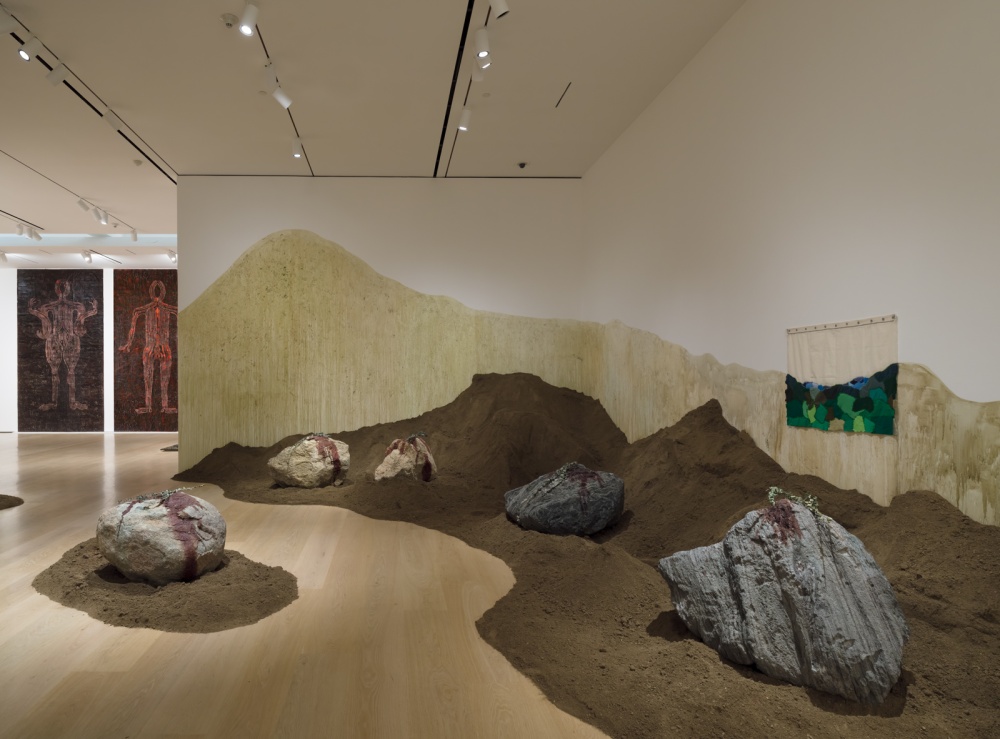
In an artist’s talk at the Hammer Museum, Calel discussed how his practice is dedicated to sharing—particularly with those from Guatemala who cannot return—both the landscapes of Guatemala and communal and ancestral memories.3 Calel’s centering of ancestral knowledge is crucial to this installation and the artist’s wider practice. In her book, Visual Disobedience: Art and Decoloniality in Central America, art historian Kency Cornejo frames Calel’s work through the lens of visual disobedience, which she defines as a visual strategy that counters state repression and visual coloniality.4 According to Cornejo, visual disobedience is a multi-sensorial intervention motivated by decolonial love.5 She describes Calel’s practice as follows, “[Calel’s] visual disobedience contests the rootless and ahistorical notions ascribed to Indigenous migrants and the erasure of Indigeneity entailed in imperial border policies.”6 In Ch’ablin nu rayb’el Chua taj ab’ej, Calel constructs a living landscape that resists erasure by disobeying geographical borders and temporal norms as it melds past and future, as well as Los Angeles and Comalapa.
Around the corner, the artist Ana Mendieta oscillates between two distinct geographies as well: Iowa and Oaxaca. Mendieta serves as one of the four artists who anchor the exhibition (the others being Carlos Mérida, Mary Sully, and Francisco Toledo), and her work functions as a historical signpost meant to contextualize the various acts the exhibition.Two Super 8 mm short films, Burial Pyramid (1974) and Grass Breathing (1974), are projected side by side on a grey wall. Burial Pyramid was filmed at the archeological site Yágul in Oaxaca, and in the film, we see Mendieta half-buried beside a stairway leading to an ancient Zapotec tomb, her body heaving under stones. As the stones roll off her body, unearthing the artist beneath, her breathing returns to a steady rhythm. In the adjacent film, Grass Breathing, Mendieta is buried under a resodded lawn in Iowa. The grass rises and falls with each breath—there are no traces of the artist’s body here other than her undulating breathing. Mendieta refuses a clear demarcation between life and death; instead, she presents an entangled existence between the body and the landscapes it inhabits. Additionally, the decision to present two drastically different landscapes—a freshly sodded suburban lawn and ancient stones understood to be imbued with life—is destabilizing. Together, Burial Pyramid and Grass Breathing depict the formation of an identity located across multiple geographies and temporalities.
This disruption of linearity extends throughout the exhibition as artists resist stable, static representations of the body. Instead, various materials, sounds, and depictions of landscapes indicate different modalities of embodiment. The selection of artworks demonstrates how materials chosen by artists to evince a body are constantly renegotiating themselves in relation to temporal cycles. As Ramírez writes, “Mayan Civilization, for instance, knew that our relationship to time is rooted in an awareness of life cycles, which are tied to the movement of the cosmos. . . . Our relationship to time is performative at its core. We cannot create an objective distance to meditate on time; we need to have a stake in it.”7 Several Eternities in a Day lingers in this performative relationship by positioning the body within simultaneous temporalities. This fragmented body is constantly referenced through material traces and performed via acts of care, healing, resistance, and decomposition. Artist Jackie Amézquita explains, “Borders cut through land as they cut through flesh, lineage, and time—dividing, displacing, and scattering. Under such conditions, continuity is interrupted and wholeness becomes untenable. Yet the body does not disappear. It reorganizes. It learns to carry itself in parts, to remember across distance, to survive through separation.”8 Her artwork Cuerpos terrestres en fluidez (Terrestrial bodies in fluidity) (2025–26), literalizes this severing by constructing two monolithic walls using the rammed earth technique. Amézquita layered minerals and familiar organic materials such as achiote, cacao, volcanic rock, and obsidian. To move one of these walls into the gallery, the work needed to be broken apart and fragmented. Several Eternities in a Day understands this process of fragmentation, at times violent and driven by nation-states, to be generative by foregrounding alternatives to wholeness—ones that are deeply enmeshed with living materials.
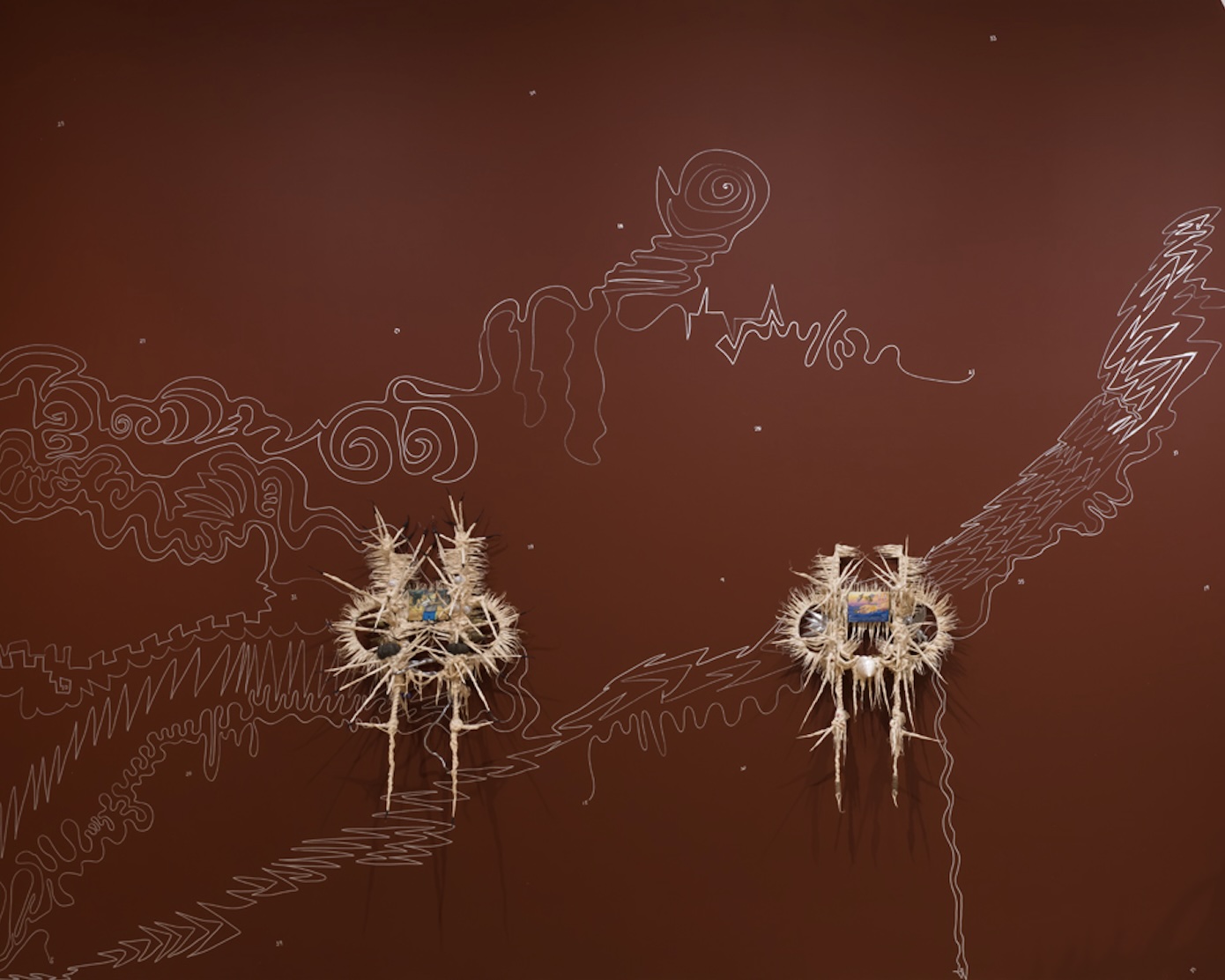
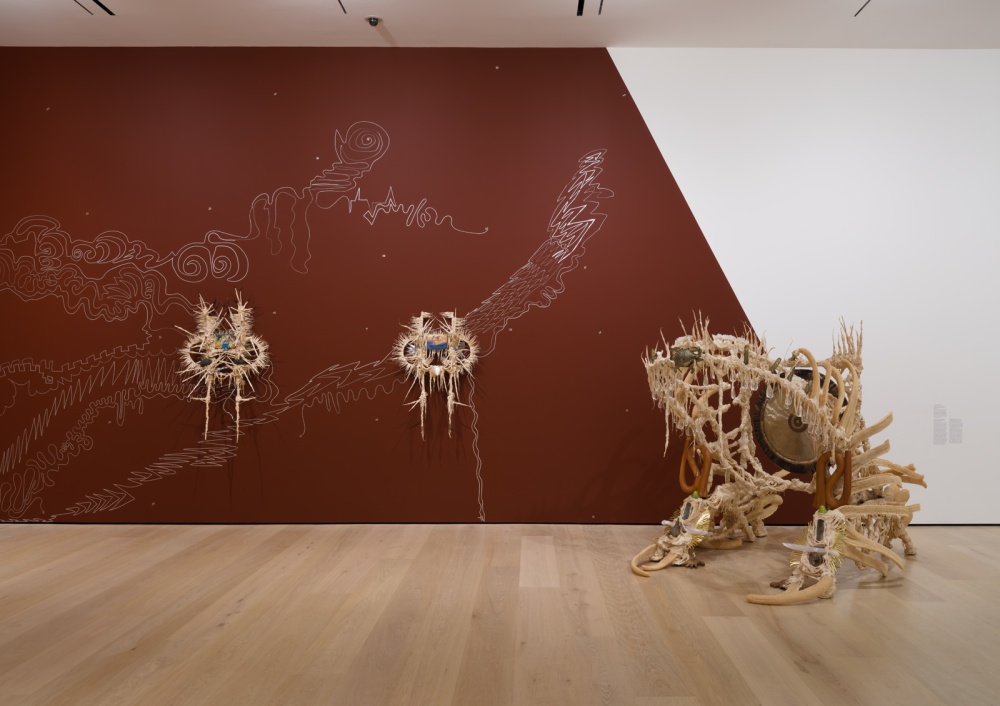
Adjacent to Cuerpos terrestres en fluidez are two monumental figures on paper that stretch from the floor to the ceiling of the gallery. In an archetype of stillness and an archetype of touch (both 2026), the Los Angeles–based artist Carmen Argote utilizes materials that carry a spiritual and cultural meaning, such as cochineal and lemon juice, to create a chemical reaction that produces a textured, dark red surface. The red appears brighter in certain areas, resembling blood that might be pulsing through these bodies. She incorporates her body in making the image via the use of her own hands and feet dipped in mashed avocado, to outline the two forms. The oil from the avocado drips down the paper like sweat. Due to the chemistry of the organic materials, the paper will gradually decompose over the course of the exhibition and will eventually be composted at its end. Nearby are several altar-like constructions by the artist Guadalupe Maravilla, all falling under the title Disease Thrower #12122012 (2022) (the numbers refer to artist’s thirty-sixth birthday and the date the artist was diagnosed with cancer). The structures are reef-like in appearance; they were created with steel, wood, cotton, glue, and loofah, while also containing objects the artist found when he retraced the migration route he took from El Salvador to the United States. Elsewhere in his practice, Maravilla has incorporated similar structures in public sound healing ceremonies.9 Like Argote, Maravilla presents us with an impression of the body that operates in relation to nonnormative time and is not fixed; the body here is one that is in process and marked by both trauma and healing.
Just past Maravilla’s artwork, II. Study for Concentric and Overlapping Circles (2026) by Chacon continues to guide viewers through the exhibition. This piece consists of two field recordings—one taken during the winter in New York’s Hudson Valley, where the artist currently resides, and the other from New Mexico, where the artist grew up. The recordings were taken on the same date, fifteen years apart.10 The overlapping of sound and geographies constructs an unmappable and nonlinear soundscape. The exhibition’s investment in alternate temporalities of embodiment further materializes in a group of works that examine the relationship between clay and land. Clay’s susceptibility to transmutation, through exposure to fire, water, or even touch, serves as an apt metaphor for the body’s transformations across time. Naomi Gamarra’s ceramic sculptures titled Tocar el alma (To touch the soul) and Los piojos caminan, no saltan (Lice walk, not jump) (both 2026), whose forms draw from Moche funerary vessels, face the entrance of the penultimate room in the exhibition. The crescent-shaped sculptures resemble combs with long dark strands of hair and terracotta lice hanging from them. The artist utilizes clay, beads, and synthetic hair to depict the intimate and physical act of delousing without depicting the women who perform it. With clay, Gamarra preserves embodied memory by documenting acts of care. In the same room, artist Ayla Taveres foregrounds clay’s inherent instability and mutability. Taveres’s Una forma siempre húmeda (An always humid form) (2024) consists of a plexiglass tank containing a pile of unglazed brown and white ceramics partially submerged in water. Like Argote’s work, these ceramics will not outlive the exhibition, but are subject to dissolution and transmutation—another visual reminder of the passage of time. Death oversees the works in this room, as a sculpture by Francisco Toledo of a Xoloitzcuintle, a dog thought by the Aztec to protect the living and guide the dead, wrapped in dusty red bones, stands watch over the gallery from the upper left corner. Several Eternities in a Day concludes with a dark room consisting of sound and sand; Night Sky (2026), the fourth and final work by Chacon in the exhibition. Entering the vault gallery, you are immediately enveloped in noise—an overlaying of all possible frequencies. The speakers on the ground cause the wall of noise to travel with you throughout the space, creating an overhead effect reminiscent of waves moving through a body of water. In this room, the exhibition culminates in an embodied form of destabilization that has been building throughout Several Eternities in a Day. This sensorial unsettling mirrors the expansive process of fragmentation that occurs as we watch clay forms erode, flowers wither, and lava rocks fracture. Submerged in a deluge of polyphonic sound, it is evident how porous the categories of time and place can be.
Orly Vermes is a PhD candidate in the Department of Art History at the University of California, Los Angeles. She studies art of the Americas with a focus on Latinx art.
- Raven Chacon, “Raven Chacon on breaking open sonic traditions,” filmed 2026, Hammer Museum. ↩
- Pablo José Ramírez, “What Is an Eternity? Meditations on Art, Time, and Continuum-Living,” in Several Eternities in a Day: Form in the Age of Living Materials (Hammer Museum, 2026), 26. ↩
- Edgar Calel, “Edgar Calel on artistic practice, communal life, and Kakchikel spirituality,” filmed 2026, Hammer Museum. ↩
- Kency Cornejo, Visual Disobedience: Art and Decoloniality in Central America, 1st ed, Dissident Acts Series (Duke University Press, 2024), 10. ↩
- Ibid., 29. ↩
- Ibid., 76. ↩
- Ramírez, “What Is an Eternity?” 19. ↩
- From the wall label for Jackie Amézquita’s Cuerpos terrestres en fluidez. ↩
- These specific sculptures were activated by Maravilla during the opening of the exhibition. ↩
- Chacon, “Raven Chacon on breaking open sonic traditions.” ↩