
This review originally appeared in Art Journal, 84, no. 3 (Fall 2025)
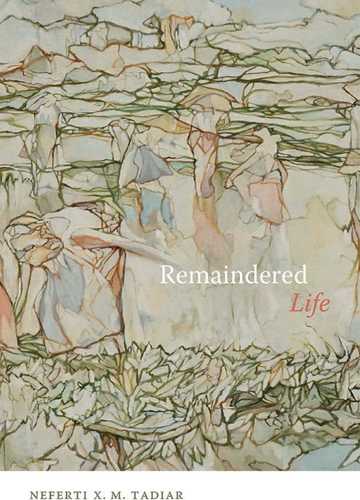
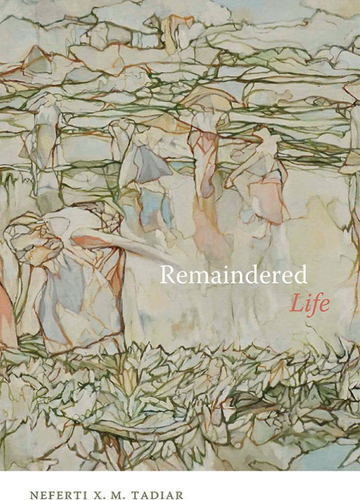
Neferti X. M. Tadiar, Remaindered Life. Durham, NC: Duke University Press, 2022. 428 pp.; 26 ills. $31.95
In Remaindered Life, Neferti Tadiar offers a stunning reconceptualization of global capitalism under permanent war and presents a new language for articulating the forms of life that cannot be absorbed by such conditions. Drawing upon a broad range of intellectual genealogies from Marxist critique to postcolonial feminism to Black studies and employing a rigorous, necessary interdisciplinarity, the book commits itself not simply to analyzing the ways that global capitalism creates throughlines between the Global North and Global South. Instead, it theorizes the formations of a new imperialism that operates precisely through the circuits of global capitalism that must always contend with the ongoing processes of decolonization. In this way, Remaindered Life extends Tadiar’s earlier works while tenaciously responding to the continuous yet shifting perversions of the global present.
Humanity figures centrally in the book. The human, according to Tadiar, is a privileged status bestowed upon subjects by universal law (11). Tadiar describes the current political moment as a struggle between the “war to be human” and “becoming-human in a time of war.” Against liberal definitions of the human outlined by an international human rights regime, Tadiar notes that human life functions as “the life-form of value” (49). As such, political recognition is a violent “humanizing process” that also generates myriad forms of humanization that serve the extractive impulses and processes that constitute global capitalism under imperial war (12).
The book is organized into five parts. Part I, “In a Time of War,” provides the conceptual organization for the book through the themes of value, waste, and remainder. Part II, “Life-Times,” traces the myriad ways that value is extracted from the lives of surplus populations. Part III, “Globopolis,” studies the social conditions of servitude in what Tadiar names as “city everywhere” or the expansive urbanism of the capital city in the Global South. Part IV, “Dead Exchanges,” tracks the organizing ideals of freedom and democracy and the ways that war waged under these ideals operate through violence and value. Part V, “By the Waysides,” offers considerations of bypass, striving, strife, and splendor as well as the environment and the land, all of which help to further articulate the possibilities for tracing remaindered life. In each of these sections, Tadiar highlights several artists and cultural producers whose practice emerges from the very social conditions shaped by war and extraction. Tadiar’s study of contemporary aesthetics and art practices is never simply an attempt to actualize theoretical concerns; rather, it is an acknowledgement of the ways that artists can offer modes for envisioning futures other than the ones that global capitalism portends. Remaindered Life reads as a careful and deliberate unfolding: a cutting theorization of global capitalism and permanent war and their humanizing projects that gives way to an expansive rumination on wayside forms of life and living that reverberate across lifetimes.
For Tadiar, imperialism and capitalism are inextricably linked; that is, imperialism is the system by which capital expands. Imperialism as such employs two forms of reproduction: the generation of war for the purpose of establishing and extending capitalism’s reach and the remaking of sociality through the destruction of social life (33). The function of imperialism is to collect assets and naturalize the order through which it secures those assets, and this securitization depends upon the dispossession of Indigenous people from their lands. The incisiveness of Tadiar’s articulation of the intertwined systems of imperialism and capitalism is in her discussion of financial speculation as the critical mode for materializing reproduction. Speculation is the practice of “anticipating the realization of value in excess of the present value for which it is exchanged” (113). Imperial forces invest in the value of waste, destruction, and degradation (60). Tadiar spends a significant portion of the book theorizing waste as the valorizable object of a new imperialism through which neoliberalism functions. This process of valorization distinguishes different forms of humanity, namely, “at-risk populations” whose lives can be wasted and “risk-capable subjects” who speculate upon the value of wasted lifetimes. At-risk populations are surplus and disposable populations and the “securitized assets for risk-taking ventures for proper investor subjects” where the future is already determined (117).
Noting Marx’s postulation that “equality and freedom are the idealized expressions of de facto economic processes of capital accumulation,” Tadiar explains that freedom and democracy are the organizing ideals for the imperial state and its military power. For readers familiar with the forms of capitalist expansion that took place in Asia and the Pacific in the second half of the twentieth century, Tadiar’s theorization of equality and freedom as the site where the exploitation of wage labor takes place is particularly significant. It gives name to the concurrent establishment of export processing zones and the strengthening of military power in places like the Philippines where the promise of transnational finance and the fight against communism (in the form of counterinsurgency programs directed against poor, Indigenous, and Muslim communities) are the expressions of a militarization that relies upon the usurpation of Indigenous land for the purpose of capitalist expansion. Highlighting the terms of an Israel-Philippines political alliance whereby the former trains and arms the latter for war against named insurgents, Tadiar instructs that “developmentalist democracy-making in one region enables liberalizing democracy promotion in another region.” Indeed, both nations have touted freedom as the organizing principle for permanent war.
Given such theoretical moves, it is clear why Tadiar finds inadequate the category of “labor” as the primary mode by which one conceives of surplus populations such as migrant workers from the Philippines. A note: throughout the book, however, surplus populations are not only migrant workers but also undocumented immigrants, people suffering the harshest effects of climate catastrophe, Palestinians struggling to survive the relentless onslaught of Israel’s settler warfare, slum dwellers, poor people killed in drug wars, Indigenous people, queer and trans people, Chinese workers, and women murdered along the US-Mexico border. Where labor might assume a kind of unchanging coherence or solidity of the laboring subject, instead, surplus populations as “aggregate matter,” as liquified or changing matter, are the things that drive capitalism’s evolution. Here, Tadiar draws from Randy Martin’s theorization of the social logic of the derivative, which speculates on value based on the continuous process of disassembling and reassembling things (66). Capitalism’s innovation materializes through what she describes as vital systems projects that establish systems central to the political and economic order of capitalism, including infrastructure and communication. Vitality, as Tadiar explains throughout the book, is the form of organic life that capital seeks to arrest in the process of valorization (72). In one example, Tadiar describes the detention-industrial complex as a business that profits from the management of “illegal” immigrants whose function is not simply labor but, instead, social waste. She writes that value does not accrue from the labor of immigrants but from the expenditure of their life-times (that is, the process of managing, controlling, and overseeing). Additionally, migrant domestic workers are not only reproductive labor but also the “savors and producers of valorized and valorizable surplus life-times for host employers” (96).
Yet, and this is perhaps the key theoretical contribution (among many important contributions) of the book: not all life is valorized and valorizable. While Tadiar’s conceptualization of the “becoming-human” directs readers to the multiple forms of subjection that constitute the elision of surplus populations from the category of the human, it also pays close attention to the myriad strategies of “survival and thriving against the disposability of one’s life” (21). The becoming-human enact creative life-making practices that can only be made by those who live along and beyond the borders of human recognizability. This is what Tadiar refers to as remaindered life, “the modalities of living that exceed the necessary reproduction of becoming-human as the resource of disposable life for capital” (14). Remaindered life highlights the experiences that are not absorbed into the processes of production, namely, those that extract value and produce waste. Tadiar is clear that the concept of remaindered life draws on past forms that are not restricted to the forms of development and modernization that capitalism creates (66). Here, she draws upon Cedric Robinson’s genealogy of the Black radical tradition and Angela Davis’s study of abolition to present both historical antecedent and shared vocabulary of living under the duress that capitalism creates.1 Fate playing is another example. Referencing workers’ articulation of their work overseas as playing fate, Tadiar describes fate playing as a “speculative adventurism” that finds possibility and treats life as “porous, shareable across persons, transmissible across distances of space and time” (103–4).
If the war to be human and becoming human in a time of war is a problem of the representation of political emancipation and subjectivity, Tadiar also treats it as an aesthetic quandary, as a matter of signs and significations, of culture. Throughout the book, she reads the work of several artists—ranging from filmmakers, sculptors, photographers, writers, and painters—whose work reflects upon and engages remaindered life. That is, against the proclivity for art “to make the disposable life of others the occasion, the impetus, and the material for creative endeavor and innovation” (259), Tadiar points, instead, to artistic (“aesthetic-political”) practices that engage not semiotic inquiries or value-making endeavors alone but struggle to participate in the social networks that emerge from and persist against war’s detritus.
In chapter 6, for example, Tadiar presents Jia Zhangke’s film Still Life (2006) and Brillante Mendoza’s films Tirador (2007), Serbis (2008), and Lola (2009) as techniques for capturing the catastrophes of capitalism. Jia and Mendoza reject the cinematic spectacle and focus on the laggard, protracted, and wasted forms that characterize the transformation of life under capitalism. Taidar notes that throughout Still Life, examples of vanishing, immobility, and silence create a temporal structure that grasps the “life-times of disposability” of workers by illustrating “the surplussed condition of human life remaindered through the structure of excess time” (124). As a type of contrast, Mendoza’s films focus on banal actions that together point to “anticipations of development.” The films attempt to subjectify disposable populations by restoring time to them. Tadiar describes this as Mendoza’s cinematic exercise of “abidance,” which “enables transformation from within life-times rather than from without.” In addition to these films’ treatment of time, films—such as Still Life—also treat landscapes as the places where time unravels.
And then there are those artistic practices that illuminate socialities that are incommensurable with the forms of humanization that thrive under permanent war. The Filipinx artist Kiri Dalena is a political documentary filmmaker whose film subjects—activist leaders—were abducted and murdered by military officers operating under the Philippine state’s counterinsurgency program Oplan Bantay Laya. Dalena’s installation Present Disorder Is the Other of the Future (2010) reflects upon the killings through the presentation of bodily fragments that lie in an open space of human suffering. The installation invokes social practices of what Tadiar describes as “radical bereavement” that has propelled political uprisings in the Philippines for over a century. Radical bereavement is a reckoning that allows the remains of life taken to nourish the life movements of others. Dalena’s work, which weaves its way throughout the book, presents life as that which can move beyond the temporal space of the now to reject imperialist and capitalist definitions of humanity.
The protest art of RESBAK (Respond and Break the Silence against the Killings), a collective of artists and cultural workers responding to former Philippine president Rodrigo Duterte’s war on drugs accomplishes something different. Insofar as Duterte’s extrajudicial killings depend upon the reclassification of mostly poor young men as national parasites who feed off the nation, as Tadiar notes, so, too, does Duterte’s program of violence require a reorganization of signs and significations to accomplish that reclassification. For instance, Duterte’s death squad often wraps the heads of its victims in packing tape and leaves them with a sign that reads “Drug Addict. Do Not Emulate.” In the RESBAK artwork that Tadiar features, artists stage their work upon these very sites and against these signs to challenge Duterte’s portrayals of “drug pushers”: artists replace key figures in well-known artistic works or historical images with the violent scenes of police killings. Andoyman Komikero uses the dead bodies of the killed to spell out “No to EKJ” (No to Extrajudicial Killings) (262); Jason Dy wraps packing tape around the head of the baby Jesus (263); and Bam Doctor and Patricia Ramos replace the figures in Juan Luna’s Spolarium with those killed by Philippine authoritarian regimes (265). Moreover, the Nightcrawlers, a group of photographers in the Philippines whose mission is to photograph each killing in the drug war, do not only take photographs of victims but also become the advocates and friends of the families of the dead. Tadiar notes that the photographers and their photographs help to generate a “social economy intended to sustain them all.” Tadiar refers to the work of RESBAK and the Nightcrawlers as the vital platforms or means of social reproduction that hold forms of sociality that remain unabsorbed by imperial war and global capitalism that may also bear political potential.
In an especially moving analysis of journalistic reports of the killings under the drug war, which proliferated as Duterte’s authoritarian tactics gained international attention, Tadiar argues that some reports craft narratives that attempt to humanize victims by focusing on stories of singular subjects while eliding the “liminalities” that most often characterize the victims’ experiences. Here, Tadiar offers portraits of the nonhuman that better encapsulate the experiences of the becoming-human living in a state of permanent war. For example, when responding to Heart de Chavez’s murder, Heart’s sister, Arianne, described Heart as “just a bird, that even if it weren’t sick just died like that, as if nothing” (293). Similarly, when María Sagrário González Flores’s daughter was murdered in Ciudad Juárez, her surviving parakeet nodded affirmatively that he knew where she could be found. She was found shortly afterward.
These seemingly minor examples that live within the larger constellation of the book may best encapsulate the openings that Tadiar’s theoretical and political provocations carve for us: the vital platforms of the dispossessed and colonized do not prescribe any singular action or foreclose any one possibility but demand another and other life-making practices, “a broader milieu for thriving than what a human politics would allow” (326).
Josen Masangkay Diaz is Associate Professor of Critical Race and Ethnic Studies at the University of California, Santa Cruz.
- See Cedric Robinson, Black Marxism: The Making of the Black Radical Tradition (University of North Carolina Press,1983) and Angela Davis’s Are Prisons Obsolete? (Seven Stories Press, 2003). ↩