
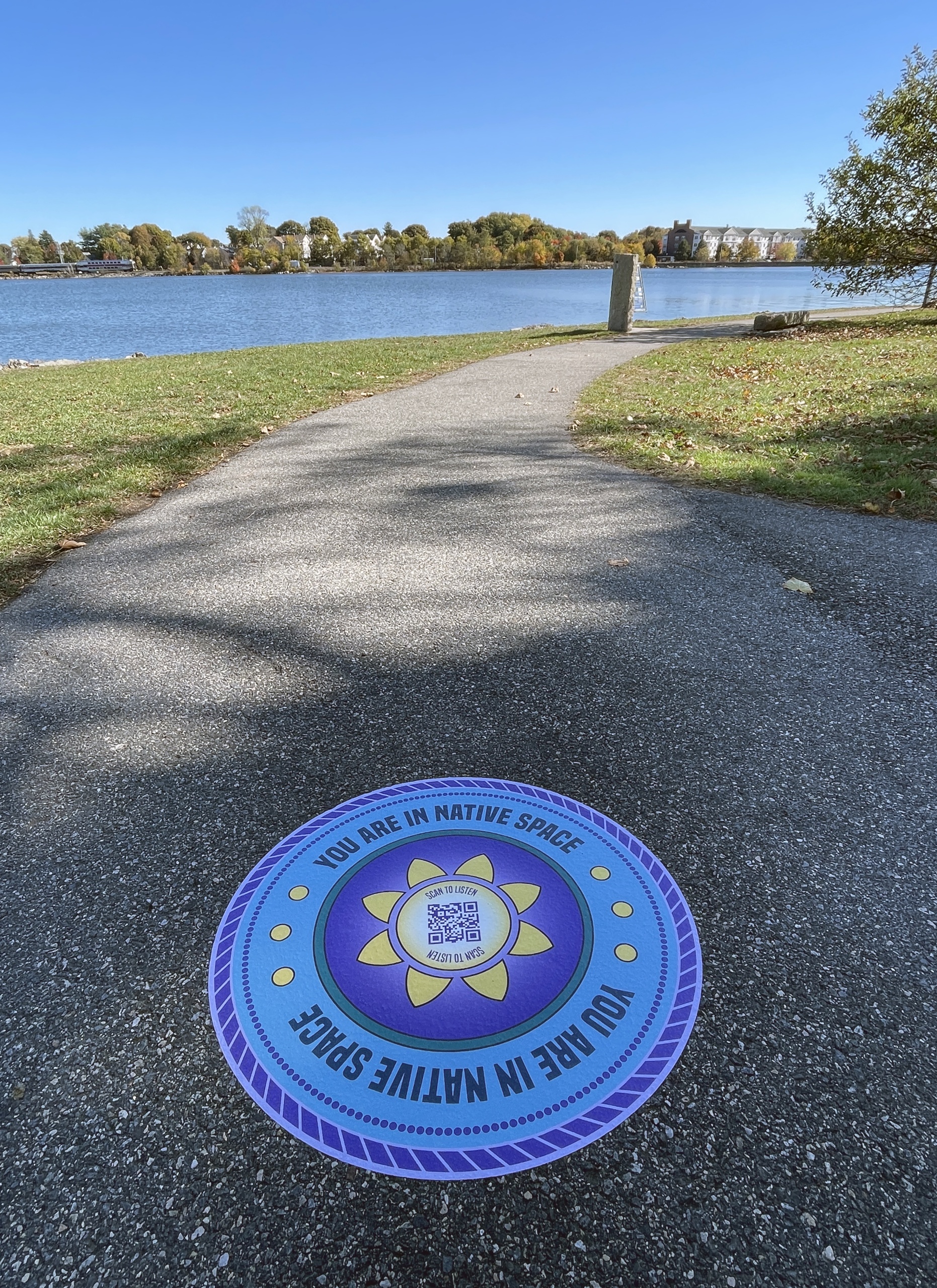
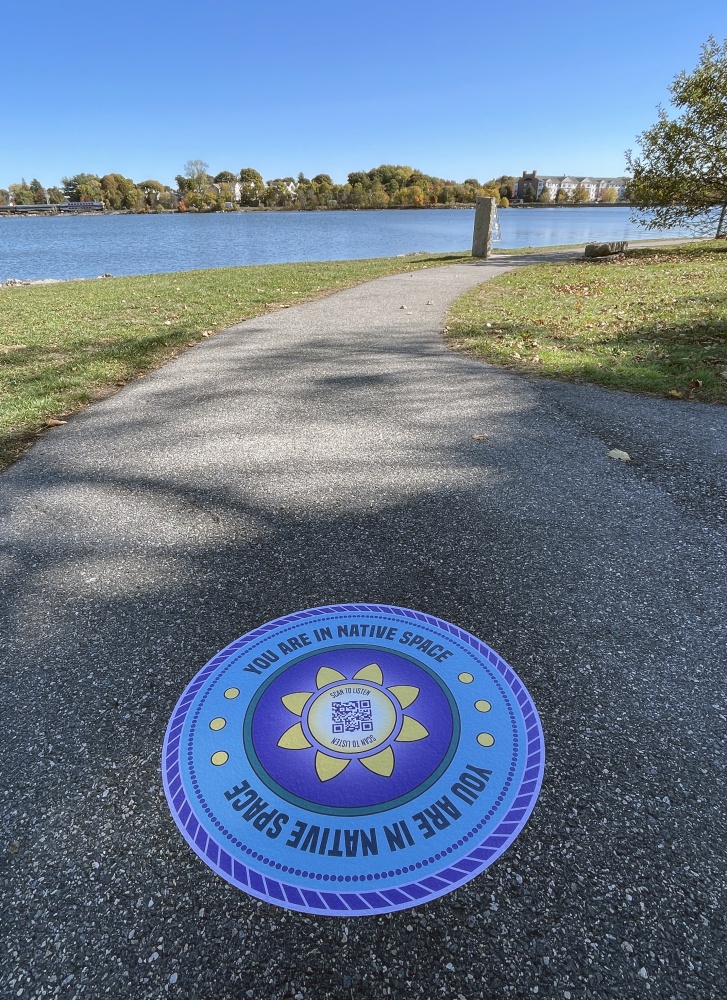
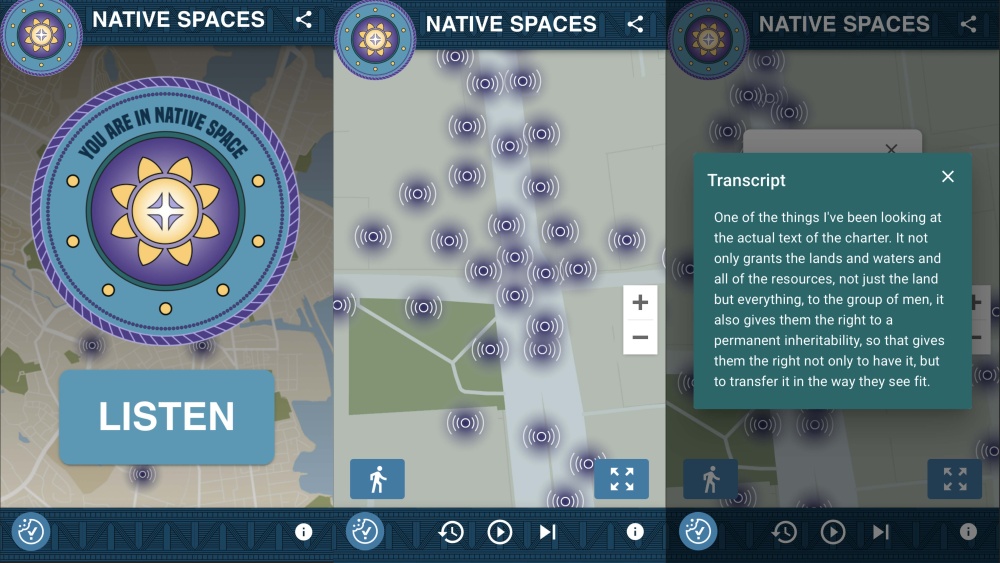
Imagine coming upon a colorful, round medallion on the sidewalk of your neighborhood park. The marker announces, “You are in Native Space.” You use your phone to scan the QR code in the center of the medallion’s sun-like symbol and load a location-aware web app inviting you to “listen.” You put on your headphones and move through the park, immersed in an ever-changing tapestry of sounds that respond to your location: field recordings of human and more-than-human life, powwow drums with electric bass, and a collage of voices describing diverse experiences with and visions of this place past and present, over a timeline extending over 10,000 years.
Native Spaces is an audio platform co-created by artist Sarah Kanouse and Indigenous elder Elizabeth Solomon of the Massachusett Tribe at Ponkapoag. Accessible by QR code that opens the project in any browser, the project’s location-aware website also offers a desktop interface allowing remote audiences to simulate the on-site listening experience. The pilot chapter launched on October 11, 2024, in Salem, Massachusetts, with nearly 12,000 listening sessions in its first year. As one of the first sites of permanent English colonization in what would become the United States, the city closely identifies with its colonial history, which is actively and successfully promoted in its tourism outreach. However, for over 10,000 years, the Massachusett people lived in the coastal areas of Massachusetts, between Cape Ann in the north and the town of Kingston, south of Boston. Despite the long history of Indigenous presence in Salem, Native stories, perspectives, and priorities are both unknown and inaccessible to most residents and visitors. The project explicitly insists that Salem remains an Indigenous place while it expands the public’s understanding of Native history and culture with an approach that is equally poetic and pedagogical.
Situated at the intersection of socially engaged art and experimental audio documentary, Native Spaces is not a conventional audio tour in which a single preproduced track is associated with a given location. Rather, when a visitor physically enters one of five sonic zones indicated on the map, audio clips start, stop, and crossfade algorithmically based on the user’s location. These zones may be anywhere from one city block to an entire neighborhood in size. Overlaid atop a looping background unique to each zone, these clips number more than 200 and include interviews with members of the Tribe, Salem residents, and scholars, as well as voices from the more-than-human world: birds, insects, water, and wind. Sound zones represent locations of significant precolonial Indigenous presence, and each zone’s audio content reflects historic and contemporary themes resonant with the site. Far more than a land acknowledgment focusing on traditional lifeways, the project shares varied perspectives on contemporary issues, including the ethics of property ownership, the relationship of climate change and colonialization, and tensions between place-based spiritual traditions and Christianity—as well as counternarratives of early colonial history that center Indigenous and anticolonial points of view.1
This paper attends to Native Spaces as a process-based case study in fostering collaboration between Indigenous communities and settler individuals and organizations in ongoing, mutually transformational relationships. While we describe aspects of the project’s aesthetics and content as they embody or reinforce this relational commitment, our primary goal here is not to offer a detailed formal analysis or art historical positioning.2 Rather, we hope to share insights from our experience to others who may be contemplating similar collaborative work between settler and Indigenous communities.
Native Spaces was released on the anniversary of the signing of the colonial “deed” of 1686 that legitimized, under colonial law, the then nearly sixty-year-old occupation of the summer village of Naumkeag (“The Fishing Place” in the Massachusett language) by the English colonists of Salem. Although its production was facilitated and funded by the city to highlight the Tribe’s perspective on the historic deed, the relationships that generated the project and its conceptual scope exceeded the circumstances of its realization. Along with other municipalities in their traditional territory, the Tribe had already been cultivating a relationship with the city of Salem as a practice of community recognition as meaningful as formal federal or state recognition.3 Elizabeth Solomon and Sarah Kanouse first met eight years ago and have collaborated on projects, some legibly artistic and others less so, since 2019. For us, collaboration is not about applying individual expertise toward a predetermined outcome—an approach that tends toward the transactional, rooted in capitalist values of productivity, efficiency, and scalability. Because the project sought to bring Indigenous perspectives to a setting grounded within settler-colonial norms, the collaboration also needed to bridge the divergent and frequently opposing ideas, values, and beliefs of traditional Massachusett culture and the more prominent dominant culture. Rather than one-off engagements with specific, short-term deliverables, the Tribe seeks collaborations that build long-term relationships.
Attending to collaboration as process-driven and relational does not so much de-emphasize the outcome, as implied by the familiar phrase “means over ends.” Rather, it means that outcomes are understood and function differently for different relational partners, depending on the frameworks and priorities they bring to the process. It also means that Native Spaces, even after its public completion, remains perpetually both in process and part of an unfolding, unpredictable practice, a standing invitation to come into relation with all whose traces and labor are evident in the work. Significantly, the invitation to relationship extends to the project’s largely non-Native audience who, because of the algorithmic nature of the piece, compose their own auditory experience through movement. Informed by both Massachusett traditional beliefs and recent scholarship in sound studies, we argue that listening as an embodied process invites what sound settler artist/geographer A. M. Kanngieser calls greater “attunement” to place and discuss how our compositional decisions challenge or frustrate settler norms of extractive listening.4 Finally, we discuss how our decision to keep the project open to future contributions from non-Native Salem residents supports the Tribe’s goals of cultivating mutually transformative, ongoing relationships with the people of many lands and backgrounds who now call their territory home.
With this relationality in mind, this paper alternates written text with excerpts from a video call where we developed our ideas. This decision foregrounds the relationality of our collaborative practice and reflects our broadly anticolonial commitments. The paper’s text may align with academic expectations through the presence of footnotes and bibliography, but the video clips resist Euro-American culture’s elevation of the written over the spoken word. They also refuse the tendency of scholarly writing to homogenize, departicularize, disembody, and universalize knowledge, sanding off the jagged edges of process to deliver a finely polished product. Instead, we laugh, start sentences in one place that end in another, say “um” and “like” a lot, and generally exhibit all the verbal tics and ellipses that characterize thought in process. These clips offer glimpses into the texture of our ongoing dialogue and demonstrate, rather than assert, its relationality.
Native Spaces as Relational Object
Native Spaces emerged at a cultural moment characterized by a generative mutual engagement across socially engaged art, sound art, and contemporary Indigenous creative practices. Many leading contemporary Indigenous artists began as trained musicians, such as Raven Chacon (Diné), Cheryl L’Hirondelle (of Cree, French, German and Polish descent), and Kite (Oglála Lakȟóta). Others, like Nicholas Galanin (Sitka Tribe of Alaska, of Tlingit/Unangax̂ descent) and Rebecca Belmore (Lac Seul First Nation, Anishinaabe) have used sound or listening as significant conceptual and formal elements in installation works. Others, notably interdisciplinary artists Peter Morin (Tahltan First Nation) and Tanya Lukin Linklater (Native Villages of Afognak and Port Lions, Alutiiq), have employed drumming, instrumental music, dance, and song in collaborative, site-specific performances oriented toward sacred ancestral belongings held in museum collections, while Jeffrey Gibson (Mississippi Band of Choctaw Indians and of Cherokee descent) frequently references dance music in his paintings and has invited noted Native musicians to perform with his works. The formal and conceptual scope of Indigenous artists’ sonic engagement is vast and has been taken up in recent exhibitions including “Beat Nation: Art, Hip Hop and Aboriginal Culture,” curated by settler Kathleen Ritter and Tania Willard (Secwépemc) 2008–14; “wnoondwaamin/we hear them,” curated by Lisa Myers (Beausoleil First Nation, Anishinaabe) 2016; “Soundings: An Exhibition in Five Parts,” curated by Candice Hopkins (Carcross/Tagish First Nation, Tlingit) and Dylan Robinson (Stó:lö/Skwah First Nation), traveling 2019–25, and “Making a Noise: Indigenous Sound Art,” curated by settler Victoria Sunnergren, 2025. While this work is diverse and wildly inventive, a common characteristic is site-responsiveness, understood as a reciprocal, even intersubjective engagement with the historical, physical, material, and spiritual dimensions of place. Writing of Indigenous sound art in Canada, the settler art historian Sara Nicole England notes that sound operates “as both a metaphor and material for decolonizing spatial practices” that holds the “potential to participate in a process of world-making that is rooted in Indigenous ways of knowing, assert presence and self-determination, and form solidarity across human and more-than-human entities.”5 Sound studies scholar and “Soundings” co-curator Dylan Robinson goes still further, describing an approach that acknowledges “spatial subjectivity . . . addressing the ways by which space exerts agency, affect, and character beyond the realm of striking aesthetic impact.”6
Outside the relatively niche world of contemporary art, sound has been central to a growing number of cultural reclamation projects that originate with Indigenous communities, rather than individual artists, and use aural media to remap or reterritorialize Native space even (or especially) in places that remain resolutely colonized. In these places, sound offers an affective and informational overlay that attests to enduring Native presence. Some projects, such as Seattle’s “Saltwater Soundwalk” may be framed and funded as public art; others are classified as public history tourism, such as Toronto’s “First Story” and the Mohawk/Haundenosaunee Six Nations Tours on the Driftscapes app or the Yalinguth First Nations walking tour in Melbourne.7 Commissioned by the Niagara Parks Foundation and curated by Michele-Elise Burnett (Métis of Nipissing Algonquin descent),“Rekindling All our Relations” occupies a space between, artfully combining ambient sound’s immediacy with the intimacy of the human voice to invite a quiet and respectful attentiveness to Indigenous perspectives in the Niagara Glen without clearly framing the project as either tourism or art.8
Publishing Native Spaces in an academic art journal might suggest that contemporary art, public art, or sound art are the primary lenses through which it can or should be viewed. Indeed, aspects of the project resonates with England’s and Robinson’s analyses of more-than-human solidarity and spatial intersubjectivity, respectively. Elizabeth has described one of her goals for the project as allowing non-Native people to be “with place” differently—a framing that holds open the potential for an intersubjective experience of space described by Robinson. However, the project sits between art, documentary, and public history. Only the non-Native collaborator identifies as an artist and situates her work within contemporary socially engaged and critical art discourses, rather than sound art. An arts organization did not commission the project; instead, it emerged from relationships among collaborators who each brought with them different frames of reference. While we all agreed on the creation process, aesthetics, and installation (and went through the city’s public art approval process), we never sought nor achieved consensus about what each partner believed the project and its goals to be. Native Spaces can be productively understood as a socially engaged art project; as public history; as digital humanities; as a reckoning with past misdeeds; as a way of honoring ancestors and place; as an assertion of Tribal presence, voice, and sovereignty; as a municipal undertaking; as a mechanism for building Tribal capacity; and, for some city departments, as just another aspect of the job. Most partners hope the installation will affect some degree of change in public discourse and public consciousness, but how they see the project achieving it varies according to each partner’s professional background. In our composition process, we sought to balance the vocal intelligibility and thematic coherence that our partners in public history or tourism might seek with an artistic approach to the timbre and rhythms of everyday speech, the layering and expressive use of other-than-human sounds, and a more conversational pacing—including asides, logical leaps, and repetition—than audiences might find in something like a museum’s audio guide.
The decision not to seek a consensus understanding of the nature of the project—public history, art, or tour—reflects both a pragmatic and a philosophical orientation. Pragmatically, the flexibility of the conceptual frame allows us to speak and work with a broader range of participants and a wider audience than the art frame alone. Philosophically, forgoing categorical definitions recognizes that differently situated stakeholders might have incommensurable understandings of the category used to describe the project and its stakes. In particular, “art” is an uneasy category for Elizabeth, saying:
For Elizabeth, the art label does not entirely fit, as it focuses on the aesthetic experience of a non-Native public over how the project operates ceremonially for tribal members and as an expression of sovereignty over traditional Massachusett territory. Her reluctance to rely on the institutional and aesthetic frame of art resonates with Dylan Robinson’s analysis of Indigenous contemporary artists’ sound-based performances in museum contexts that seek to restore right relations with the ceremonial belongings because the conditions of display for non-Native aesthetic contemplation are not just inappropriate but harmful. Coming from an art background and hoping to shape the perception of fellow settlers, Sarah is more comfortable with the category of art but holds it loosely, saying:
Our refusal to categorically define Native Spaces allows us to honor our incommensurable perspectives while committing to shared work. Definitional multiplicity prioritizes the needs of the relational partners as they emerge and shift at different points in the project. Indeed, we might describe Native Spaces less as an art object than a relational object capable of mediating diverse definitions and developing relationships that both precede its creation and are generated through it.
The relational groundwork for the project was laid years before its release. Elizabeth’s first contact with the city of Salem occurred more than ten years ago: a routine invitation to speak in a city-run museum that gave her the sense that more was possible. The respect conveyed by the mayor’s attendance and the city’s effort to televise the event initiated a years-long process of relationship building. Since then, a group of directors of Salem historical and cultural sites—private, city, and federal—has met regularly to discuss decolonizing their official programming and elevating Indigenous issues as community allies, even beyond their professional capacities. The city commissioned a portrait of settlement-era Massachusett leaders Nanepeshemet and Saunkswa by contemporary Native painter Chris Pappan (Kaw Nation of Oklahoma, with Osage and Cheyenne River Sioux heritage) that now hangs prominently in the Council Chambers, and elementary school students help to construct a traditional fish weir with tribal members in Salem Harbor each fall. The most significant (and still controversial) plan is to relocate and reimagine Salem’s dilapidated and flood-prone living history museum into a more honest account of the asymmetrical encounter between Salem’s first settlers and the Indigenous inhabitants of Naumkeag in time for the city’s quadricentennial in 2026. Sidestepping both the controversy that can accompany physical interventions and the tendency to invite Indigenous groups to “respond” to colonial narratives (but not set the narrative), Native Spaces immaterially recasts Salem’s public spaces as always already Indigenous.
Native Spaces is also noteworthy for being controlled by the Tribe itself. Salem paid for the development of the web app and the sidewalk decals, but the city does not own, control, or supervise the project in any way. Elizabeth Solomon and Sarah Kanouse are listed as initiators, not creators, and the credits highlight the participation of members of the Massachusett Tribe at Ponkapoag. While Sarah exercised editorial and aesthetic judgment in selecting interview clips, building the backing tracks, and developing the graphic identity, these decisions were affirmed by individual interviewees, Elizabeth, and ultimately the Tribal Council. Tribal members were paid for participation, received raw interview audio files, and hold rights to their materials indefinitely. The Tribe may also expand the project to other locations as they see fit, and the authors have an open-ended commitment to stewarding it. This degree of Tribal authority raises the bar beyond consultation and collaboration toward what Sherry Arnstein’s famous ladder of participation termed “citizen control.”9. Moreover, as a contribution to the city from the tribe, the project’s autonomy emphasizes that Massachusett sovereignty is not a gift to be granted by the state or Federal government but something that they already exercise.
If the project emphasized the reciprocal and sovereign relationship between Salem and the Tribe, its production process was structured to benefit the tribe internally. As a small, unrecognized Indigenous group with an all-volunteer leadership, capacity issues loom large in prioritizing which projects to take on and how to resource them. Well-meaning gestures of inclusion can be extractive, redirecting time from internal initiatives toward educating a mainstream audience. Elizabeth emphasizes that:
We organized Native Spaces to enhance the Tribe’s capacity beyond the scope of the project. Audio workshops for tribal youth allowed them to interview age-mates, affording generational diversity and, more importantly, building skills that could be personally useful and contribute to future tribal projects. We have also planted the seeds of cooperation with special collections at Northeastern University that will result in the stewardship of the project’s raw interview files and the tribe’s language reclamation program documents. In this way, we intend for the social, relational, and technological infrastructures developed for Native Spaces to serve the Tribe’s internal goals.
Sound as a Relational Medium
Native Spaces used sound as its primary medium to further our commitment to relationality. Sound is an ineluctably relational medium: its perception, even as inaudible vibration, requires a body to receive physical vibrations generated by another body or object. Don Ihde’s germinal work on the phenomenology of listening emphasized that sonic perception is a profoundly embodied experience of immersive resonance in a vibrating, sonic world and a co-constitutive and active, yet open, relationship between listener and sound.10 Settler Canadian sound theorist R. Murray Schafer called sound a means of “touching at a distance,” while Roland Barthes’s notion of the “grain of the voice” describes vocal sound as an embodied expression that exceeds what language alone can communicate. These early texts conditioned the reception of sound art to emphasize its intimacy, immersion, and relational openness.11 Parallel critiques of the primacy of vision and the written word in Western thought set the stage for sound and listening to become associated—almost axiomatically—with a feminist, anti-racist, ecological, and decolonial orientation that Jonathan Sterne critiques as sound’s “political theology.”12 More recently, scholars from or working with/in Indigenous communities and the Global South have complicated these associations, assailing the overt racism of canonical sound theorists like Schafer and noting how practices of listening, recording, and classifying the audible world have long played a role in colonial knowledge and racialized power regimes.13 Sound may be a phenomenologically relational medium, but the relationships it engenders depend on the positionalities and dispositions of listeners and speakers. Artists working with sound must therefore consider not just their compositional choices but the historically asymmetrical power relations in which they work and the contemporary spatial, cultural, and political contexts in which listening takes place.
For Elizabeth, the use of sound in Native Spaces is an expression of traditional Indigenous oral culture and a commitment to embodied and emplaced understanding rather than strictly intellectual knowledge:
Elizabeth’s description of how the twin acts of hearing and walking ground the audience in place connects to the basic physiology of sound. The perception of vibrations in the bones of the inner ear is involved in proprioception, or the ability to sense one’s body in space and navigate through one’s surroundings.14 The essentially spatial function of sound has deep poetic resonance for a project, such as Native Spaces, that seeks to re-orient the listener to the landscape: sound operates orientatively at the level of medium, not just content. When, for example, a nocturnal whip-poor-will silences a human voice and calls at midday on a downtown street, sonically positioned above and to the right of the listener, the taken-for-grantedness of space and time is disrupted, along with the assumption that only humans have the right to speak. Supplementing the everyday sonic environment at a given location with acoustic evidence of people, activities, and more-than-human beings that are not visibly present introduces a gap between visual and aural perception that requires constant, if subtle, physical, conceptual, and emotional reorientation.
Although the proprioceptive nature of sound almost certainly remains below the level of consciousness for most listeners to Native Spaces, nearly all will experience an uncanny, if momentary, confusion between the “real” sounds of the place and those layered into the composition. The backing tracks layer recordings made in the project’s actual locations with sound recorded elsewhere in the city and region that represent what was displaced to produce the present-day landscape. In the audio zone on Mill Street, for example, listeners will hear both live and recorded sounds of present-day traffic, as well as the lapping of waves that would have been heard before the freshwater stream, tidal marsh, and brackish pond were filled centuries ago to create buildable and ownable land. For geographer Michael Gallagher, the sonic superimpositions of the audio walk are experienced as an “absent presence” or a haunting of space.15 When such overlaid sounds are identifiably Indigenous, the audio literalizes the ever-present “haunting” of the dominant culture by the Native peoples it dispossessed that Angie Morrill (Klamath), Eve Tuck (Unangax̂) and the Super Haunt Futures Qollective describe as a “pulse at the center” of settler-colonial society.16
Significantly, however, the “ghosts” of Native Spaces do not speak from beyond the grave: they are named individuals whose voices present with digital fidelity, peppered with the slang and verbal habits that mark them as contemporary. The backing tracks also demonstrate their contemporary and communal context: powwow drums were recorded at a tribally sponsored event, not in a studio, and the recordings carry the acoustic traces of shrieking children, gossiping friends, and expansive sense of space. Field recordings of Salem and its surroundings are full of the noise of modern life: airplanes, traffic, and trains. Rather than being unwanted background noise, these droning, rhythmic, or punctuating industrial sounds are compositionally interwoven with the more musical elements. For example, in the six-and-a-half-minute backing composition that loops in the downtown area, the muffled backbeat of a passing car fades into the rhythm of a powwow drum as a reverb-heavy bass improvises open chords that respond to the intonations of the traditional singers. These compositions intentionally refuse to deliver colonial fantasies of “untouched” authenticity and instead frame Native voices as living in the same world as the settler. In so-called New England, where colonial narratives of Indigenous extinction originated and have saturated public memorial practices for nearly 200 years, many Massachusetts residents still have no idea that the descendants of the tribe whose name the state appropriated continue to exist.17
Yet Native Spaces aims to do more than assert the basic fact of Native contemporaneity. Instead, speakers voice opinions that not only challenge historical narratives but also connect the experience of colonization to various present-day issues: climate change, consumerism, religion, governance, and urban development. For example, two Massachusett speakers from different generations address the legal doctrine of eminent domain, suggesting that their tribe’s experience of dispossession at the hands of the colonial government reveals just how tenuous any claim to property can be in the face of a more powerful actor with its own idea about “highest and best use.” Placing such comments in a residential neighborhood facing gentrification pressures makes an implicit, if unmistakable, claim of continuity between past and present. The emphasis on such contemporary themes resists the tendency of the dominant culture to view Indigeneity through a cultural rather than a political lens and to happily consume Native narratives as “folklore” without allowing the incommensurability of Indigenous experience in the United States to destabilize national myths and conventional political frames.
Significantly, Native Spaces does not explicitly center the non-Native listener: no audio introduction describes the project or welcomes the visitor. Instead, several short “refrains” periodically remind the listener that “you are in Native Space” and briefly describe the location. For example, a refrain placed in a waterfront park says:
You are surrounded by Native Space and in the homelands of the Massachusett Tribe. We know this place as the fishing place. Since the 1600s, we have lived with the settlers in what is now called Salem, in the state that still bears our name. But regardless of what you call this place, how you think about its resources, and who owns it, it’s still Native space, and we’re still the holders of the land.
Clips using similar language are embedded in each audio zone and play according to the same algorithm that loads all the other audio content, so they are only occasionally experienced first and sometimes (though rarely) not at all. The intended effect is to drop the listener into a thematically cohesive, if fragmentary, conversation that began long before they arrived and will continue after they leave. The disorientation that results from being dropped into the conversation pushes the listener beyond passive hearing and encourages the cultivation of what sound artist and geographer A. M. Kanngieser calls “sensing, attunement, and noticing,” which transforms listening but into “a laborious, humbling, and self-reflexive process.”18
Elizabeth underscores how the fragmentation of Native Spaces invites active, relational listening:
Additionally, Massachusett perspectives are not monolithic, and we took care not to smooth over areas of disagreement between interviewees or pretend that the tribe speaks with a unanimous voice. As Sarah notes:
Differences—whether of opinion, style, or emphasis—between Massachusett voices in Native Spaces are held lightly and given room to breathe, grounded in a deeper, shared sense of relation within the tribe. The selective inclusion of non-Native voices in the project, which are denoted in the onscreen interface but not audibly distinct, highlights heterogeneous positions beyond the tribe itself and further underscores Native contemporaneity. Yet the recognition that relation can include—or even demand—difference is a jumping-off point for considering the project’s next phase: the seeding of relationships between the Tribe and the people of Salem.
Seeding New Relations
The most tenuous, unpredictable, and potentially frictional relationship that constitutes any artwork is, of course, with its audience. While the centrality of relationships to co-creation cannot be overstated, the resulting work inevitably has a public life beyond the reach of its makers, contributors, and funders. Public art, in particular, must consider and incorporate its variegated audience as collaborators of a sort: their affective and interpretive responses are also where the work is made (and sometimes unmade). Artists must develop public works not just with “the audience experience” in mind (as if there were only one audience or one experience) but also both consider and actively shape the contexts in which the audience encounters the work.
The public release of Native Spaces may have been timed to the anniversary of the signing of the colonial deed, but the date fell at the start of Indigenous People’s Day weekend in October. This month corresponds to peak tourism season for Salem: between mid-September and November 1, more than a million people visit this small city of 45,000 for notoriously rowdy Halloween celebrations fueled by mass fascination with the Witch Trials of 1692–93. The convergence of these anniversaries and timelines demonstrates how Indigenous stories run through every colonized place; the challenge in designing Native Spaces was to make this fact perceptible in a place whose identity is overdetermined by colonial narratives that are uniquely wrapped in equal parts pop culture kitsch and neo-pagan sincerity. While several audio zones are located far from the tourist center, competing for attention in the chaotic environment of downtown Salem at Halloween is next to impossible; the best we could manage is inviting people to exist in it differently. The sidewalk medallions, based on a design that Lakota graphic artist Sadie Red Wing donated to the Tribe, functioned as “portals” to a separate auditory dimension, a way to be what Elizabeth Solomon terms “with place” differently than the largely non-relational, short-term tourist frame affords.
The digital nature of the project means that it can be forever in process, and Salem’s long touristic off-season presents an opportunity to develop programs directly addressing the city’s residents themselves. While Native Spaces launched with four non-Native voices among the interviews, we are planning structured occasions for Salem residents to contribute audio, beginning with students at Salem State University in Spring 2026. Speaking is typically understood as an expression of empowerment, but it is also an act of vulnerability, sharing, and potential exposure. Structuring these events around listening before speaking suggests an emergent protocol for non-Native residents to engage respectfully with place and people through sound—by both sensing and making it. Natives Spaces ultimately asks for more than personal education and passive consumption of Native “content” that can function, for well-meaning progressives, as what Dylan Robinson calls “hungry listening”—the desire to be culturally enriched by “otherness” without giving up the “unmarked forms of listening privilege” that allow the settler-listener to understand herself as separate from what she hears. 19 The structured invitation to speech, embedded in educational events whose protocols are founded upon listening, is a challenge to articulate a different, more intentional relationship with the project, with the Tribe, and with Salem/Naumkeag as a place.
Conclusion
Native Spaces remains an experiment, a relational object that both reflects and generates collaboration at many scales through its making, reception, and ongoing expansion. Our emphasis on the project’s embeddedness in relationships recognizes that no artwork operates in isolation, nor can the work of making a decolonial community be carried by any individual organization or initiative. Artworks can, importantly, reframe experiences of and with place for their audiences, but the process of their creation offers opportunities to put into practice nontransactional forms of collaboration that slowly transform how communities approach one another, understand themselves, and come into relation with the fullness of the places they live. Including the voices of non-Native residents is an invitation to connection and a challenge to respond to the ethical, political, and ecological complexities of living in and—crucially, intersubjectively—with a colonized place.
Sarah Kanouse (she/her) is an interdisciplinary artist and writer examining the politics of space, landscape, and ecology. Her solo and collaborative work has been presented through the Haus der Kulturen der Welt, Documenta 13, Museum of Contemporary Art Chicago, the Cooper Union, the Smart Museum, and several academic institutions and artist-run spaces. She is an associate professor in the Department of Art + Design at Northeastern University.
Elizabeth Solomon (she/her) is an enrolled member of the Massachusett Tribe at Ponkapoag and works with Native communities on exhibitions and public history programs. Retired after three decades of public health experience working in university and community-based settings, she holds a master’s degree in Museum Studies from Harvard University and serves on multiple advisory boards in the Boston area.
- We use the term “anticolonial” instead of the more common “decolonial” because our project’s interventions remain at the level of public discourse and cultural practice. Following Eve Tuck and K. Wayne Yang, we understand decolonization a settler-colonial context to require the return of land to Indigenous communities. Writing specifically of anticolonial praxis in a global context, Tuck and Yang note that “anti-colonial critique is not the same as a decolonizing framework; anti-colonial critique . . . doesn’t strive to undo colonialism but rather to remake it and subvert it.” Our project subversively and critically reinterprets the colonized landscape of Salem by uplifting Native perspectives that have been erased and inviting listeners (Indigenous, settlers and visitors) into a different relation to place. However, it doesn’t directly return land to Indigenous governance or to dismantle settler colonial structures like land ownership. See Eve Tuck and K. Wayne Yang, “Decolonization is Not a Metaphor,” Decolonization: Indigeneity, Education and Society 1, no. 1 (2012): 19. ↩
- For a more descriptive and analytic essay on the project, see Sarah Kanouse and Elizabeth Solomon, “Native Spaces: A geography of sonic emplacement,” Cultural Geographies (August 5, 2025). ↩
- The Massachusett Tribe at Ponkapoag has documented government to government relationships dating from the start of the English colonization of what is now known as the United States. However, the Tribe has neither federal nor state recognition. Significantly, eligibility for Tribal citizenship follows the exact same conventions as those of the two federally recognized Tribes located within the Commonwealth of Massachusetts. Much is made of the governmental recognition status of Native communities—with official recognition frequently standing as a marker of legitimacy. It should be noted that not all Tribal communities feel the need to be recognized by the governments that have historically and consistently worked to destroy them. Additionally, the financial and administrative hurdles presented by the recognition process can make it nearly impossible for some Tribal communities to undertake the daunting task of even applying for recognition. This is especially true for those communities that have been directly impacted by colonization for more than 400 years and whose intergovernmental relationships began well prior to the formation of the United States. For a comprehensive examination of the issues see: Amy E. Den Ouden and Jean M. OʹBrien, eds. Recognition, Sovereignty Struggles, and Indigenous Rights in the United States: A Sourcebook (University of North Carolina Press, 2013). ↩
- A. M. Kanngieser and Zoe Todd, “From Environmental Case Study to Kin-Study: A Citational Politics for Studying Earth Violence,” History and Theory 59, no. 3 (2020): 390. ↩
- Sara Nicole England, “Lines, Waves, Contours: (Re)Mapping and Recording Space in Indigenous Sound Art,” Public Art Dialogue 9, no. 1: 11. ↩
- Dylan Robinson, Hungry Listening: Resonant Theory for Indigenous Sound Studies (University of Minnesota Press, 2020), 97. ↩
- Jenny Asarnow and Rachel Lam, “Saltwater Soundwalk,” 2022; Andrew Applebaum, “Empowering Indigenous Self-Guided Tours with Digital Storytelling,” Driftscape blog, December 15, 2017. ↩
- Niagara Parks Foundation, “Rekindling All our Relations,” curated by Michele-Elise Burnett with sound design by William Riech Jr., 2024. ↩
- Originally published in 1969, Sherry Arnstein’s ladder of participation has been adapted for artistic collaboration by Pablo Helguera, though his model focuses on viewer participation and does not fully address questions of community stewardship or reciprocal benefits beyond the frame of art. See Sherry Arnstein, “A Ladder of Citizen Participation.” Journal of the American Institute of Planners 35, no. 4 (1969): 216–24 and Pablo Helguera, Education for Socially Engaged Art (Jorge Pinto Books, 2011) ↩
- Don Ihde, Listening and Voice: Phenomenologies of Sound (State University of New York Press, 2007). ↩
- R. Murray Schafer, The Soundscape: Our Sonic Environment and the Tuning of the World (Destiny Books, 1994), 11. ↩
- Jonathan Sterne, The Audible Past: Cultural Origins of Sound Reproduction (Duke University Press, 2003). ↩
- See Ana María Ochoa Gautier, Aurality: Listening and Knowledge in Nineteenth-Century Colombia (Duke University Press, 2014); A. M. Kanngieser, “Sonic Colonialities: Listening, Dispossession, and the (Re)making of Anglo-European Nature,” Transactions of the Institute of British Geographers 48 (2023): 690–702; Dylan Robinson, Hungry Listening: Resonant Theory for Indigenous Sound Studies (University of Minnesota Press, 2020); and Jennifer Lynn Stoever, The Sonic Color Line: Race and the Cultural Politics of Listening (NYU Press, 2016). ↩
- Kathleen E Cullen and Omed A Zobiere, “Proprioception and the predictive sensing of active self-motion.” Current Opinion in Physiology 20 (2021): 29–38. ↩
- Michael Gallagher, “Sounding Ruins: Reflections on the Production of an ‘Audio Drift,'” Cultural Geographies 22, no. 3 (2015): 467–85. ↩
- Angie Morrill, Eve Tuck, and The Super Futures Haunt Qollective, “Before Dispossession, or Surviving It,” Liminalities: A Journal of Performance Studies 12, no. 1 (2016): 1–20. ↩
- Jean O’Brien, Firsting and Lasting: Writing Indians Out of Existence in New England (University of Minnesota Press, 2010). ↩
- Kanngieser and Todd, 390. ↩
- Robinson, Hungry Listening, 10. ↩