
In the photograph before us, La sesión fotográfica (The photography session, 2010), clever spotlighting favors a light-skinned young woman in a pale pink chiffon dress. Standing awkwardly behind her, the woman’s twin sister, of notably darker complexion and wearing a pleated dress in striking magenta, affectionately embraces her sibling by the shoulder. To the right of them both, a housemaid—dressed in an aged mustard uniform—bears a silver tray with a sparkling necklace. The colors of the twins’ clothing mimic those of the overall setting: a two-toned wall displays pink accents, a wooden pedestal supports a decorative copper vase, and a vintage camera is partly cropped by the photographer’s tight frame. As it turns out, what we see in La sesión fotográfica are the elements of no candid snapshot but a fictive photo shoot, wherein the sisters are being readied for a double family portrait—their housemaid presumably destined to be left out of the picture.
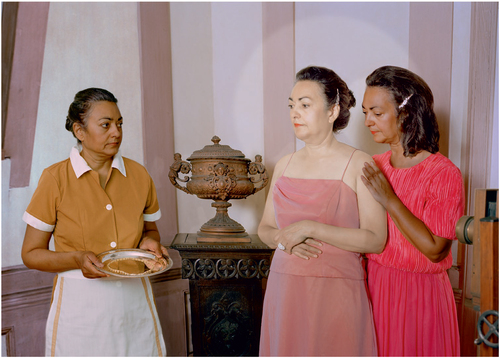
La sesión fotográfica is the work of contemporary artist Rachelle Mozman Solano (b. 1972), who—although born and based in New York—created the puzzling image in Panama City. On closer inspection, it becomes evident that each of the characters inhabiting this picture is played by the artist’s own mother, María Teresa Solano (b. 1946). The uncanny element of repetition—María Teresa’s simultaneously taking on the roles of housemaid and sisters—may well haunt and disturb the viewer, as it elicits a compelling question: How can one woman inhabit three different identities?
The quizzical artwork that I have been describing is part of Mozman Solano’s celebrated photographic series Casa de mujeres (House of women, 2009–13). Over the course of forty distinct images, the series reenacts stories of intra-familial rivalries rooted in Panamanian class and racial difference. For the artist, the subject is a familiar one: As a young girl Mozman Solano heard these stories time and again from her mother—a woman who grew up in the segregated Panama Canal Zone.
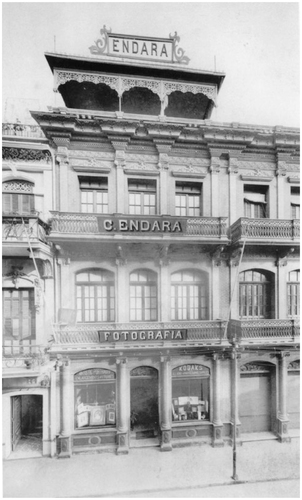
The modus operandi of La sesión fotográfica is that of a “tableau” in the sense of the term’s original art historical emergence. French Enlightenment philosopher Denis Diderot (1713–1784) coined tableau in the mid eighteenth century in reference to paintings in which the subjects were absorbed in their own world, walled off from the viewer (as in the theater), and yet projecting mesmerizing, narrative scenes that a beholder could hardly look away from.1 While tableau painting was on the rise in eighteenth-century Europe, contemporary viceregal subjects in the Americas enjoyed a parallel trend in casta (lineage) painting. Casta painting excelled in visualizing the racial mixtures of the New World based on a racial classification system introduced by Spanish colonialism—an Enlightenment taxonomy aimed at classifying these mixtures into stock types.2La sesión fotográfica engages both of these visual legacies, using the tableau to capture the viewer’s attention and evincing the ghost of a racial caste system that remains, to this day, firmly entrenched in Central America. Mozman Solano’s photograph likewise references a concrete historical site where the production of this kind of tableau was fostered: the portrait studio of Ecuadorian Carlos Endara Andrade (1865–1954), who after working for the French canal operation went on to found the most important photographic portrait studio in Panama City.3 Endara photographed a diverse clientele in this international crossroads, from Chinese merchants and humble canal workers to elite families and sitting presidents. La sesión fotográfica marks the one hundredth anniversary of Endara’s studio and symbolically positions Mozman Solano’s oeuvre at the crux of these transnational genealogies. The site-specificity of the photo shoot in this turn-of-the-century portrait studio implies a critique of the medium’s proclivity towards visualizing family photography in decidedly racial terms.
In this article I turn my attention to auto-ethnography as a method that shifts how we understand family photography. In his essay “The Artist as Ethnographer?” (1995), art critic and historian Hal Foster tracked a paradigm shift in advanced art of the 1990s, where a quasi-anthropological model interested in the “cultural and/or ethnic other” came to replace a former focus on the proletariat by artists on the left.4 Foster cautioned artists how this practice could engage the “primitivist fantasy” of avant-garde movements such as Surrealism, which claimed anticolonial positions but saw the non-white subject as a purveyor of “primal psychic and social processes” (allegedly inaccessible to the white bourgeoisie).5 Art historians Derek Conrad Murray and Soraya Murray have deftly demonstrated how the weight of Foster’s theory crumbles when meticulously analyzed for its ideological concerns.6 Whereas Foster sees the extreme ethnographic turn as a “practice of narcissistic self-refurbishing” by the artist, the Murrays point to a marked difference when the artist identifies as an ethnographer of their own culture. To assume that this self-othering is somehow a form of navel gazing is one thing, but the Murrays show that locating the work within anthropology rather than art history is a form of epistemic violence that renders the art of women, queer, and POC (people of color) artists as extraneous to the canon, in fact even completely outside its purview as a result of its engagement with questions of identity.
The ethnographic eye has certainly produced problematic and uneven encounters with “ethnic others” in the history of photography in Latin America, but what happens when the subject is the photographer’s own mother and the site is the artist’s ancestral homeland? How does this contiguity between artist and subject blur traditionally presumed boundaries existing between them? What are the ways in which this contiguity engages the tropes of ethnography and also undoes the field’s claims to objectivity? The Casa de mujeres series may hint at how in some sense we are all ethnographers of our kin—we study our familial relations intensely since birth, especially that relation we share with our mothers, indeed as if our life depended on it. On close examination, it becomes clear that Mozman Solano engages auto-ethnography in this series as a research method to more fully understand her mother and the family lore that animates her mother’s intimate stories. While a prior reading of this series framed these works through the lens of melodrama akin to the telenovela genre, I propose there is more at play in these photographic reenactments.7 Mozman Solano’s Casa de mujeres series places women at the center of reproducing genealogies of race, and shows how the pigmentocracies that we remain beholden to are in fact a family matter.
The Ghost in the Maternal
In her book Ghostly Matters (2008), sociologist Avery Gordon proposes that “haunting is a constituent element of modern social life,” and thus to study social life, “one must confront the ghostly aspects of it.”8 According to Gordon, “The ghost is not simply a dead or missing person, but a social figure, and investigating it can lead to a dense site where history and subjectivity make social life.”9 In keeping with this reading, the social figure of the mother animates the site of history in a place marked by colonial violence, subjugation, racism, and death. Mozman Solano’s series may be understood along such lines: Rather than focus on the structural factors that create those conditions of coloniality, Casa de mujeres draws attention to the subjective experiences of these systems, suggesting that the wounds that appear to haunt these photographs are something “partial, coded, symptomatic, contradictory, ambiguous.”10 In the timeless invocations of colonialist fantasies in these images, the viewer is asked to interpret: What is ghosting these images?
Mozman Solano recently published many of the images from the Casa de mujeres series in a photobook titled Colonial Echo (2020), where the series’s photographs appear alongside interviews and genuine family snapshots.11 The first such interview in the book is conducted by the artist’s mother, María Teresa, interviewing her own mother (Mozman Solano’s maternal grandmother), Carmen Thatcher de Solano. The interview dates from 1981, just months before Carmen’s death. Carmen reflects on the difficulties her family faced, such as the poverty they endured, but a larger subject—it resurfaces again and again—is the topic of various family members’ phenotype, and skin color. Art historian Tatiana Flores has written on how “anti-Black racism is ubiquitous in Latin America and commonplace in Latinx communities, even in those with Afro-descendant roots,” which Flores attributes to the region’s embrace of a European construct of latinidad (shared identity).12 Carmen mentions that her aunt Manuela was married to a man from Panama who was “the son of Americans . . . white, with blue eyes but tough hair.”13 María Teresa inquires about Carmen’s own mother’s skin: “Wasn’t your mother trigueña (olive skinned)?” Carmen prosaically responds, “She was white. She was like Rachelle’s color, Rachelle’s skin type.” In an annotation accompanying the interview transcript, Mozman Solano recalls that she was a young girl playing nearby as this conversation took place on the porch.
The interview is revealing for a number of reasons. For one, it documents an oral history tradition, which Mozman Solano has continued with her own mother (as the reader of the book learns in a subsequent interview). The interview between the artist’s mother and maternal grandmother also foregrounds how the machinations of race on the Panamanian isthmus shape family relations, as well as how related beliefs, behaviors, and attitudes are passed down from mothers to daughters through stories, silences, and gestures. The men among the family were not immune to this phenomenon: In another part of the interview, Carmen talks about her paternal grandfather, who served as governor of the Panama Canal, but whom—despite his distinguished position—could not accept her father, who was born to an Afro-Panamanian woman. She concludes in a strident tone, “I have erased the past from my mind, I don’t want any contact with my family.” While the comment speaks to the hurt caused by this negation of blackness, Carmen’s instinct to erase the memory, rather than confront it, speaks to the ways in which this history is repressed yet nonetheless continues to haunt the everyday life of the family.
To return to La sesión fotográfica, it now becomes clear that to take in this image, indeed with all its apparent disjunctions, is to bear witness to the ways in which race, class, and color have shaped Panamanian relationships—not only in the public commons, but inside the home. The stark racial differences between the idealized whiteness of the light-skinned sister, the darker skin tone of her sibling, and the racialized otherness of the housemaid are performed through Mozman Solano’s mother as profoundly embodied behaviors and attitudes. Such behaviors and attitudes are even—as we eventually learn—further purposely exposed by the artist via techniques of digital brownface and, on the opposite side of the spectrum, artificial whitening. Here it is important to distinguish Mozman Solano’s use of brownface from the tradition of racial ridicule, such as that of the American actor and comedian, Bill Dana (1924–2017), in his late 1950s creation of the Latino buffoon character, José Jiménez.14 Sociologist Raúl Pérez argues that at a time when Black minstrelsy had become socially unacceptable, white performers turned to brownface to continue a racist comedic tradition that gave white audiences a feeling of superiority, specifically by relying on cultural, linguistic, and nationalistic markers. Pérez explains, “by performing an incompetent, working-class, Latino immigrant for a largely Anglo-American audience, Dana, of Hungarian-Jewish descent, was becoming a national celebrity in ‘brownface.’”15 Pérez further points out that in the wake of America’s Civil Rights Movement (ca. 1954–1968), both Black and brown minstrelsy became unacceptable for white performers, and “this gap was filled by non-whites mocking themselves.”16 For many Latinx performers, this self-deprecating humor is also a way to undo the power of a racial stereotype. But in the case of Mozman Solano’s Casa de mujeres, given that the element of skin tinting is not meant to invoke comedic relief, the photographs are both striking and unsettling. Their aim is to create a contradictory dramatic effect that speaks to the nuances of racial formation as matters in which the women in the family play a central role.
Among the striking features of the series is the subtle critique of her mother’s trauma. In the realm of psychoanalysis, the imago (likeness) is theorized as an idealized image of our parents formed in early childhood.17 But here the artist seems to question the idealization, and to search for something hidden in the maternal object. Clinical psychologist Jill Salberg explains how transgenerational trauma is not necessarily relayed through content but moves within affective registers:
When a parent has experienced a trauma, part of their mind and body has been affected, along with their ability to self-regulate emotions. Thus, some part of a person may not be knowable to themselves, dissociated and inaccessible. Some part of this unmediated experience will likely be transmitted transgenerationally from parent to child. Children are constant observers of their parents, noticing when a parent is attuned, misattuned and/or psychically absent. In response, children adjust and adapt to the emotional presence and absence of their caregivers.18
The creative space of reenactment enabled a search for these unknowable parts of things that haunted Mozman Solano’s mother. The photographic sessions were thus intersubjective to hold space for her mother to repeat and rework, but also to witness the trauma transmissions in the photographer’s own family. In an interview with curator Leslie Moody Castro, Mozman Solano talked about what compelled her to make the series:
My mom is from Panama, and I really wanted the work to be focused on Central America and the environments and backgrounds to be colonial homes. She was my first subject, really the first person I pointed the camera at and was like, “oh, there’s something really deep here.” I think it was that she was my biggest enigma. I just could not understand my mother. So I feel like a lot of my work with her is about trying to understand her. She’s just very enigmatic, odd, and eccentric and traumatized.19
After completing her MFA at the Tyler School of Art & Architecture in 1998, Mozman Solano embarked on a new challenge by undergoing coursework and clinical practice in psychoanalysis at The Training Institute of the National Psychological Association of Psychoanalysis (NPAP), New York. She explained, “I [saw] patients for seven years, and I think it really affected my work.”20 The established dialogue between psychoanalysis and photography was a natural draw for the artist. The effect of psychoanalytic training and clinical practice on her artistic practice hints at Mozman Solano’s singular ability to imagine the scenes that her patients described to her in vivid detail as if she could see or inhabit them in her dreams. On activating her imaginative capacity and deploying it in her creative practice, Mozman Solano has commented, “It’s [a matter of] listening to people, and then sort of traveling with them through their psychic experiences.”21 That said, we might yet ask what is at stake in having her mother, María Teresa, perform this trauma for the sake of art. Moreover, is there something perverse about reenacting brutal human relationships and taking pleasure—artist-photographer, portrait actor, audience—in the performance?
One clue about the psychological transmissions taking place during these photoshoots comes from developmental psychoanalysis. In tracing the affective communication between mothers and infants, scholars have shown that the “gaze represents the most intense form of interpersonal communication, and the perception of facial expressions is known to be the most salient channel of nonverbal communication.”22 Whether attuned to produce a positive affect or attuned to induce stress, the gaze mediates this early bond which is crucial for psychological development, indeed eventually facilitating the infant’s ability to grow into an adult who can effectively regulate their emotions. It is as if the artist-daughter reverses the usual trajectory of that dyad by turning her lens back upon her subject-mother retrospectively, indeed to reclaim early experiences from the deep unconscious. The camera acts as a witness to nonverbal transference (María Teresa’s feelings toward Rachelle) and countertransference (Rachelle’s feelings toward her mother). There is no pretense to objectivity when Mozman Solano is both daughter and therapist in these scenarios, and yet what the participants are able to generate collaboratively in these photographs is a system for representing split-off parts of the self of a larger pathology that belongs to both of them.
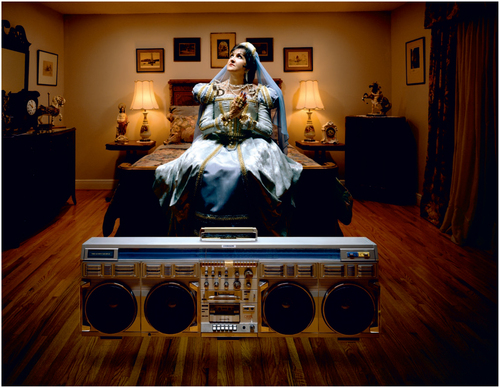
Mozman Solano is part of a generation of photographers, including Sarah Jones (b. 1959), Deana Lawson (b. 1979), and Luis Gispert (b. 1972), who are resolutely meticulous in their formal experimentation with their chosen photographic settings and framing techniques, and who similarly employ actors in creating the arresting poses and compositions. But in Mozman Solano’s turn to her mother and auto-ethnography as subjects for her investigative lense, she shares something with the approach of Gispert, whose photograph of his mother offers a similarly acerbic yet loving portrayal. For example, the Cuban American photographer’s life-sized C-print tableau Bedroom (2003) is a portrait of the artist’s mother seated on a bed and holding a pose of devout prayer. She is dressed in an ornate lilac dress with gold trim, and she wears a veil while gazing toward the ceiling, bathed in spotlighting that illuminates her presence as no less than angelic. The bedroom emanates a warm soft light, and careful attention to symmetry and balance has allowed the artist to frame a baroque bedroom scene. The plunging geometry of the wooden floor draws the eye powerfully into the strange mise en scène: a sleigh bed framed by lamps, religious symbols, equestrian statues, framed pictures, decorative clocks, and voluminous drapery—an excess of objects that theatrically, and perhaps stereotypically, sheds light on the cultural aesthetics associated with Cuban immigrants. Aligned with this tongue-in-cheek portrayal of his mother, Gispert has placed an extravagantly large 1980s boom box at her feet, almost as if it represented an offering to the Virgin Mother. Despite its exceedingly modest cast, the tableau envelops the viewer in a scene where the hip-hop of his youth sonically moves the picture forward in time, and the mother remains in a frozen, pious, and muted pose as embodying a figure of the past—a ghost that cannot cross over to the contemporary moment. There is love and contempt in nearly equal measure in such a portrayal that viewers might well question not only the artist and mother’s bond, but also how the personal translates into larger questions of cultural and social meaning. Similarly, the politics of race that play out in Casa de mujeres—stories of class privilege and live-in servants, colonial homes filled with curious objects, and sibling rivalries based on colorism—address the various colonial and imperial incursions in Panama (which I will briefly rehearse for the reader), but they do so from a subjective viewpoint where the colonial wound doubles as the mother wound. Casa de mujeres engages in a ritual of “remembering, repeating, and working through” to bring the forgotten into consciousness.23
Mirrors and Hauntings in the Canal Zone
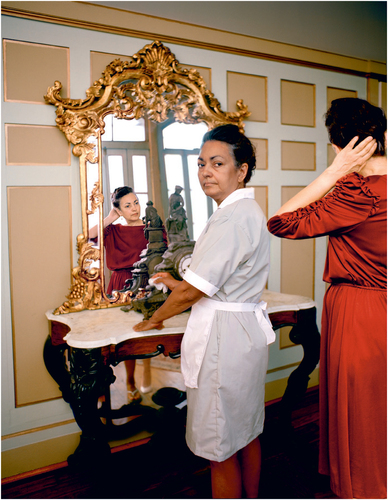
Across the multiple images that make up Mozman Solano’s Casa de mujeres series, the mirror proves an exceptionally important component. In El espejo (The mirror, 2010), for example, the lady of the house (la dama) and her maid are placed in close proximity to a baroque full-length mirror. The maid is dusting an antique clock that rests on a marble table bearing the weight of the mirror. While the lady of the house stands in the foreground, her body is turned away from the camera lens as she faces herself in the mirror. La dama adjusts her hair and gazes upon her silken red dress as sunlight streams in from the windows. Notably, while the maid also faces away from the camera and has been posed by the artist in the privileged, central zone of the picture (where Diderot would have been expecting to find climactic action), she does not appear in the mirror—save for her feet. Rather, she twists her body toward us—as though to side-eye the camera.
El espejo invites a number of psychoanalytic readings in which Mozman Solano’s mother fractures into doubles, as in a dream or a hallucination. The symbolic role of the mirror recalls the early “mirror stage” of Jacques Lacan (1901–1981), that developmental moment when an infant gazes in the mirror and assumes, for the very first time, an image of the self apart from the world around them.24 The function of this mental image is to establish a new relationship between the infant and external reality. But as Lacan noted, “The mirror stage is a drama whose internal pressure pushes precipitously from insufficiency to anticipation—and for the subject caught up in the lure of spatial identification, turns out fantasies that proceed from a fragmented image of the body . . . an ‘orthopedic’ form of its totality.”25 The specular image constitutes an “I” that is haunted by the fragmented body or an incohesive image of the self. As such El espejo may invoke a collective reckoning, particularly for Panamanian viewers, who are invited to see themselves in this tableau, through a master-slave, white-colored dichotomy. In such a work Mozman Solano holds up a mirror to an elite sector of Panamanian society and speaks to its racial unconscious girding their idealized white identity in opposition to indigenous and Black subjects, the latter’s abjection an imperative for the construction of this subjectivity. And yet the fact that her mother inhabits both roles here suggests that her character is not a racially cohesive subject, but one that has internalized a fractured identity based on these colonial projections.
The mirror is also a metaphor for the camera lens through which Mozman Solano hopes viewers will critically engage—by way of this series of images—Panama’s internalized racial hierarchies. These social stratifications were intertwined with the country’s ascent as a major hub of interoceanic and intercontinental transportation. From the earliest European-led explorations, the isthmus was regarded as key to connecting South America to the Atlantic Ocean. The first interoceanic land route, a fifty-mile cobblestone road known as El Camino Real, was built by slaves to transport gold and silver destined for the Spanish Crown. The Spanish explorer Vasco Nuñez de Balboa (1475–1519) is purported to have brought enslaved Africans to the region as early as 1513, but within a decade many of them would flee to found maroon communities. These communities staged defensive and offensive actions that forced the Spanish to issue a decree and grant their permanent freedom in 1579.26 However, the slave trade continued even as the Viceroyalty of Nueva Granada (later Gran Colombia) gained independence from Spain in 1821. Slavery was subsequently officially abolished in Colombia thirty years later. In the United States, following the annexation of Oregon (1846) and the discovery of gold in California (1848), American businessman William Aspinwall secured a formal contract (1850) to build an “iron road” across Panama, as well as to construct multiple lines of steamships under the Pacific Mail Steamship Company for speeding up travel routes. These transportation developments, coupled with the French initial attempt to build the canal (under entrepreneur Ferdinand de Lesseps, from 1880 to 1889), also brought a large number of Black West Indian laborers from the Anglophone Caribbean, namely from Jamaica and Barbados. The influx of West Indian immigrant Blacks created tensions with preexisting groups, including the slave-descended Afro-Hispanic populations.27 As legal historian Robert Cottrol has noted, “The desire of political leaders to create white societies often clashed with the wishes of foreign-owned enterprises for cheap labor.”28
The hierarchies of race and labor became further complicated when the US became involved in Panama. In November 1903 Panama declared independence from Colombia with the help of the United States; soon after, negotiations led to the enactment of the Panama Canal Treaty (1903) that granted the US control in perpetuity over 533 square miles of the zone. Scholar Katherine Zien argues that performance allowed the treaty’s redefinition of sovereignty, by which she means that Panama retained sovereignty while the US could perform sovereign acts in the zone, leading to a legal borderland, a labor colony, and a new system of racial segregation.29 The US construction of the canal from 1904 to 1914 brought somewhere between 150,000 to 200,000 Caribbean migrants from Barbados, as well as Jamaica, Saint Lucia, and Martinique. Notably, canal authorities assigned each worker to a gold or silver roll according to their race, with white workers earning higher wages, vacations, and pensions, and instituting Jim Crow–like separate towns, schools, recreational facilities, and transportation, to keep the workers from mixing.30 In order to accomplish what the French had failed to, the Americans drained swamps, killed swarms of mosquitoes, built schools and hospitals, and instituted a police force.31 The work conditions for what were mostly immigrant laborers were treacherous; under intense heat or punishing rain, these men cut—with dynamite, picks, and steam shovels—a trench fifty miles long and ten miles wide through mountainous terrain for about ten cents an hour.
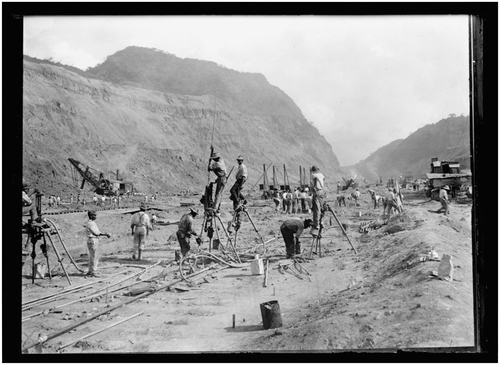
Most commentators today still laud the canal as an engineering marvel, as it greatly reduced shipping routes across the globe. But Panama’s dream of becoming a central nexus for commercial trade was doubtless hampered by the US Government’s retaining political and economic control of the canal through the late 1990s.32 These are the structural inequalities that ruled the public sphere in Panama, but tracing their wounds is much harder. Historian Kaysha Corinealdi explains, “The violence of this building effort marked entire generations.”33 Mozman Solano’s Casa de mujeres invokes this troubled history by dwelling on its mark on the family, and interrogating how women have had a role in enabling this brutalization—even when it was to their own detriment.
By learning of her familial ancestors through auto-ethnography, Mozman Solano has been able to identify members of her extended family who have rubbed elbows with power in recent history. Her maternal grandfather, Enrique Solano y Rafecas (ca. 1886–1953), was a medical doctor whose patients included the infamous three-time president of the republic of Panama, Arnulfo Arias (1901–1988).34 During his first brief presidential term of 1940–1941, Arias experienced a bout of testicular cancer, and Mozman Solano’s grandfather was the attending surgeon. As the artist recently explained, “My grandfather [subsequently] paid a real price for that . . . [as] he was banished to the countryside.”35 The vernacular phrase, “Una bola de Arias,” which Panamanians would then jocularly use to order a scoop of ice cream, made light of the situation, effectively poking fun at the hard right policies that characterized Arias’s administration. Arias rose to prominence with a right-wing campaign based on a growing nationalist movement of Panameñismo (Panamanianism), resulting in the modification of the Panamanian constitution in 1941, one of the effects of which was to effectively (and retroactively) denationalize Afro-Caribbean Panamanians—thereby stripping them of citizenship. In his first presidential inaugural address in the early autumn of 1940, Arias framed Panama’s underdevelopment as a consequence of its “ethnic problem.”36 The new social order that was to be imposed internally through gender and racial segregation, coupled with the performance of sovereignty over the region by the United States, would have lasting consequences. Evolving in tandem, they gave rise to far right leaders who fomented xenophobic rhetoric; at the same time, this internal-external dynamic effectively served to internalize the ghost that is racism, a ghost that psychologically fractures, if not devastates, the self—as we have seen in the incohesive image of El espejo.
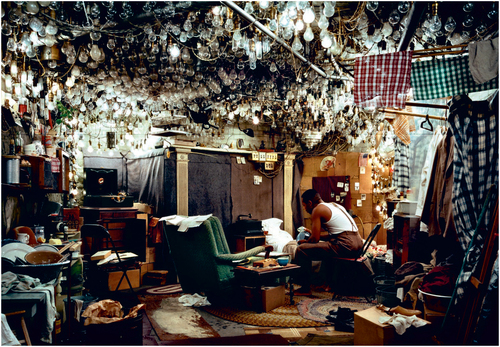
The tableau photography of Jeff Wall (b. 1946) serves as a productive comparison here. In Wall’s After “Invisible Man” by Ralph Ellison, the Prologue (1999–2000), Wall (and his assistants) staged an elaborate scene where the protagonist of Ellison’s celebrated novel sits in an overcrowded basement. The large-scale lightbox transparency shows a modest dwelling that includes a twin bed, a record player, two chairs, a dresser, and a makeshift kitchen. Seated on a folding chair, the solitary protagonist looks away from the camera, presumably focused on drying the cookware in his hand. In the 1952 novel, Ellison tells the story of a young Black man struggling with the hardships of racial segregation and the pain of feeling invisible. In a basement where he lives and writes, he finds comfort in light: “Perhaps you’ll think it strange that an invisible man should need light, desire light, love light. But maybe it is exactly because I am invisible. Light confirms my reality, gives birth to my form.”37 This fascination with light and its ability to give form is a central theme of the photograph. Hundreds of incandescent lightbulbs illuminate the basement. While some of the bulbs have burned out, the cascading and undulating rhythms of bulbs and their burning light renders the space warm and inviting. The sensuous glow bathes virtually everything in its path, from felt to cardboard, flesh to metal.
This is perhaps the quasi-anthropological model that Foster had warned against, to enter the realm of that “cultural and/or ethnic other” in the production of a fantasy—even if based on fiction. Art historian Régis Michel has written on the ways that Wall “betrays Ellison,” by showing a Black man “with the eyes of the white,” calling out a “photopantomime” of racism that veers on “endless narcissism.”38
For Mozman Solano, her auto-ethnography series does create living pictures, however these are not simulations in the Baudrillardian sense. They tap into a lived experience (her mother is not an actor but a retired schoolteacher) and are further animated by the mise en scène of existing historical sites. El espejo, for example, was taken in the colonial home of President Ernesto Tisdel Lefevre (in office 1920) in the historic district of Panama City. The tableaus in Casa de mujeres are interpretations which at times draw upon her specialization in psychoanalysis to approach her mother’s trauma, and perhaps her own intergenerational trauma, with compassion and curiosity. They likewise show the beholder the photographer’s “second sight,” her physical presence in these colonial interiors.
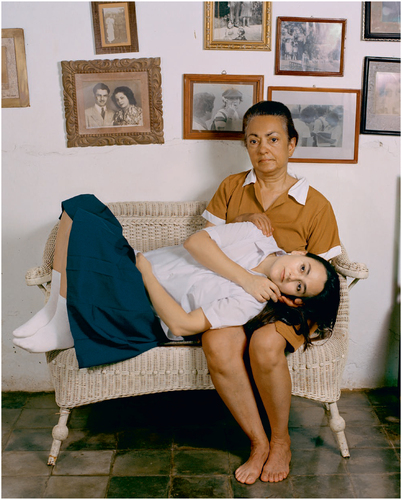
The blurring of boundaries between maker and subject, to further erode any sense of objectivity, appear in instances where Mozman Solano inserts herself into these photographs.39 In El sillón (The armchair, 2011), a maid and a young schoolgirl sit together in a large wicker chair. The pieta-like pose, loosely reminiscent of Michelangelo’s carved marble Pietà (1498–1500), represents the artist reclining while the maid—once again, her own mother—affectionately cradles her body. There is a notable difference between the porcelain skin of the young girl and the brown skin tone of the maid, whose bare feet rest on the tile floor. A series of family photographs are hanging on the wall behind them, and some other furniture is visible, though judging by its modesty, the sitters are probably in the maid’s quarters. El sillón hints at the emotional bonds that connect maids and the children of their employers. This mothering provided by maids to their employer’s children is often rendered at the expense of their own young ones. Ironically, children of the wealthy will learn about racial bias from an early age while they will nonetheless love these women, indeed sometimes more than their own parents.
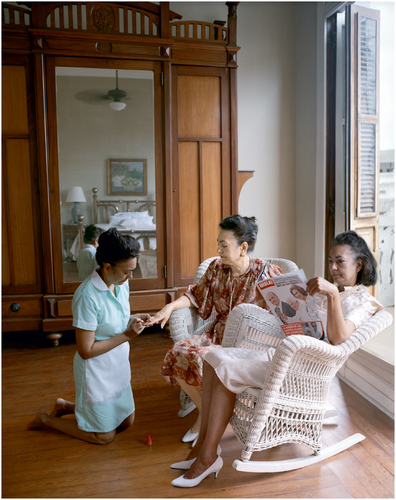
Furthermore, the mirror plays into the photographer’s sleight of hand. One might expect the artist, camera, and tripod to appear in Pintando las uñas (Doing their nails, 2011), and yet there is no trace of their presence. The vanishing from the picture plane of such images lends insight into Mozman Solano’s process. These are not simply staged photographs but constructed images initially shot on film, but then digitally manipulated, one layer after another, to create seamless montages. In this scene, the maid kneels before the twins and paints the nails of the fair-skinned sister. The other waits her turn, while reading a celebrity gossip magazine. To achieve such a composite would require the artist to photograph her mother at least three times in these different poses and costumes, in addition to photographing the mise en scène looking both towards and away from the bed. The mirror is, then, a window for the viewer to explore, identify, or disidentify with these social relationships.
Who Rules the Private Sphere?
In order to expand her critique to the entire Central American region, Mozman Solano chose multiple sites throughout the isthmus, including some in Guatemala and Nicaragua. The photographs from Guatemala City’s historic center are particularly lavish in capturing the wealth accumulation and aesthetic splendor of the Republican era. In El cuarto de la niña (The girl’s room, 2010), an elaborate nineteenth-century period room comes to life through a tightly framed tableau in which la dama sits on a mahogany bed.40 Sitting beneath a light fixture, the subject, dressed in a pink silk dress, looks pensively toward the ground. Her reflection is visible in a mirror mounted on the wall, and the fairness of her skin mimics a porcelain doll that rests on a bed pillow. The dark-skinned maid stands directly behind her, looking toward the floor, submissively. Her placement at an angle creates a chevron shape between the maid, la dama, and the idealized white figure in the mirror from darkness to light. This masterful use of chiaroscuro, not unlike in Wall’s tableau of a Black man polishing his kitchenware beneath a resplendently lit basement ceiling, provides embodiment of the time’s racial hierarchies. Mozman Solano’s mise en scène likewise conjures this tonal range and points to a colonialist nostalgia with an excessive feminine aesthetic that camouflages every domestic surface, from the flowery wallpaper to the lace pillowcase to the mahogany armoire topped with delicate glassware. In such a tableau viewers are enveloped in a drama that unveils the usually invisible machinations of race, including how women have played their own part in enforcing racial hierarchies in the domestic sphere.
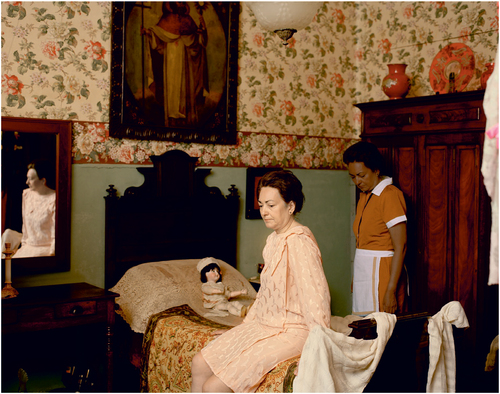
Rachelle Mozman Solano, En el cuarto de la niña (The girl’s room), 2010, chromogenic print, 23 x 26 in. (58.42 x 66 cm) (artwork © Rachelle Mozman Solano; photograph provided by the artist) 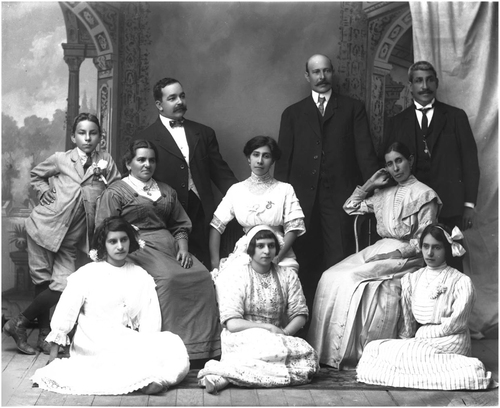
Juan José de Jesús Yas, Portrait of the Cuéllar Family, Antigua, Guatemala, 1895–1915, Archivo del estudio “Fotografía Japonesa” (photograph provided by Fototeca Guatemala; published under fair use)
While the vast majority of structural conditions—colonialism, imperialism, capitalism—were primarily the work of men, prominently recorded in history, Casa de mujeres exposes a kind of complicity: the invisible hand of women. Most elite women ruled the private sphere with similar brutality as their male partners in the public space in order to maintain power in a modest realm afforded them by a patriarchal and racist society. Sociologist Marta Elena Casaús Arzú has shown how, from the colonial period to the present, family networks have been of considerable relevance in the formation of Central American social structures.41 Her focus is on the oligarchy and the endogamy (marrying within one’s own circle) practiced by the elite to remain in power within a rigidly stratified racial order. In places like Guatemala, women played an important role in the reproduction of this social class, and their marriages secured economic and political standing for their families. In the studio portraits of Juan José de Jesús Yas (1844–1917) it is possible to see how women performed various identities along race, class, and gender lines.42 For example, Yas’s Portrait of the Cuéllar Family (1895–1915), shows a ladino (mixed race, non-Indigenous) family at Yas’s studio in Antigua. Six of the ten family members are women. Their careful placement in the composition indicates their degree of importance to the family, with a central seated figure, two matriarchs at her side, and her three daughters seated on the floor. Art historian Paulina Pezzat has shown how these portraits of Guatemalan bourgeois society were a space of performativity, where class aspirations, racial tensions, and notions of feminine modernity converged.43 The family in this instance don westernized clothing: While the men and the young boy (to the viewer’s left) wear dark three-piece suits, the women are in long flowing dresses with high necklines. Some of these women conform to Victorian elite fashion, their sporting pinned up hair styles and covetable jewelry. The neoclassical studio backdrop reinforces the aspirational nature behind the projection of European values. At dead center, la dama projects a gentle gaze, yet her body language signals authority. Photography is a crucial technology here in documenting this performance. Nineteenth and early twentieth-century portrait photography helped consolidate kinship, whiteness, and elite ladino identities through these symbolic means.
As the new republics in Central America forged a sense of postcolonial nationhood, they transformed the colonial caste system through racial positivism and liberal homogenization in the name of national unity.44 In the case of Guatemala, which achieved independence from Spain and Mexico in 1821, this meant that a prosperous or upwardly mobile ladino family would see themselves as white, thereby erasing ties to indigeneity and blackness at all costs, and producing what Casaús Arzú refers to as “white societies where mestizaje [mixing of races] was unthinkable.45 This is the projection on which the Cuéllar family portrait hinges, even if the skin color of its family members lay within a broad spectrum. The Cuéllar daughters would have been encouraged to marry within their own circle and not mix with races deemed “degenerate.”46Official state policies throughout Latin America, from Mexico to Brazil, eventually began promoting the concept of racial mixing in the early twentieth century, which could be complemented in the work of prominent public figures, such as the Mexican writer-philosopher José Vasconcelos (1882–1959), who as early as 1925 was espousing the virtues of la raza cósmica (cosmic race) in direct opposition to US ideals of protecting white Anglo-Saxon racial purity; or Brazilian anthropologist Gilberto Freyre (1900–1987), who put forth a notion of “racial democracy” in arguing that miscegenation was instrumental to the eradication of racism.47 But in practice, elites everywhere across Latin America postulated their own blanqueamiento (whitening), which could find codification through the image regime of photography. Elite families viewed mestizaje thinkable only for the lower classes, particularly the poor who already exhibited signs of indigeneity or blackness. This racial animus would ultimately coalesce into state-sponsored campaigns to eradicate indigenous populations, as witnessed during the long Guatemalan Civil War (1960–1996), or to displace Black communities to the fringes of the polity: the rural coastlines.
Mozman Solano shares an interest in exposing women and their elite social behavior with contemporary photographers Tina Barney (b. 1945) and Daniela Rossell (b. 1973). Barney’s series Theater of Manners (1977–91) documents the daily life of her well-to-do New England family. In these images, mother and siblings become actors in their own lives, sometimes comfortable with, sometimes defiant of, the camera’s gaze, yet always immersed in the trappings of American bourgeois life. Critics writing on Barney in the late 1980s were at first confounded by the seemingly cool and detached ways in which she approached her subjects: Barney operated seemingly without judgement, all the while indulging a predilection for capturing lush and marvelous domestic interiors that seemed to spring from a design magazine spread.48 Comparing her work to the practice of anthropologists, curator and art historian Quentin Bajac notes that this distance, perhaps a result of Barney’s moving away from her family in the 1970s, had given the artist a unique ability to perfect “a photographic process that neutralized a form of sentimentality.”49 From this unsentimental perspective, Barney could capture some of her closest kin, who also happen to be white women in a privileged habitus, their projecting power and desire, and idealizing White Anglo-Saxon Protestant (WASP) values.
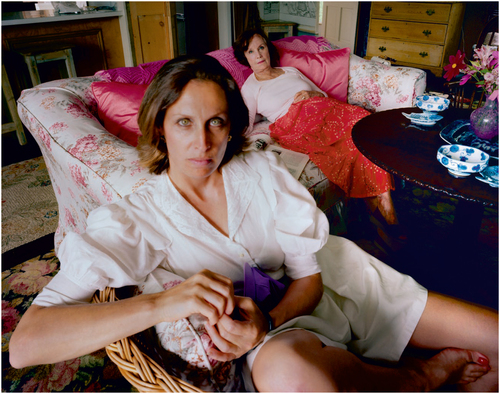
Similarly, when Mexican photographer Daniela Rossell published her photobook Ricas y Famosas (Rich and famous), in 2002—the book reproduces twenty photographs of elite Mexican society drawn from Rossell’s larger series of the same title—critics were scandalized and confused about her artistic intentions.50 Tabloid-like exposés began revealing the identities of the sumptuous women in Rossell’s photographs, most of whom were the wives and daughters of men in the Institutional Revolutionary Party (PRI; Mexico’s conservative governing coalition from 1929 to 2000). Rossell photographed these women of privilege in their homes between 1994 and 2001 in Mexico City, Guadalajara, Monterrey, and Acapulco, in a project that had begun with her own relatives and acquaintances. In Untitled (Ricas y Famosas) (1999), for example, a birds-eye view captures a blond woman dressed in a short gold lamé dress as she reclines on a sofa and gazes directly at the camera. The room is bathed in the soft light of a chandelier that hangs along the inner right edge of the frame. Rossell captured a luscious baroque aesthetic in the woman’s lavish interior, perhaps having stood from a spiral staircase from where she could surveil the opulent furniture, Persian rug, antiques, and large-scale paintings. Tucked away in the left-hand corner of the room is a maid in a starched uniform, looking up with dismay at the artist’s camera.
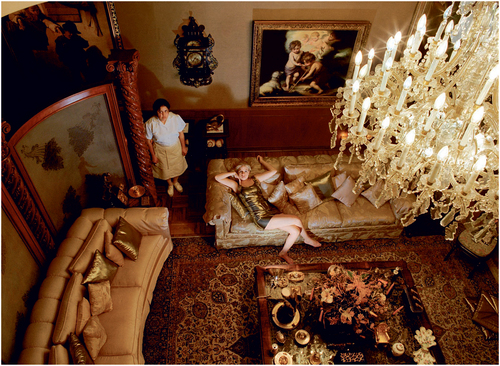
The press scandalously ridiculed these elite women, their “bad taste,” and the moral decay of this blatant corruption, but as scholar Rubén Gallo has pointed out, rarely did the critics read these as art photographs, noting that “they were not merely a window into the lifestyles of multimillionaires but compositions featuring careful choices of framing, cropping, editing, and point of view–representational strategies that are as important a part of the photograph as the subject matter they depict.”51 One obvious mark of the photographs’ staging can be detected by closely examining the Italian mahogany glass table on which the artist placed a floodlight to heighten the dramatic effect. The cast light reflects off the light skin of Rossell’s subject, and it projects shadows on the wall that seem to hover menacingly over the maid.
What truly troubled these critics was the unbearable ambiguity of these images—that is, the way in which they glamorize and aestheticize the mannerisms and taste of the rich while creating peculiarities that insert a degree of incredulity through masterful framing and clever set direction. As in Rossell’s case, this element of unbearable ambivalence, so to speak, is part and parcel of Mozman Solano’s Casa de mujeres series. One might say that a “paranoid” reading would question Mozman Solano’s seemingly compulsive desire to reenact the wounds that appear in these photographs, and her aestheticization of seemingly benign, yet luscious nineteenth-century interiors, but as feminist scholar Eve Sedgwick has deftly argued, a “reparative reading” seeks to find hope and potential in the ambiguous.52 Mozman Solano has described her staged photographs as portraits of her mother as a “nested doll,” and the five-year series attests to her commitment to unlock hidden wounds through a performative and visual language that pulls away layer after layer.53 While a personal catharsis might be a desired outcome, the series uses the personal to get at larger truths about culture by engaging in a self-reflexive analysis that is particularly damning for women. How do we use our privilege to become the oppressors inside our homes? How does this violence manifest in our psyches? How do we pass this on to our children? How does this pernicious system continue to replicate itself? Mozman Solano’s “nested doll” is a metaphor for this replication. In this system, even the subaltern housemaid will learn to adapt and survive by playing along and oppressing the ethno-racial underclasses below them. And the beauty of Mozman Solano’s images, their overly feminine aesthetic, genders this violence. In the lure of these images, we can glimpse something nostalgically longed for, and that raises questions about who we truly are and yet what we believe ourselves to be.
Significance for the Central American Diaspora
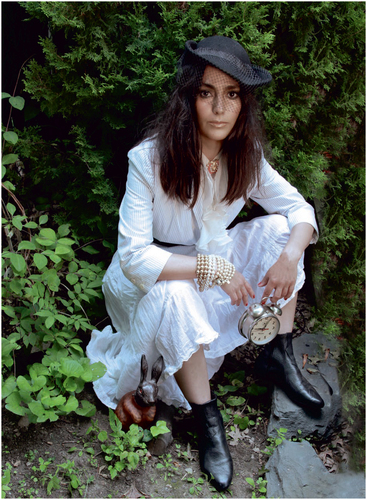
To return to Derek and Soraya Murrays’ remarks about the ethnography of one’s own culture, I have proposed that an artistic practice of auto-ethnography may be produced from the center of art history as a paradigmatic field, not confined to its margins. Drawing on the visual legacies of tableau and casta painting, and of the Spanish baroque that became all the more splendorous in the colonies, Mozman Solano invites viewers to an art historical lesson in which, mesmerized, we can no longer turn away from the complex interplay of race, class, and gender in such photographs. Mozman Solano’s ability to do so has been similarly enacted by others, for example, multidisciplinary artist Elia Alba (b. 1962). In the portrait The Ethnographer (2014), of her series The Supper Club (2012–19), Alba pictured the artist as an embellished Alice in Wonderland character.54 The clock in her left hand and the rabbit to her right each reference key points in the children’s fantasy story when, out of curiosity, Alice jumps down a rabbit hole only to discover an underworld where everything is topsy turvy. The title is an apt metaphor for an artist whose oeuvre is driven by a quest to fall down rabbit holes and unearth hidden psychogeographies. But in Mozman Solano’s Casa de mujeres series, the artist is not only revealing something external that has been long obscured. In addition, she opens up her own lineage to public scrutiny.
I conclude this article with some personal thoughts on why Mozman Solano’s series has preoccupied me for the last five years. Much like the critics troubled by the ambiguities in Barney’s and Rossell’s depictions, I have been haunted by these images. María Teresa is a silent partner in this collaboration and yet the camera discloses so much about her consciousness and history. I picture what it would be like to talk with her about the series. Was she aware that these staged photographs commented on her trauma? What did she understand about her role in performing gendered typologies and racialization? We have never met. It feels as if the artist understandably guards her mother’s privacy, and that this in turn allows her to single-handedly shape the narrative. In this quest to interpret the series, I have also donned the hat of anthropologist, tracing this family history, and following Mozman Solano back to Panama literally to see for myself the peculiarities and specificities of this lost familial homeland.
In looking at family photographs, even staged ones, they can easily become a mirror for our own fears and desires.55 I have had to stop myself, multiple times, from reading the work through the prism of my own mother wound, a wound so deep it sometimes feels uncontainable. The series has allowed me to question the racial biases transmitted early on in my development by family members in Central America, where I was born into a family whose class privilege enabled close proximity to whiteness. My family’s verbal and nonverbal interactions with domestics, gardeners, and nannies, often of indigenous ancestry, shaped my worldview in ways that I had to consciously unlearn as an adult living in the US. The series has also compelled me to interrogate my own practices of mothering. Have I been able to break old patterns? Is my child proud of their brown skin? How will my own trauma shape their life? Perhaps that is the allure that keeps me coming back to these images and newly appreciate, each time I do so, the ways they enable entry points into a self-reflexive analysis. This is particularly significant for the Central American diaspora. US Central Americans are the fastest growing Latinx demographic, often hypervisible in the media as migrants fleeing misery and violence, or as tattooed gang members, yet stubbornly unintelligible to established Latinx diasporas (Chicanx, Puerto Rican, Cuban) and US Black and white racial paradigms.56 Mozman Solano’s Casa de mujeres series seems to suggest that our beginning to self-define this diaspora requires a collective reckoning with these histories of racialization, and to do so we must start with those closest to us, our kin—especially our mothers. To examine the role of women in sustaining oppressive genealogies of race is not about passing blame or falling prey to some psychoanalytic cliche about mothers. It is, rather, a reparative act toward one day seeing ourselves whole again.
My sincere thanks go to Karen Graubart, Roberto Tejada, colleagues of the Latin American Critical Cultural Studies Working Group at the University of Notre Dame, and the anonymous peer reviewers for Art Journal whose insights helped to shape this article. I would also like to express my gratitude to the Getty Scholars Program, which supported this research.
Tatiana Reinoza is an associate professor of art history at the University of Notre Dame and a former member of the Dartmouth Society of Fellows. Her book Reclaiming the Americas: Latinx Art and the Politics of Territory was published by the University of Texas Press in 2023 [Department of Art, Art History, and Design, University of Notre Dame, Notre Dame, IN 46556, treinoza@nd.edu].
- Diderot fully developed his theory of the tableau in his Discours de la poésie dramatique (Essay on dramatic poetry) of 1758; for more on the development of tableau painting, see Michael Fried, Absorption and Theatricality: Painting and the Beholder in the Age of Diderot (University of California Press, 1980). ↩
- Casta paintings were produced primarily by Spanish painters in Mexico and Peru. Europeans developed the genre for the viewing pleasure of European audiences, and the families depicted are pure acts of imagination that speak to typologies. While the casta paintings fixate on differences of skin tone, hair, dress, and occupation, these differences seem minimized as families of varying racial classifications appear jovial and carefree. The families in casta paintings never include servants which would introduce social and visual confusion. For more on the tradition of casta painting see Ilona Katzew, Casta Painting: Images of Race in Eighteenth-Century Mexico (Yale University Press, 2004), 63–109. ↩
- For more on Endara Andrade see Juan Antonio Susto, Carlos Endara Andrade y la fotografía en Panamá (Impresora Panamá, 1967); Mario Lewis Morgan, 100 Años de Panamá, 100 Portadas de Épocas: vida y obra de Carlos Endara Andrade (1865–1954) (Editorial Panamericana Formas e Impresos S.A., 2003). ↩
- Hal Foster, “The Artist as Ethnographer?” in The Traffic in Culture: Refiguring Art and Anthropology, ed. George E. Marcus and Fred R. Myers (University of California Press, 1995), 302–09, accessed October 17, 2025. ↩
- Foster, “The Artist as Ethnographer?,” 303. ↩
- Derek Conrad Murray and Soraya Murray, “Uneasy Bedfellows: Canonical Art Theory and the Politics of Identity,” Art Journal 65, no. 1 (2006): 22–39. ↩
- The art historian Rocío Aranda-Alvarado has written on the prevalence of melodrama in the work of Mozman Solano and its predominant appeal akin to that of the Latin American soap opera; see Aranda-Alvarado, “Bodies of Color: Images of Women in the Works of Firelei Báez and Rachelle Mozman,” Small Axe 21, no. 1 (March 2017): 57–69. ↩
- Avery F. Gordon, Ghostly Matters: Haunting and the Sociological Imagination (University of Minnesota Press, 2008), 7. ↩
- Ibid., 8. ↩
- Ibid., 24. ↩
- Rachelle Mozman Solano, Colonial Echo (Kris Graves Project, 2020). ↩
- Tatiana Flores, “‘Latinidad is Cancelled’ Confronting an Anti-Black Construct,” Latin American and Latinx Visual Culture 3, no. 3 (2021): 58–79. ↩
- Related to her comment on “tough hair,” Ginetta Candelario argues that hair is the principal identifier of race in the Hispanic Caribbean context, which is closely linked to the Panamanian context through regional proximity and migration. See Ginetta E. B. Candelario, Black behind the Ears: Dominican Racial Identity from Museums to Beauty Shops (Duke University Press, 2007), 224. ↩
- Bill Dana created the television character of José Jiménez for the Steve Allen Show in 1959, thereafter continuing to play the popular character in various guises well into the mid-1960s. While he maintained that the character was “not a Latin character” but “a universal character,” he officially retired the character of José Jiménez in 1970, by that time widely accused of engaging in racial stereotyping; see Bruce Weber, “Bill Dana, Comic Best Known for José Jiménez Character, Dies at 92,” New York Times, June 19, 2017. ↩
- Raúl Pérez, “Brownface Minstrelsy: ‘José Jiménez,’ the Civil Rights Movement, and the Legacy of Racist Comedy,” Ethnicities 16, no. 1 (February 2016): 52. ↩
- Ibid., 61. ↩
- The term imago was first applied in the realm of psychology by Carl G. Jung (1875–1961) in his Psychology of the Unconscious (1911–12); see Jung, Psychology of the Unconscious: A Study of the Transformations and Symbolisms of the Libido, trans. Beatrice M. Hinkle (Moffat, Yard, 1916). ↩
- Jill Salberg, “Maternal envy as legacy: Search for the unknown lost maternal object,” The International Journal of Psychoanalysis 103, n. 5 (2022): 726–43. ↩
- Leslie Moody Castro, “Stillness is Never Stillness: Artist Rachelle Mozman Solano in Conversation,” Spot Magazine (Fall 2020), Houston Center for Photography. ↩
- Rachelle Mozman Solano, interview with the author, December 12, 2020. ↩
- Rachelle Mozman Solano, interview with the author, January 9, 2023. ↩
- See, for example, Allan N. Schore, Affect Regulation and the Repair of the Self (W. W. Norton, 2003), 7. ↩
- Sigmund Freud, “Remembering, Repeating and Working-Through (Further Recommendations on the Technique of Psycho-Analysis II),” in ed. James Strachey, in collaboration with Anna Freud, The Standard Edition of the Complete Psychological Works of Sigmund Freud, Volume XII (1911–1913): The Case of Schreber, Papers on Technique and Other Works (Hogarth, 1958), 145–56. ↩
- Jacques Lacan, Écrits: The First Complete Edition in English, trans. Bruce Fink, in collaboration with Héloïse Fink and Russell Grigg (W. W. Norton, 2006), Chapter 5, “The Mirror Stage as Formative of the I Function as Revealed in Psychoanalytic Experience,” 75–81. ↩
- Ibid., 78. ↩
- The Spaniards called these Black communities palenques. Leaders of the cimarrones negotiated with Spanish officials to become loyal subjects of the Spanish crown in order to maintain their free Black settlements. Jorge Díaz Ceballos, “Cimarronaje, jurisdicción, y lealtades híbridas en la monarquía hispánica,” en Dimensiones del conflicto: resistencia, violencia, y policía en el mundo urbano, ed. Tomas A. Mantecón Movellán and Marina Torres Arce y Susana Truchuelo García (Editorial de la Universidad de Cantabria, 2020), 79–102; Ignacio Gallup Díaz, “A Legacy of Strife: Rebellious Slaves in Sixteenth Century Panamá,” Colonial Latin American Review 19, no. 3 (December 2010): 417–35. ↩
- Sonja Stephenson Watson, The Politics of Race in Panama: Afro-Hispanic and West Indian Literary Discourses of Contention (University Press of Florida, 2017), 11. ↩
- Robert J. Cottrol, “Blanqueamiento: Building White Nations in Spanish America,” in The Long, Lingering Shadow: Slavery, Race, and Law in the American Hemisphere, ed. Robert J. Cottrol (University of Georgia Press, 2013), 133. ↩
- Katherine Zien, Sovereign Acts: Performing Race, Space, and Belonging in Panama and the Canal Zone (Rutgers University Press, 2017), 5. ↩
- Joan Flores-Villalobos, The Silver Women: How Black Women’s Labor Made the Panama Canal (University of Pennsylvania Press, 2022); Marixa Lasso, Erased: The Untold Story of the Panama Canal (Harvard University Press, 2019). ↩
- Lindsay-Poland argues that Panama was an instrument of empire and a testing ground which solidified ideas on race for the US. The French attempt had failed due to the spread of yellow fever. Army doctors believed that indigenous and Black Panamanians were immune, but that they needed to tame the tropical environment to make it safe for whites; see John Lindsay-Poland, Emperors in the Jungle: The Hidden History of the U.S. in Panama (Duke University Press, 2003), 32–33. ↩
- The canal was officially transferred back to the Panamanian Government on December 31, 1999, after a roughly twenty-year transfer process that had been negotiated between the United States and Panama in 1977 through the Torrijos-Carter Treaties. By early 2025, US President-elect Donald Trump was calling for the canal to once again be annexed by the United States; see Lisa Friedman, “Why Does Trump Want the Panama Canal? Here’s What to Know,” New York Times, January 8, 2025. ↩
- Kaysha Corinealdi, Panama in Black: Afro-Caribbean World Making in the Twentieth Century (Duke University Press, 2022), 7. ↩
- Arnulfo Arias rose to the Panamanian presidency in 1941 after serving as an ambassador to various countries in Europe, including Mussolini’s Italy, from 1934 to 1938. He is said to have become “enamored of Mussolini’s fascism” and to have met with Hitler before returning to Panama; see New York Times, “Arnulfo Arias, 87, Panamanian Who Was President Three Times,” August 11, 1988; and Sandra Blackman, “The Legacy of the Three Presidencies of Arnulfo Arias Madrid” (master’s thesis, Loma Linda University, 1985). ↩
- Rachelle Mozman Solano, interview with the author, January 9, 2023. ↩
- The view of West Indians as dangerous began with the 1926 Law 13 which named Blacks from the Antilles and Guyana as prohibited immigrants. These eugenicist practices claimed Antilleans were incompatible with the nation based on their English language and Protestantism, and further that they were leaving Panamanian nationals without work. Law 13 also restricted entry to Chinese, Syrian, Turkish, Japanese and South Asian immigrants. Those caught were fined 500 balboas or one year of forced labor. Businesses such as the UFCO needed these immigrant workers so eventually Law 15 permitted entry for agriculture and industrial labor. The law also demanded a gradual replacement of foreign workers with nationals to achieve 75 percent Panamanian workforce. President Arnulfo Arias capitalized on these policies and led the effort to denationalize Afro-Caribbeans; see Corinealdi, Panama in Black, 16–21. ↩
- Ralph Ellison, Invisible Man (Modern Library, 1994), 6. ↩
- Régis Michel, “White Negro: Jeff Wall’s Uncle Tom: On the Obscenity of Photopantomime,” Oxford Art Journal 30, no. 1 (2007): 55–68 (citations 60, 62, 68). For a more celebratory reading based on the absorption of the subject and how that promotes engagement in the spectator, see Michael Fried, Why Photography Matters as Art as Never Before (Yale University Press, 2008), 44–50. ↩
- In some cases, Mozman Solano photographed her mother, switched clothes, and shot the exact same pose twice to create a composite of the two. ↩
- The period room is part of Casa Mima, a nineteenth-century home (ca. 1870) owned by the Escobar Vega family, which is now a house museum in Guatemala City’s Historical District. ↩
- Marta Elena Casaús Arzú, Guatemala: Linaje y Racismo (FLACSO, 1992). ↩
- Juan José de Jesús Yas arrived in Guatemala at the end of January 1877 and apprenticed in the workshop of Emil Herbruger for a decade. In 1895, he moved to Antigua and opened a studio called La Japonesa; see Arturo Taracena Arriola, “Fotografía en Guatemala como documento social: desde sus orígenes hasta los 1920s,” Imágenes de Guatemala: 57 fotógrafos de la Fototeca de CIRMA y la comunidad fotográfica guatemalteca, 1850–2005 (CIRMA, 2005), 24. ↩
- Paulina Pezzat, “Los retratos del ‘bello sexo’: Una aproximación interseccional a los retratos de estudio femeninos en Guatemala, 1900–1950,” Istmo: Revista virtual de estudios literarios y culturales centroamericanos 43 (2021): 29–48. ↩
- Marta Elena Casaús Arzú, “El mito impensable del mestizaje en América Central. ¿Una falacia o un deseo frustrado de las élites intelectuales?” Anuario de estudios centroamericanos 40, no. 1 (2014): 77–113 (esp. 78 for reference to racial positivism and liberal homogenization). ↩
- Ibid., 97. ↩
- Ibid., 81. ↩
- See José Vasconselos, La raza cósmica/The Cosmic Race, bilingual ed., trans. Didier T. Jaen (Johns Hopkins University Press, 1997); and Gilberto Freyre, The Masters and the Slaves: A Study in the Development of Brazilian Civilization, trans. Samuel Putnam, intro. David H. P. Maybury-Lewis (University of California Press, 2022). ↩
- Charles Hagen “Tina Barney,” Artforum 24, no. 1 (September 1985): 125–26; Roberta Smith, “Collages that Seek to Fuse Beauty and Feminism,” New York Times, May 26, 1989; Andy Grundberg, “Tina’s World: In Search of the Honest Moment,” New York Times, April 1, 1990. ↩
- Quentin Bajac, “Family Affairs,” in Tina Barney: Family Ties, exh. cat. (Jeu de Paume and Aperture, 2024), 8. ↩
- Daniela Rossell, Ricas y Famosas (Turner, 2002). ↩
- Rubén Gallo, New Tendencies in Mexican Art: The 1990s (Palgrave MacMillan, 2004), 47–48. ↩
- Eve Kosofsky Sedgwick, Touching Feeling: Affect, Pedagogy, Performativity (Duke University Press, 2003), 123–51. ↩
- Rachelle Mozman, “Casa de Mujeres,” Lens Culture, accessed October 14, 2025. ↩
- See Elia Alba et al., The Supper Club, ed. Sara Reisman, with George Bolster and Anjuli Nanda (Hirmer Verlag and Shelley & Donald Rubin Foundation, 2017); see also the artist’s official website, accessed October 21, 2025. ↩
- See Shawn Michelle Smith, “Feeling Family Photography: A Cautionary Note,” Photography and Culture 10, no. 2 (July 2017): 165–67. ↩
- Maritza Cárdenas comments on this unintelligibility when Border Patrol agents classify US Central Americans as “Other Than Mexican”; see Cárdenas, Constituting Central American-Americans: Transnational Identities and the Politics of Dislocation (Rutgers University Press, 2018), 17. Kency Cornejo juxtaposes this hypervisibility to the unrecognizability of their cultural production, which she theorizes as a mechanism of visual coloniality–the effects of cultural erasure; see Cornejo, Visual Disobedience: Art and Decoloniality in Central America (Duke University Press, 2024), 3–20. ↩