
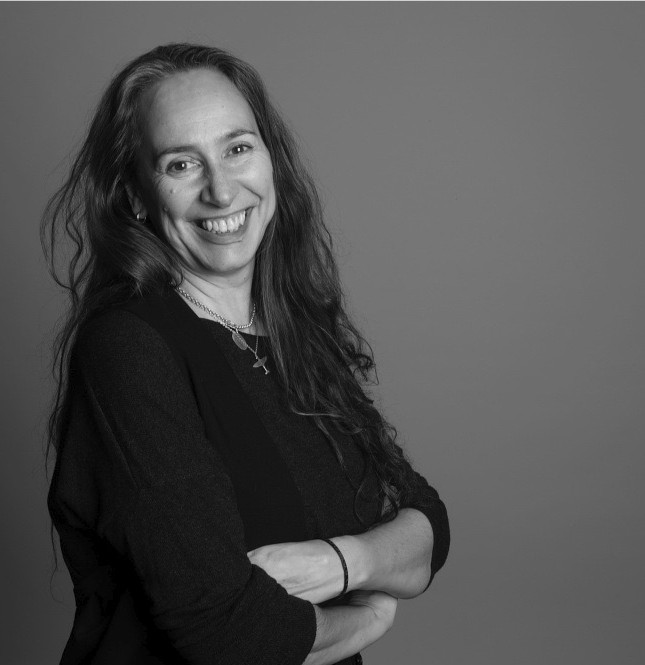
The Feminist Interview Project, organized by CAA’s Committee on Women in the Arts (CWA) examines the practices of feminism by interviewing a range of scholars and artists. The project aims to preserve the living histories of feminist art practices, while interrogating and expanding the boundaries of what might be considered feminist. Through its interviews, this project reimagines the possibilities of feminist practice and feminist futures by exploring a diversity of perspectives and approaches to research. This collection of interviews aspires to critically examine the relationships between feminism, feminist art, and the lived realities of women, nonbinary and female-identified artists and scholars across the globe. For our ongoing collaboration with Art Journal Open, we are excited to present Hilary Robinson in conversation with Jehan Mullin.
Each year, CWA awards one artist and one scholar the Distinguished Feminist Award. In 2024, Dr. Hilary Robison received the award for her invaluable contributions to feminist art history, theory, and criticism, and for her decades-long commitment to feminist education. The following October, CWA sat down with Hilary over Zoom to discuss her lifelong engagement with feminism. From feminist pedagogy to questions of historiography, from the politics of location to the importance of citation practices, Professor Robinson detailed the ways that feminism has shaped her practice over the past 40 years—and the way it continues to do so today.
—Jehan Mullin
. . . [F]eminism is a way of being in the world. It’s a set of politics. It’s how you live, it’s how you think, it’s how you analyze things. It’s not something that you just turn on for a particular purpose, and I hope that it also brings with it a set of ethics about how you behave with others.
Jehan Mullin: I’ll begin by asking you a question we ask all interviewees for the Feminist Interview Project. What does feminism mean to you?
Hilary Robinson: That is such a huge question. Where do I start? I think that some form of feminism was always with me. Both my parents came from working class backgrounds, and the women’s struggle was definitely part of that. So, I was kind of inculcated with it. My mother was a fierce and very engaged woman, and she raised me in a particular way. She was born in 1923 and came from a socialist working-class background. Most of her family all left school when they were fourteen years old. She was able to stay on because she was the youngest and everything opened up for her after the war. She became a teacher herself. My father also came from a working-class background. He left school at fourteen and became apprenticed as a book binder and eventually became internationally known as a fine binder. There is a reason why I’m going on this tangent. His mother’s father came from Barbados and was a sailor and landed in England and met my great grandmother-to-be who was a suffragette. So, it’s in my family going back generations.
For me, though, feminism is a way of being in the world. It’s a set of politics. It’s how you live, it’s how you think, it’s how you analyze things. It’s not something that you just turn on for a particular purpose, and I hope that it also brings with it a set of ethics about how you behave with others. To me it’s something very dynamic. It cannot be reduced to any single definition because it will vary depending on the local cultures and politics and practices that people find themselves in. And, yes, it’s to do with being a woman, but because it’s a set of politics, it’s not confined to women at all.
JM: Could you talk more about this understanding of feminism as a set of political practices and how it informs your work as a scholar?
HR: I’ve been thinking about this quite a lot recently, as I’ve been going back through some of my earlier writings, and what I see there is that feminism, of course, is antagonistic to disciplines, to academic disciplines, to cultural categorizations and the canon because such things were developed very much within a Eurocentric, colonialist, and patriarchal set of structures. Lisa Tickner said it best back in 1988 when she said that feminism is not a methodology.1 You can’t just apply it to something. I think this is why feminists and feminisms have often had problems within the academy and problems within canon-forming institutions because they want to deconstruct the structures of power that have produced certain cultural and pedagogical practices.
So, feminism informs my work at every level. For me as a scholar, feminism affects the way that I teach. It affects how I interact with other scholars. It affects my working relationships with others. And it affects the kinds of projects I want to do.
JM: What does this look like in your working practices? Can you provide an example?
HR: Yes, let me tell you a little anecdote. I got my first full-time teaching job in Belfast, Northern Ireland, in 1992, before the first ceasefire in 1994, before the peace process, and before the Good Friday Agreement, which happened a few years later in 1998. I knew that the Troubles were ongoing but, you know, I was quite naïve. After I got the job, I found a place to live, packed up a van and got over there two or three weeks later to find that the people next door had left and there was a bullet hole in the window. The first week I was there, I was awoken twice in the night by the sound of bombs going off in the center of town. That was a kind of “What have I landed into?” type of moment for me. But this also came into my teaching. In my classes, it was often the first time that students from both sides had met each other because primary and secondary schools were segregated—Protestant and Catholic—and there was no trust. If a bomb went off or if a killing happened, half the students just wouldn’t come to university for a week or so, sometimes longer.
It was also a means of trying to build trust in that situation, in what was a low-grade civil war—and it was important for me to try to build that trust. I drew upon my feminist experience as a means of working on that.
So, the second year I was there, I started teaching elective modules and I used consciousness-raising techniques in the seminar room. We all sat in a circle and tried to acknowledge the kinds of differences of experience that we all brought. For example, there was a group of slightly older women there, and some of them had children, and I didn’t have children, so immediately there was an understanding that they would have knowledge they’d bring with them that I didn’t have. It was that type of dynamic where we’d ask, “What constitutes knowledge in the classroom? What do you bring to bear on the subject under discussion?” It was also a means of trying to build trust in that situation, in what was a low-grade civil war—and it was important for me to try to build that trust. I drew upon my feminist experience as a means of working on that.
Maybe I should add another pedagogical practice that I’ve been working on since 2018 with my PhD students. We all meet as an informal group about once a month for an afternoon. One of the things that we often do when we meet is conduct a slow reading of a text. By slow reading, I mean that we select a text that we would like to study, we bring it to the classroom, somebody reads a paragraph out loud, we discuss it, and then we move on to the next paragraph, and we discuss that one too, and so on. While it’s a very close reading, it’s also a collective and collaborative bringing of understandings to a particular text, which is beneficial because what we’re reading could be extraordinarily difficult theoretically or some of it could be very difficult emotionally. It might also be a text that everybody knows so no one reads closely anymore. And I find it really great because, again, it sort of . . . not flattens it, but it produces a kind of égalité in the room because people bring different knowledge to different things, and it’s a lovely way to work with a group of PhD students. The people in the room have been all genders, have ranged from their twenties to their sixties, and, you know, there’s usually at least four different accents in the room at once. It’s really great to bring those sorts of differences into the very active and creative discussion of a text. I just wanted to throw that in as another pedagogical practice that I use.
JM: In hearing you speak about pedagogy, I’d like to ask you about the mentors and teachers who’ve shaped your practice. Who has influenced you most, and how has your practice developed over time?
HR: Yeah, well, when I was an undergraduate—1974 to 1979—I was an art student. I studied Fine Art. I’m not an art historian. I’ve never trained in art history. While I was very interested in what women artists were doing, and in feminist art and what that might be, in my practice at university that hardly showed. This was in Newcastle upon Tyne in the northeast of England, a strong political city from the left. While there was a lot of feminist stuff happening there, it just didn’t cross over into the art school, where all but one of my teachers were men. So, I wrote my undergraduate dissertation on Matisse as a draftsman, and then ran away to London. After a few months, I got myself a part-time job at the Whitechapel Art Gallery. That first year in London was transformative.
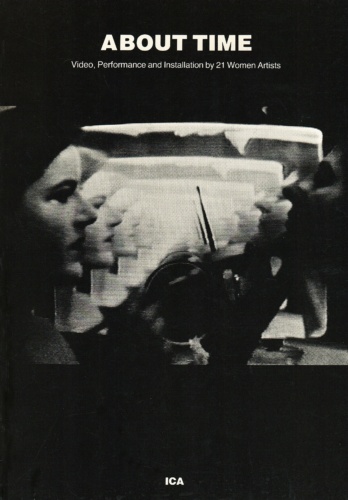
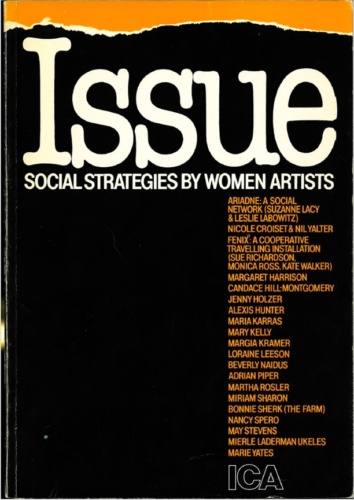
I remember there were a series of three exhibitions at the Institute of Contemporary Arts in London in 1980: Women’s Images of Men, which was exactly what it said and was mainly painting. There was another exhibition called About Time, which was performance and installation and video work, and then Issue: Social Strategies by Women Artists, which was explicitly political work, and that was curated by Lucy Lippard.2
And then there was a two- or three-day conference that I went to. I still remember very clearly one panel with Lisa Tickner. She was talking about hegemonic practices and so on. It was packed—standing room only. At one point a woman standing fairly close to me put her hand up and said, “Look, you’re using language that I don’t understand. What does this mean? What does this word hegemonic mean? Don’t assume that we’ve all had the same access to learning that you’ve had.”
I thought, “Oh, brave question.” Then Lisa sort of settled back in her chair, took a deep breath and then explained the term in a very lucid manner. It was a very gracious, generous exchange, and I thought, “This is what I should have had at university. This is somebody who knows how to teach. This is somebody who could stretch my thinking.”
I also remember Martha Rosler being there on a panel about, you know, “Is the personal political?” She read out a few sentences, which were very concise, very intense. The room was silent when she finished and then somebody said, “Can you read it again?” That was really important for me as well so when I produced my book Feminism-Art-Theory, I asked her if I could put that in it.3
So, you know, it was these sorts of moments—quite lively moments really—that were so transformative.
The following year, in 1981, Andrea Dworkin’s book on pornography came out.4 At that point, I was making big body-related artworks using huge sheets of paper. I had a studio down in Wapping, in East London, and I was literally using my body against these large pieces of paper to draw, using gesture in graphite and white paint. Then her book came out and it was quite breathtaking. I could immediately understand what she was getting at, you know, having been exposed to forms of pornography as a teenager and later as well. But I also thought, “What the hell does this mean for those of us who are trying to re-image bodies of women?” That was really important, and it was a point of tension. Maybe that’s why I remember the story about the woman who asked Lisa Tickner if she could explain these [academic] terms. It was a point of tension out of which something important came. And for me, what came out of that was the decision to go to the Royal College of Art to do an MA by thesis because I thought this really needs thinking about.
Oh, and I must mention Griselda Pollock, who has been the most influential teacher for me. I wrote an essay about her early work, which was published maybe three or four years ago, and I opened it by saying it took me two years to summon up the courage to ask her if she would supervise my PhD. She said yes. I was in awe of her. I am still in awe of her. She has done so much, and has produced so much. She is extraordinary. She’s driven, absolutely driven, and I’m full of admiration for her. I just wanted to say that.
JM: If you don’t mind, what was the answer you found to that question—the question you posed after coming across Dworkin’s book and asking what her work might mean for artists trying to re-image women’s bodies?
HR: Yeah, well, there wasn’t a straightforward answer. I looked at the work of different artists and different forms of representation of women at different points, mainly contemporary artists, and of course, it was all different. You couldn’t define feminist art by style or material or even subject matter. So, the answer, I think, would have to be, “It depends.” You know? It depends on where you are and what it is you’re trying to do. It depends on how you understand the relationship between the one who is looked at and the one who is creating the image to be looked at. This is Laura Mulvey’s phrase, “to-be-looked-at-ness,” that she developed in the mid-1970s when talking about film.5 Does that answer your question?
JM: Yes, thank you. Shifting a bit, I’d like to ask you what you see happening in art right now—feminist art specifically—that you find exciting. Likewise, what do you find exciting about feminist scholarship currently?
HR: There are a couple of things. One has to do with women of my generation and older—I’m sixty-eight—who were part of the women’s movement in some shape or form and who are still out there making work, really interesting work, work that’s still vital. What are their politics now? What are they producing and how are their politics reflected through what they’re doing? And I think that goes for both artists and those who are writing about art.
A second thing that I’m really interested in is how communication happens between countries, or not. So, for example, Griselda Pollock and Rozsika Parker’s Old Mistresses has been translated into other languages.6 Yet, we don’t get to see how that work is then interrogated in those languages because we aren’t bothered to do the translation back again. I’m also very excited by the fact that some of the Italian feminist writing from the 1960s and ’70s is finally being translated into English, particularly people like Carla Lonzi and Carla Accardi, who were involved with the art world, because they were part of a truly radical movement that is hardly known in Anglophone contexts.7
This is a sort of circular way of getting around to say that I’m always really excited to see work in and of different places, especially those bypassed by the mainstream art world. And, I’m interested in how feminisms, in the widest possible sense of the word, have developed through visual practices in different cultures where the visual references are distinct and different.
JM: Speaking of feminist art in and of different places, I’d like to ask you about the current oral history project that you’re working on, Feminist Art Making Histories. Could you tell us about the project and how it came about?
HR: Yeah, absolutely. The project is called Feminist Art Making Histories and it came about, in fact, just after my father died. The week after, I was in the kitchen with Mum, and I remembered that my father was interviewed by someone from the British Library back in the 1990s I think, maybe earlier because the interviewer had cassette tapes. They were collecting interviews with craftspeople and with artists.8
I said to Mum, “Do you remember that?” And I started thinking about artists who I should really go and talk to as well. I told her that there was an artist who I knew was ill, and that I needed to go and talk to her. That artist was Alexis Hunter and she died that week, just a few days after my father died. That was a bit of a kick really. Eventually I got in touch with a colleague and said, “Shall we do an oral history of feminist artists?”
My impulse for this project is that, if you don’t have these histories, then the historiography of tomorrow will be wrong. It will be missing something quite fundamental.
Then, sometime later, the Arts and Humanities Research Council advertised a grant with the Irish Research Council that was part of their UK-Ireland Collaboration in the Digital Humanities. We applied and got it, and our team trained with the Oral History Society on history from below methodology. In addition to me, our team includes Tina Kinsella at the Institute of Art, Design and Technology in Dublin; Amy Tobin at the University of Cambridge; Elspeth Mitchell at the University of Leeds; and two research associates, Ana Baeza Ruiz and Martina Mullany. Our goal is to conduct long-form interviews with about sixty artists, most of whom were active in the 1960s, ’70s, and ’80s, possibly into the ’90s as well. We’re most vulnerable to losing people and memories from that particular generation. A horrible number of them have already died.
My impulse for this project is that, if you don’t have these histories, then the historiography of tomorrow will be wrong. It will be missing something quite fundamental. As I mentioned, there is this problem we have where there’s a dominant narrative of what constitutes feminist art, how it traveled, where it started, etc. which is increasingly problematic, and it seems to be producing a practice of citation, a citation that always seems to go back to Linda Nochlin—you can’t knock Nochlin, and I’m not knocking Nochlin at all—but that essay wasn’t translated into Spanish, for example, until the early 2000s. Does that mean there’s no feminist art history or history of feminist art in Spanish-speaking countries? No, of course not! It means it was different. It was particular. It was informed by other things. So, you know, there are these issues, and if you don’t have those detailed, nuanced kinds of histories that are embedded in a particular place, then the histories that you produce in the future will fall back onto this narrative where Linda Nochlin was the starting point. Whereas, in fact, the story is much richer, much more diverse than that.
JM: I want to clarify something for our readers, because I didn’t hear you say this, but the artists you are interviewing for this project are feminist artists in the UK and Ireland. Is that right?
HR: Yes, yes, absolutely! In the UK, in Britain, hardly any artists from the island of Ireland are known. You know, there’s a little sliver of water between us but within the art world, we hardly know any of the artists, and that is even more compounded when you’re talking about feminisms.
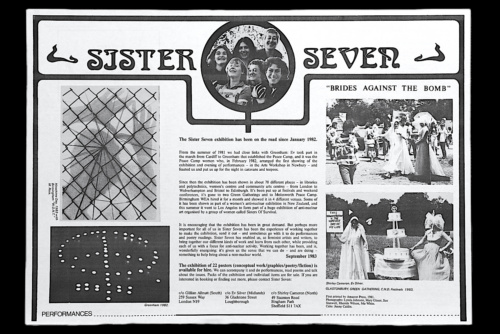
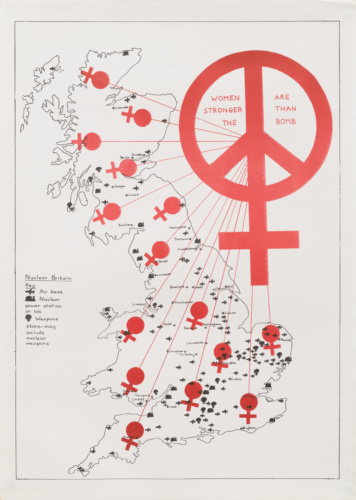
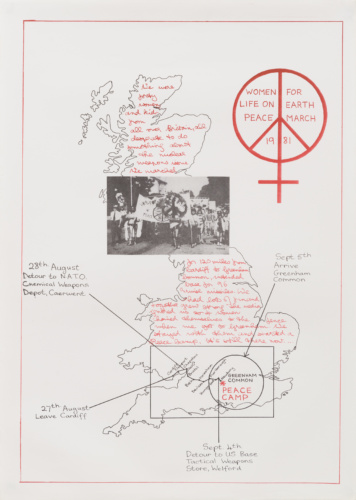
Coming back again to thinking about what it means to be a feminist in a particular place, well, it wasn’t until the 1990s, I think, that women in Ireland could get divorced and it was only in 2018 that they managed to get the repeal of the anti-abortion amendment.9 So, we’re talking about a very, very different political structure and different debates for what is happening with feminism. So, for our project, we really wanted to look at what happened in different places across the UK and in Ireland. For example, there’s a group called Sister Seven that was very prominent in the anti-nuclear movement in the 1980s. It was a group of feminist artists who were active in the Midlands of England.10 They didn’t live in London, you know, so they didn’t have that kind of exposure. The same is true for artists we talked to in Scotland and in Northern Ireland. Again, those contexts are quite particular and different. The work doesn’t always travel.
So, for Feminist Art Making Histories, we want to make sure the work is accessible. We’re going to put everything in a digital format—the audio recordings, transcripts, any visual matter that we have captured digitally, like photographs, letters, flyers, etc. Each of those objects is going to have a DOI, like an academic paper would, so that they will always be findable, and the Digital Repository of Ireland is going to look after these materials in perpetuity. Right now, we’re working on getting the transcriptions finished and finishing off the website so we can begin to get the work out there.
JM: For those who might not be familiar with history from below, could you say more about it? I think there are meaningful connections between it, in terms of methodology, and feminist research practices. It would be great if you would speak on the relationship between them, especially in your work.
HR: Yeah, well, I think they resonate enormously. The idea of a “history from below” is really about thinking about who tells stories—because the person and the voice who tells the story is the one who has authority and can set the tone of the narrative. Pioneers of the movement were people like E. P. Thompson, Raphael Samuel, and Eric Hobsbawm, from the New Left in the UK, working on social histories and class issues. So, if you’re able to just sit and listen to people who might have other stories, and if you allow them to take their time because . . . well, some people may not be used to speaking, or they may not have sat down and thought about the things you are asking for a long time. So, if you give them space and say, “I’m really interested. I think this is worth listening to and I will sit and listen,” then you can begin to find other aspects to narratives, and other histories.
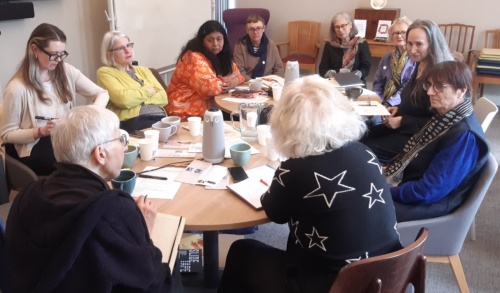
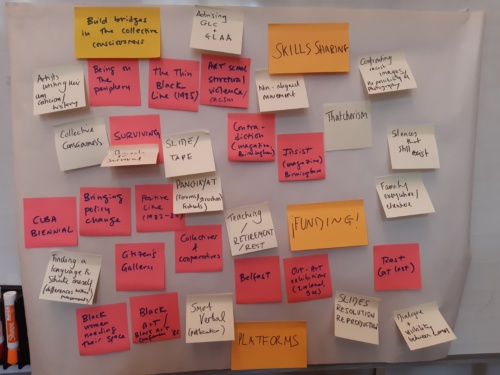
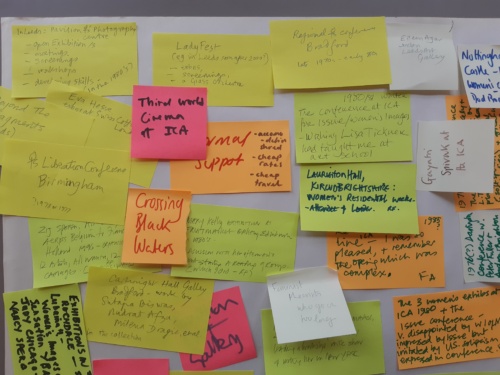
For Feminist Art Making Histories, our interviews are usually just with one person, but you can bring people together, which we’ve done a couple of times in our research to reflect more collectively on what happened and how it happened. How did these groups come together? How did they split up, and why? What were the key moments for feminist artists that really consolidated things, or were problematic? We’ve done things like that. We’ve brought people together and collectively asked questions, spreading papers and things out on tables, using Post-it notes and arrows and stickers and so on. It’s really great when you have ten women in the room and they’re all doing this kind of work together.
JM: Earlier I asked you what you find to be exciting about feminist art and scholarship currently and, in a similar vein, I want to ask you what you believe are some of the most pressing challenges for feminist artists and scholars today.
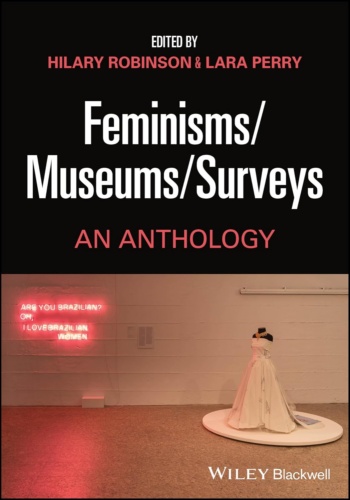
HR: Yeah, okay, well they are definitely related. It’s about exhibitions and publishing. I’m working on another anthology at the moment, which is going to come out in the spring, co-edited with Lara Perry called Feminisms/Museums/Surveys.11 The book is a collection of curators’ essays of exhibitions that 1) are informed by feminism and 2) held in major national or regional canon-forming institutions 3) are survey exhibitions and 4) have a focus on contemporary work, so art since the 1960s really.
You know, when we think of feminist art exhibitions, we think of WACK!: Art and the Feminist Revolution; we think of Global Feminisms, and maybe a few others.12 But Lara and I have found fifty-one such exhibitions since 2005 and they’re everywhere from Rio to Reykjavik, from Los Angeles to Latvia. There is one called Bread & Roses: Four Generations of Kazakh Women Artists, for example.13 I mean these are wonderful, wonderful projects! That’s what’s really exciting to me.
What is troubling to me, though, is that nearly all of these exhibitions and their catalogs have been bilingual. They’ve been in the local language, if it’s not English, and translated into English, with three exceptions—an Indonesian exhibit was one exception, an Icelandic one was another, and I think a Polish one as well. Most of them, though, are translated, so the idea is that they expect some kind of transmission, but that hasn’t happened. We hope very much that our work will help with that. We’re producing an index of the curators and an index of all the artists, and that is quite interesting as well because it helps you see, again, that there’s a kind of canonicity that is forming. You can see how information travels, mainly through Anglophone formats, which needs to be addressed.
Something else I’m finding problematic at the moment has to do with a particular kind of focus on women artists that I see in publishing. The problem I’m finding with some books is that it seems like they are saying, “Okay, we’ll add a few women artists in here and stir them up, and it’ll be fine.” So, they might add in Marina Abramovic, Frida Kahlo, Artemisia Gentileschi and say, “Aren’t these great exceptions? They had difficulties, but here they are. Isn’t their work wonderful?” While they might nod or quote certain art historians, it seems that fifty plus years of feminist thinking has really been smoothed out. There is work that people were trying to do on the structures of the institution, the structures of collecting, on how to shift the canon and so on. So, I think that having books that treat women or feminism, or artists of color, artists of diaspora, etc., as an add on is not really going to do it. I think something bigger is needed. You know? Maybe . . . maybe . . . maybe a bit of a revolution. I think this is why we need to go back to pedagogies and to issues around curriculum. I’m not an art historian, as I’ve said. I haven’t been trained in art history or art historical thinking, so maybe that gives me a kind of carte blanche to be a bit ruder about the discipline.
JM: Given all your contributions to feminist art history, if you’re not a feminist art historian then what are you? What do you consider yourself?
HR: Well, I am a feminist and I do write about art, and I tend to focus on art that is by other feminists, yes. What am I? I am not a certified art historian. I did my undergraduate studies in painting, my MA thesis in Cultural History, and my PhD in Art Theory with Griselda Pollock. So, I’m not a trained art historian. I’m undisciplined.
JM: To bring it around as we close, I began by asking what feminism meant to you and I think it would be nice at this point in our conversation to ask you what advice you would give to feminists today, especially those committed to art—whether they are making it, studying it, or writing about it.
HR: I would say a couple of things. I would say, be prepared to be learning all the time and often from unexpected sources.
Be prepared to find today’s institutions as ones that have enveloped what we in the UK would call EDI—equality, diversity and inclusion (I think you call it DEI in the US), which has developed on an assimilationist model. What I see institutions say is, “Yes, we need to have a diverse group,” but how much of that is actually achieved by simply opening the door to others without attending to the structure of the house inside? Do you have to assimilate and be like “dot, dot, dot,” fill in the blank, in order to fit in? How much has anti-racist, decolonial, and feminist thinking shifted things? How much has the opening up of higher education to people from disadvantaged backgrounds shifted power relations and assumptions around class and education and intelligence?
You know, I see people trying to assimilate all the time, and I think that often gives those of us who are politically engaged a very hard time. So, my advice is to find your cohort, find your people. They may be outside the institution, but try and find them because you’re going to need them. That sounds very down, doesn’t it?
JM: No, that was a fine ending, but you can add another one if you like.
HR: I was going to say, just keep going because it’s so bloody important. You know?
JM: That’s even better.
This interview has been edited for length and clarity.
Hilary Robinson, PhD, is Professor of Feminism, Art and Theory, and the Director of the Centre for Doctoral Training: Feminism, Sexual Politics, and Visual Culture at Loughborough University, UK. She has authored and edited numerous publications, including Reading Art, Reading Irigaray: The Politics of Art by Women (2006); Feminism-Art-Theory: An Anthology, 1968-2014 (2015); The Art of Feminism: Images that Shaped the Fight for Equality, 1857-2017 (2018) (with Amy Tobin and Lucy Gosling); A Companion to Feminist Art (2019) (ed. with Maria Elena Buszek), and Feminisms/Museums/Surveys: An Anthology (2025) (ed. with Lara Perry), among others. Dr. Robinson is also the UK Principal Investigator for the oral history and digital humanities project, Feminist Art Making Histories, and the 2024 recipient of CAA’s Distinguished Feminist Award.
Jehan Mullin, PhD, is an interdisciplinary scholar whose research explores global contemporary art; the relationship between artists, museums, and communities; feminist politics and activism; and Arab American and SWANA diasporas. She is particularly interested in Arab American feminist art and art-making practices—interests that are situated within a broader set of commitments to the study of global feminist art and to Arab American and contemporary Islamic art. Dr. Mullin has previously served on CAA’s Committee on Women in the Arts and currently serves on the Committee on Diversity Practices where she is working with colleagues to strengthen and expand support for CAA members working outside of academia.
- In her 1988 article, “Feminism, Art History, and Sexual Difference,” Lisa Tickner wrote, “We have a plurality of feminisms now, not all of them easily compatible, and the discipline of art history is a contested field, and not just by women. In a sense, therefore, there is no such thing as a ‘feminist art history.’ Feminism is a politics, not a methodology.” Genders 3 (1988): 92. ↩
- Women’s Images of Men, curated by Joyce Agee, Catherine Elwes, Jacqueline Morreau, and Pat Whiteread, Institute of Contemporary Arts, London, October 4–26, 1980; About Time: Video, Performance and Installation by 21 Women Artists, curated by Catherine Elwes, Rose Garrard and Sandy Nairne, Institute of Contemporary Arts, London, October 30–November 9, 1980; Issue: Social Strategies by Women Artists, curated by Lucy R. Lippard, Institute of Contemporary Arts, London, November 14–December 21, 1980. ↩
- Martha Rosler, “Well, is the Personal Political?,” statement presented at the conference, Questions on Women’s Art, Institute of Contemporary Arts, London, November 15–16, 1980. Reprinted in Hilary Robinson, ed., Feminism-Art-Theory: An Anthology 1968–2000 (Blackwell, 2001), 95–96 and Feminism-Art-Theory: An Anthology 1968–2014 (Wiley-Blackwell, 2015), 68–69. ↩
- Andrea Dworkin, Pornography: Men Possessing Women (Perigee Books, 1981). ↩
- Laura Mulvey, “Visual Pleasure and Narrative Cinema,” Screen 16, no. 3 (1975): 6–18. ↩
- Rozsika Parker and Griselda Pollock, Old Mistresses: Women, Art and Ideology (Routledge and Kegan Paul, 1981). ↩
- In 1970, three Italian feminists—art critic Carla Lonzi (1931–1982), abstract painter Carla Accardi (1924–2014), and journalist Elvira Banotti (1933–2014)—founded the feminist activist group, Rivolta Femminile (Feminine Revolt), in Rome. Later that year, the group established its own feminist press, Scritti di Rivolta Femminile, in Milan. In recent years, writings by both Lonzi and Accardi have been translated into English. Lonzi’s Self-Portrait (originally Autoritratto, 1969) was published in English for the first time in 2021 (trans. by Allison Grimaldi Donahue, Divided Publishing) while Accardi’s Superior and Inferior (originally Superiore e Inferiore, 1972) was published in English for the first time in 2025 (trans. by Bennett Bazalgette-Staples, Crackers Publishing). ↩
- Hilary Robinson’s father, Ivor Robinson MBE (1924–2014), was a British craftsman, fine bookbinder, author, and educator whose work is held in numerous public and private collections internationally. In 2004, he was interviewed by Hawksmoor Hughes for the Crafts’ Lives project. An initiative of National Life Stories, an oral history charitable trust based at the British Library, Crafts’ Lives has been documenting the life stories of Britain’s leading craftspeople since 1999. Robinson’s interviews with Hughes are available through the British Library’s Sound Archive. ↩
- In 1995, Irish voters approved the Fifteenth Amendment of the Constitution by referendum, removing the constitutional prohibition on divorce and paving the way for the Family Law (Divorce) Act of 1996. In a 2018 referendum, Irish voters overwhelmingly approved the Thirty-sixth Amendment, effectively repealing the Eighth Amendment banning abortion, and leading to the Health (Regulation of Termination of Pregnancy) Act of 2018. ↩
- Sister Seven was an anti-nuclear activist and feminist art collective founded in England in 1980 by artists Monica Ross (1950–2013), Shirley Cameron (b. 1944), Evelyn Silver (b. 1949), and poets Mary Michaels (b. 1946) and Gillian Allnutt (b. 1949). Active in the early 1980s, Sister Seven operated nationally, producing poster art and performances presented in libraries, colleges, church halls, art galleries, shopping malls, conferences, festivals, and peace camps, including the Women’s Peace Camp at Greenham Common in Berkshire, England, and the Molesworth Peace Camp in Cambridgeshire, England. The group’s widely traveled poster exhibition, first shown in 1982, has toured more than seventy venues worldwide and continues to be exhibited today. A selection of their work was included in Tate Britain’s Women in Revolt! Art, Activism and the Women’s Movement in the UK 1970–1990, curated by Linsey Young (November 8, 2023–April 7, 2024). ↩
- Hilary Robinson and Lara Perry, eds., Feminisms/Museums/Surveys: An Anthology (Wiley–Blackwell, 2025). ↩
- WACK!: Art and the Feminist Revolution, curated by Connie Butler, The Museum of Contemporary Art, Los Angeles, California, March 4–July 16, 2007; Global Feminisms, curated by Maura Reilly and Linda Nochlin, Brooklyn Museum, New York, March 23–July 1, 2007. ↩
- Bread & Roses: Four Generations of Kazakh Women Artists, curated by David Elliott, Almagul Menlibayeva, and Rachel Rits-Volloch, MOMENTUM, Berlin, September 25–October 20, 2018. ↩