Through the Looking-Glass, Darkly

By Tina Rivers

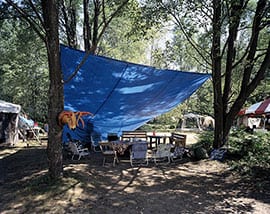
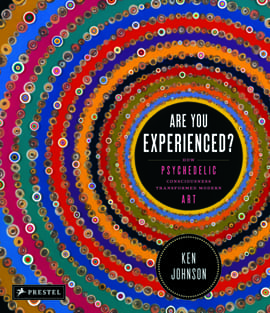
When H. H. Arnason published the first edition of his 1968 book The History of Modern Art, it ended with a one-page entry on “Psychedelic Art.” Positioning the inchoate movement as a bridge between the modern and contemporary periods, the entry was a blueprint for a future that would never come to pass, and was expunged from all further editions, helping to relegate psychedelia to the proverbial dustbin of history.


Where Do We Come From? What Are We? Where Are We Going?

By Sarah Betzer

Spurred by global economic contractions, by the attention of politicians, legislators, and pundits, and certainly also by the historical curiosity and critical orientation of its ranks, the academy at present is in the thrall of self-scrutiny. What is the past, present, and future of the research university, an invention of stunningly recent vintage and yet of remarkable structural resilience?

If It Need Be Termed Surrender: Trisha Donnelly’s Subjunctive Case

By Michael Jay McClure

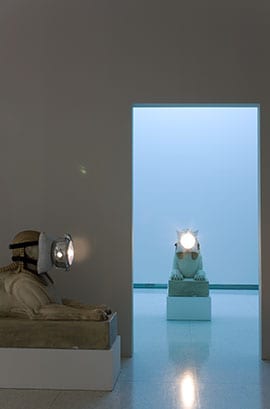
Allow for a problem within contemporary art, a problem concerning emptiness. After experiencing and writing on installations that, say, immersed me in cave systems, faux-hospitals, or forests, after navigating landscapes of fur or video labyrinths, I found myself, often, elsewhere. A group of contemporary installations seemed overwhelmingly spare, a few small objects, and I began to wonder what such a shift of spatial tenancy meant.