
With a focus on ecofeminism, this essay revisits two performative works that were sited in iconic landscapes in China during the 1990s: Ma Liuming’s Fen-Ma Liuming Walking the Great Wall (1998)—his figure in the mountain embodying the unity between humans and nature—and Chen Qiulin’s Farewell Poem (2002), documenting the dramatic changes along the Yangtze River that resulted from the new development of the hydroelectric plant located at the Three Gorges Dam (1994–2009). By the turn of the millennium, China had become the “world’s factory” due to rapid industrialization under Deng Xiaoping’s economic reforms.1 My study was inspired, however, by the way in which both artists engaged differently with the queer subject as a method to confront structures of power—whether in the form of environmental impacts of global capitalism or Confucian patriarchal hierarchies for gender and sexuality. These ecofeminist concerns connect to much larger stakes for today’s ecological issues, as well as for research methods to analyze contemporary art in the global context.
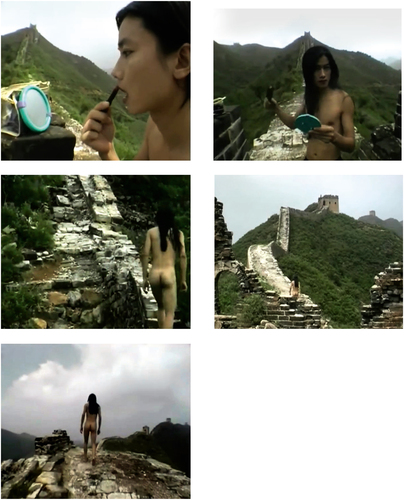
For his infamous late 1990s performance Fen-Ma Liuming Walking the Great Wall, Ma Liuming (b. 1969) sought to visually disrupt the vast landscape of the Great Wall (ca. 771 bce–1644 ad) by staging what he called his “sexually-ambiguous body” in the nude as he climbed a section of the wall’s mountainous terrain.2 The video recording of the performance introduces Ma applying lipstick in front of a mirror, his long hair and slender frame evoking a figure of conventional femininity, betrayed only by his male anatomy.3 Ma’s queering of the symbol of territorial power that is the Great Wall signifies an intervention into patriarchal structures—human-made artificial boundaries created for legislating gender and sexuality among peoples and societies since the seventh century bce, when the Wall was first built.4
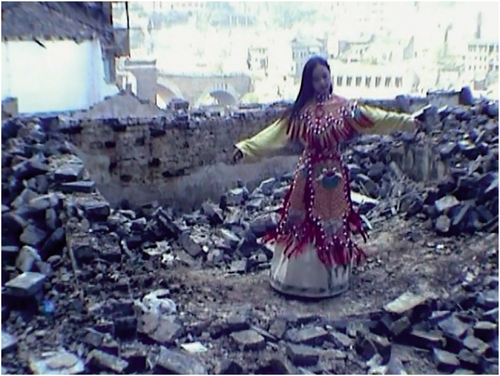
Chen Qiulin’s (b. 1975) video performance takes a different approach. The artist reinterprets traditions from Chinese opera by citing narratives and elements from Farewell My Concubine (1993); filmmaker Chen Kaige’s queer love story is a remembrance of the transgendered norm of opera whereby women’s roles were played by men for centuries. Chen inserted her opera actors—in full traditional dress—amidst the total demolition of her Sichuan hometown of Wanxian to dramatize the folklore of ritual suicide. Farewell Poem is a poignant requiem saying goodbye to a landscape that had sustained human, animal, and vegetative life for thousands of years.
In this essay I argue that a queer relation to ecofeminism engenders an identification that is affective not only for intervening into gender/sexuality binaries, but equally for disrupting the anthropogenic “human-nonhuman” binary. Even while environmental advocacy brings attention to at-risk species, ecologies, and nonhuman livelihoods, Anthropocene debates have exposed the long entrenched belief that humans are separate from nature.5 The artificially constructed divide between humans and nature was the basis for the so-called civilizing mission, the Western colonizer’s modernist vision asserting the inferiority of “primitive cultures” who are presumed to be living close to nature.6 This Euro-North American production of knowledge is a colonialist-capitalist conception that continues to be the rationale for today’s rampant global development of industrial modernization.
An ecofeminist contextualization of the subject reveals how the human-nonhuman binary is inextricable from the heteronormative systems that subjugate both women and nature. Theorists in China have recently confronted the Confucian patriarchal hierarchies that have long repressed women.7 At the same time, they have addressed the Western capitalist ideals for assenting industrial domination over the environment.8 This essay extends their discussion and examines the ecofeminist, eco-critical discourse in China, constituting a challenge to beliefs about nature, women, and the hegemony of Western knowledge that reproduces those modernist assumptions.
The paradigmatic shift to an inclusive art history would involve a radical change from the heteronormative commitment to exclusive Western traditions, philosophies, and methodologies for research in environmental humanities. Ma and Chen’s artistic contributions exhibit the complexities of such a shift in our globalized world; indeed, the syncretic use of the Western conceptual practice was the reason why they were so effective in expressing Chinese traditions and philosophies. At the same time, Chinese conceptions of the “human” differ from European metaphysics because they emanate from entirely different ontological systems connected to Daoism, Buddhism, ancient cosmologies, and a prevailing reverence for the cycles of nature. Eleventh-century Song dynasty painters often visualized human-nonhuman sensibilities based on these ontological systems. As such, this essay foregrounds a trans-traditional Chinese representation that takes into account China’s historical legacies but through shared artistic practices for conveying deep cultural meanings. Through performances of the human, located amidst mountains and streams, Ma and Chen’s integrative approach to medium, practice, tradition, and philosophy offers a trans–traditional innovation for a global aesthetics of environmental expression.
Patriarchal Systems of Power
A return to the 1990s moment of extraordinary environmental change in China activates this reviewing of two complex performance works involving the queer subject and mountain and stream landscapes. As described by Sheldon Lu, Ma “subverts thousands of years of Chinese tradition by walking the Great Wall. He challenges patriarchy, authority, symbols of Chinese tradition, and accepted notions of masculinity.”9 The patriarchal system, led by some version of socialist or imperialist administrators, including dynastic “landowners,” validated generations of authority over villages, territories, and nations. China’s cultural traditions are also inseparable from the Confucian moral order, notwithstanding attempts by Mao Zedong (1893–1976) to eradicate the “relic of feudalism” during the Cultural Revolution (1966–76).10 Li Yuhui explains that the Confucian male genealogy was a moral hierarchy, a filial law stipulating “three obediences” according to which “women must obey men, citizens must obey their ruler and the young must obey the elderly. For thousands of years, the rules of these three obediences helped maintain the patriarchal social order in China.”11 The special kinship system perpetuated a paternal birthright for male ancestors in this traditional structure of power. Ma and Chen’s artistic staging of the queer subject transgresses a male/female moral structure that still has great influence, given that the ongoing oppression of women and nature is strictly a political emanation for maintaining patriarchal power. Moreover, Ma and Chen’s example can resonate to acknowledge the power structures of all patriarchal systems around the world.
Not unlike the social conditions of many countries, women were regarded as “property” without equal rights in China until Mao established the People’s Republic in 1949. Societal change was finally legislated by the newly founded Communist Party through “Article 6” of the country’s provisional constitution: “The People’s Republic of China shall abolish the feudal system which holds women in bondage. Women shall enjoy equal rights with men in political, economic, cultural, educational and social life. Freedom of marriage for men and women shall be put into effect.”12 By 1966 the Communist crusade against Confucianism under the “Destroy the Four Olds Campaign” of the Cultural Revolution set out to eliminate the feudal dynastic system. In 1980 Deng’s “New Marriage Law” banned forced marriages, and today, the revision of the “Women’s Rights and Interests Protection Law” of 2022 indicates ongoing efforts toward legislating gender equality.13 Yet in different ways, China’s authoritarian system still maintains strict control over women, as decried in 2022 by Chinese feminist activists and proponents of the fledgling #MeToo movement who were regularly detained.14 Journalists Alexandra Stephenson and Zixu Wang have also reported that sexual harassment lawsuits in China are rare; they never succeed in going to court—and more often than not, women are fined for having made such accusations in the first place. In the larger scope, the Confucian system still runs deep in China’s political unconscious, not unlike the paternalistic Judeo-Christian system of the US Government (as demonstrated, for example, by the US Supreme Court’s 2022 reversal of Roe v. Wade). In the unambiguous realm of China’s male-dominated public sphere (including the country’s contemporary artworld), the significance of Chen Qiulin’s artistic subjectivity as a woman artist working in 2003 was indeed groundbreaking.
As a type of universal monument or heritage site known around the world, China’s Great Wall signifies generations of man-made constructions of political power. In the 1980s experimental artists such as Sheng Qi (b. 1965) sited their performances along the Great Wall to address Deng’s official 1984 campaign “Let us love our country and restore our Long Wall.”15 Under this artistic precedent, Ma presented the gender-nonconforming body in the context of national and gendered borders: indeed, Fen-Ma Liuming Walking the Great Wall can be read as a metaphorical queering of heteronormative power, the same patriarchal power that prevails over China’s industrialization and the fate of the environment (and thus the rest of the world’s).
The concept of trans-tradition, as such, is defined by Ma’s transgressive performance in the context of the Great Wall’s historical signifiers for tradition, nation, and landscape. Just as impactful, Chen’s trans-traditional critique was enacted through her renewal of historical elements of Chinese opera. Both artistic subjects represent the discursive activism of nonbinary expressions, and both raise the ecofeminist question: Is it possible to reimagine the heteronormative structures of power (inextricable from capitalism) to transform the detrimental “women-as-nature” judgment into a much needed “human-as-nature” empathy toward the environment?
Recognizing the difference between the terms “queer” and “trans” (and their respective discourses), “trans” resonates for this ecofeminist study, not only through the term trans–traditional, but because the word offers the potential to rethink the binary separation between humans and nature. In reconceptualizing “queer,” the word “trans” is used by theorists like Susan Stryker to develop a nonbinary methodology.16 The root definition of the term is the disarticulation of all that came before it regarding biological identifications and hierarchies based on “male” and “female” (or “man” and “woman”) references. As argued by Yolanda Martínez-San Miguel and Sarah Tobias, “the real alliance between Queer and Trans Studies is their common questioning of normativity.”17 This shared challenge to normativity, uniting feminist and queer studies, comprises the nexus for ecofeminism.
Trans-traditional Opera: Queer History and Patriarchal Structures
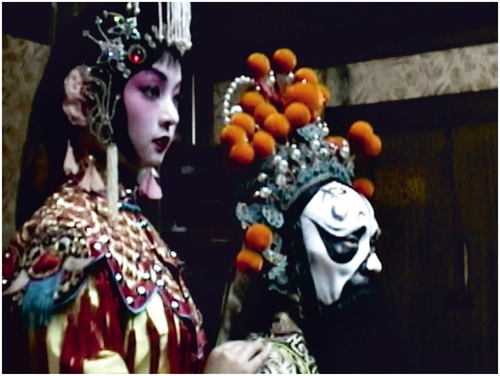
Chen Qiulin’s Farewell Poem shares reciprocally with Ma’s expressive challenge to gender-normative traditions. The artist combines film with conceptual performances of the body to engage phenomenologically with the fatal scene: the demise of the Wanxian landscape. Her nine-minute video records the extraordinary process of buildings being destroyed amidst an expanse of grey rubble and the glimmering backdrop of the Yangtze River. This region was situated along the fateful path of the creation of one of the world’s largest hydroelectric power plants. Chen weaves through the frame in her opera poses, all the while the demolition goes on around her. Mirroring Ma’s action in the video, capturing the opening sequence of Walking the Great Wall, Chen’s camera closes in on the artist putting on stage makeup alongside a male actor engaging in the same action. Chen’s inspiration from the film Farewell My Concubine was through its influential narrative, recounting the downfall of an opera troupe over the course of China’s turbulent twentieth century. My correspondence with the artist led me to focus specifically on Farewell My Concubine’s allegorical subjects of suicide and unrequited queer love.18
Chen’s Farewell Poem offers an embodied form of protest, proposing a different way forward from accepting the results of Communist and capitalist priorities. The video captures in real time the self-inflicted “death” of history, community, and landscape—the outcome of unimpeded industrialization. Chen suggests her documentation was a race against time, as entire towns and villages were demolished and disappeared due to the state project; eight county seats, including the 2000-year-old Chongqing city of Kaixian, were wholly submerged by the subsequent flooding.19 A brand new Kaixian city was built fifteen minutes away from the original site.20
Using the ruins of the destroyed city as the theatrical stage, Chen’s opera actors inhabit the landscape with the spirits of King Xiang Yu and his cherished consort, Yu Ji, the mythical lore having been based on the history of a real warlord-king of the short-lived Western Chu state (206–202 bce). The Hegemon King Says Farewell to the Concubine was first staged as a memorable part of the sixteenth-century opera The Thousand Pieces of Gold.21 Drama scholar Siu Leung Li explains the context: “Throughout the history of Chinese opera, this play has been a standard work in the repertoire of Kunqu, the theatre that dominated the Ming-Qing stage.”22 The famous scene depicts the legend of concubine Yu Ji’s suicide by the king’s own sword, which is followed by the king’s suicide in the defeat of battle for the country.23 The repetition of the story throughout time functioned to illustrate a gendered Confucian morality: The self-sacrifice of a female by suicide demonstrates loyalty to the patriarch, whereas male suicide shows leadership and self-respect, the only honorable solution for the shame of defeat in war, representing the shame and defeat of the empire.
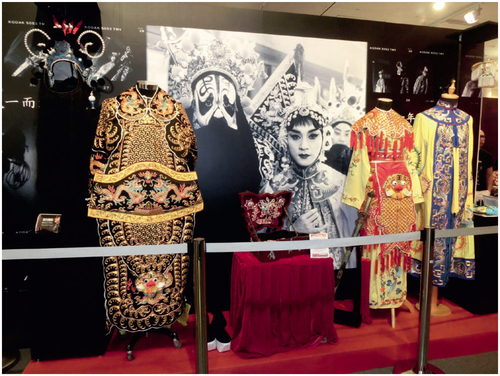
Chen Kaige’s Farewell My Concubine is based on the same story, chronicling China’s modern history to great effect by spotlighting normative gendered relations during the dramatic period. Traditional Chinese opera was a male-dominated institution, and according to Carol Martin, women were prohibited from representing their own gendered roles until the xin nuxing (new woman) movement pushed for change in the 1930s.24 Impoverished families sent their young boys to be groomed for female roles. In the film’s epic narrative, the boy Chen Dieyi—called Douzi as a child—was raised by the opera to play the concubine. The film recounts the brutal process for the construction of female gender: To play the female role, the boy endures physical restraints that are applied to his legs daily so he can do acrobatics on stage. Douzi’s only protector is his childhood friend, Shitou—called Xiaolou in adulthood. Douzi’s love toward Shitou continues from boyhood to adulthood. But Xiaolou does not return Dieyi’s romantic affections; instead, he falls in love with a woman, the prostitute Juxian (she represents the lowest social class alongside homosexuals). The real tragedy of Douzi’s childhood, a boy brutalized to submit to a female gender role (he keeps botching his spoken script, “I am by nature a girl not a boy”), illustrates the severe construction of gender by the opera system—which is also a commentary on opera’s exclusion of women actors who remain devalued in Chinese society.
Chen Kaige’s Farewell movie, in its entirety, allegorizes the concept of Confucian loyalty by correlating the queer love story with the political upheavals of the early twentieth century that followed the 1911 collapse of the Qing dynasty: notably, the civil war between Nationalists and Communists (ca. 1927–49), alongside the simultaneous war with Japan (1937–45). Near the conclusion of Farewell’s historical narrative, Shitou is detained by Japanese soldiers, and to obtain his release, Dieyi sings for the enemy, which is considered a shameful, treasonous act and a performance of absolute disloyalty to the Chinese nation. In this way, the Confucianism of the Hegemon and the Concubine suicide lore is altogether “queered,” as the signifiers for both patriarch and woman no longer fulfill the hierarchical roles ascribed to gender; therefore, these roles can no longer fulfil the Confucian role for the nation. The self-sacrifice of the male dressed as female is really a queer loyalty to the patriarch, a very public trans-traditional form of protest. Chen Kaige’s queer subject is thus both a transgendering tradition of China’s performance practice and a transgression of the patriarchal moral tale. According to Li, opera often functioned as a form of protest as commoners confronted the harsh dictates of the ruling class as “a cultural practice highly dangerous to the powered hierarchy and a possible transforming agency in society for the disempowered.”25 The contemporary versions of Farewell My Concubine are performative extensions of Chinese opera’s longstanding protest function, a trans-traditional continuation of on-the-ground resistance by the commoner class of society.
Consequently, Farewell Poem invokes a well-known artform custom: highlighting Wanxian’s long history through Chinese opera’s long history. A theatrical practice that spoke cathartically to both countryfolk and city elites, opera was an effective method for conceptualizing identity-as-nation. Chen Kaige had adapted his Farewell from Lilian Lee’s 1985 novel, but Li contends that it was the 1993 movie that brought the story into the global consciousness.26 “Today the most representative dramatic figure from Chinese opera to a world audience (both Chinese and foreign) is undoubtedly the concubine in the farewell scene of this Beijing opera. For better or for worse, Chen Kaige’s Farewell My Concubine has put the concubine figure as well as (a stereotyped) Chinese opera in the international limelight.”27 And yet the danger of opera’s function in cultural criticism continued into the twenty-first century. After its first release in Shanghai in July 1993, the film was abruptly pulled by government officials, only to be subsequently allowed back into theaters because of the international outcry with the 2000 Olympics set to debut in Beijing. The New York Times reported that “the official, who took part in reviewing the film, explained that some scenes about the Cultural Revolution and those dealing with homosexuality were cut, and some words at the end of the film were re-edited or changed to soften the blow of the suicide.”28 The Chinese censors’ prohibition of queer is a point of irony, since the movie recounts opera’s history in which males acted the roles of females—most prominently since the Yuan dynasty (1271–1368).29
The movie ends in the period of China’s Cultural Revolution, acknowledging the death of the artform when Chinese opera was denounced and purged by Mao Zedong’s wife, Jiang Qing (1915–1991), who replaced it with Revolutionary Opera (yangbanxi). The new opera form showcased women protagonists such as the eponymous character in The White-Haired Girl (1951), a patriotic Communist story about one girl’s resistance against a brutal landowner.30 Theorist Jing Liu reminds us that these works did not actually advocate for women’s rights, as she points out that the Mao’s neo-Confucian wife Jiang Qing “told women to return home and taught ‘Only Confucianism Can Settle Modern Women.’”31 Farewell My Concubine was a remembrance of the militant reality of the Cultural Revolution. The disloyalties of the state were not between proletariats and feudal lords, but between the Chinese people themselves, as university students were pitted against their teachers—and neighbors against neighbors.
While film and literary theorists have drawn different conclusions about the queering aspect of Chen Kaige’s film, Chen Qiulin’s invoking of the opera in her performance video represents the concept of disloyalty to the very place of culture, history, and tradition. Amidst industrial change, Wanxian became another kind of allegory for familial kinship and Confucian sacrifice of the landscape, and the river, with nature. Here, the Confucian patriarchal legacy comes into conflict with the “great virtue of heaven and earth” recorded in the Yijing (Book of Changes).32 According to Liu, while other feminists such as Li-Hsiang and Lisa Rosenlee “try to combine Confucianism with care ethics and feminism,” she opposes this effort because “Confucianism still holds patriarchal power’s sway in contemporary China.”33 I tend to agree with Liu’s indictment of patriarchal power, but the conflict with nature may not be reconcilable. The trans-traditional view of Confucian familial kinship must include an ethical loyalty to nature, the landscape, the river, the place.
The Anthropocene as a Western Colonialist Binary: The Ecofeminist Discourse on Woman and Nature
To gain specific insight into these questions, I look to the ecofeminist and ecocritical discourses in China. Theorists such as Marie-Paule Ha, Ning Wang, Wei Qingqi, Wong Hongqi, and Zeng Fanren provide varied and disparate perspectives. Their analyses of culture (generally ascribed to humans) as distinguished from nature (ascribed to nonhumans) also reprises the identification of women as nature in the essentialist debate. Wang Hongqi’s influential ecofeminist text, “The Female Image of the 90s,” asserts that any advocacy for equality in a social system among “men and women is also an ecological one.”34 And while Ning Wang clarifies the extent of the Confucian legacy on the “inferior” status of women—“China has long been a patriarchal country with women always remaining in a marginal position”—their diminished status was manifested by the Confucian filial structure that was juridically, legally imposed by the Neo-Confucian state.35 The logic of this marginalization is still determined by a binaristic male/female relation of power, and thus transferred, metonymized to the human/nonhuman realm in respect of the marginalized status of nature and natural resources.
The persistence of the axiom that “culture always dominates nature” becomes important to emphasize because today’s transnational societies living global-capitalist lifestyles can no longer recognize the human-as-nature identity. Theorist Wei Qingqi clarifies the binaristic human/nonhuman identity: “The dualistic opposition between man and the nonhuman world, in which, moreover, one pole overwhelms the other, is not unfamiliar to the critiques of class oppression, sexism, and racism, with the oppressors—Homo sapiens, capitalists, the male, and the West being reduced to the dominant parts in terms of logocentrism.”36 In this context, Wei argues that research in Chinese ecofeminism “ought to take its own justification not from investigating how close women are to nature, but from how close the way women are dominated,” describing a subjugation by gender that parallels the domination of nature.37 A non-gender–conforming position would foreground the question over who wages power over nature, which Wei argues originates with the oppressor, whether it be class, sexism, racism, or specifically, Homo sapiens, capitalists, the male, or the West.
Similarly, Ning Wang asserts that the term “ecocriticism,” introduced to China “from the West,” does not represent longstanding Chinese ideals for nature and ecology.38 Rather, these ideals are connected historically and ontologically to Daoism and Buddhism. Wang’s problematizing of discourse pertains to the Anthropocene’s concept of the “human” in environmental humanities. Scientists Paul Crutzen and Eugene Stoermer developed the Anthropocene’s geological dating based on the “rapid expansion of mankind in numbers and per capita exploitation of Earth’s resources,” the result of eighteenth to nineteenth-century industrialization.39 While their theory incriminates all humans in global warming and climate change, Wei’s argument places emphasis on the power differential whereby “industrial humanity” was reproduced by the West—industrialization as a dominant social model eventually overwhelms everyone and everything on the planet.
Assessing a different rationale from the Anthropocene, Donna Haraway and Jason Moore argue in their Capitalocene thesis that environmental crisis did not begin with eighteenth to nineteenth-century industrialization but with fifteenth-century colonization, whereupon European “explorers” ravaged the entire world, stealing the Earth’s natural resources and enslaving people for labor. Their formal justification was eventually published in Adam Smith’s The Wealth of Nations (1776), his ideology for civil society based on Christian “progress” and capitalist materialism.40 sanctified the injustice of the project.” Smith is credited for devising liberal capitalism and ideal solutions for “poor” countries.] Here, colonialism’s impact pertains not only to the history of the environmental crisis but notably to humanity’s separation from nature. Wang argues that ecocriticism in China follows an entirely different philosophical trajectory from that of Christian Europeans, such that “the so-called unity of man and nature (tian ren he yi) represents Chinese philosophers’ ecological wisdom. But for a long period of time, especially after the nineteenth century, these traditional ethic and philosophical resources were marginalized with the coming of Western modernity.”41 The disuniting of humans from nature was an outcome of the capitalist/colonialist ideology for modernity and progress.
The human in the landscape refers to the Anthropocene debates as much as it references China’s aesthetic history and philosophy. Chen and Ma’s embodiments of the nonbinary subject are particularly salient in light of this ontology of the “human.” I have written elsewhere about Donna Haraway’s approach to “the figuration of the Anthropos as reflexive of a fossil-fuel-burning ethos that does not represent the whole of industrial humanity in the circuit of global capital.”42 There are economic differences among the industrial populace as a whole: Does it matter that humans living below the poverty line consume much less than the growing jet-setting billionaire class of materialist humans? And how does the term “industrial humanity” represent those who live in the outer rural regions of China’s borderlands, those who still thrive in agrarian communities, people who have never participated in the petro-capitalist lifestyle?
The Capitalocene logic reconsiders the improbable return to premodern ideals for integrating all humans back to a pre-industrial affinity with the natural world, recognizing a different kind of knowledge production and shared consciousness with non-industrialized cultures. But then, the question for ecofeminism is still being asked: Would it be a good thing to associate women to nature? The answer is that essentialism itself is a Western colonialist criticism, playing a part in the Capitalocene’s excoriation of the binary logic for nature and culture, uncivilized and the civilized, and especially, female and male. Essentialism as defined for the project of modernity functions ultimately to retain capitalist normativity.
Marie-Paule Ha and many others in China working on ecocriticism denounce the neocolonialism of the Anthropocene debates but also recognize and understand the current global scholarship for research and advocacy.[Ibid.] Ha argues that because of the “hegemonic status of Western knowledge, it would be very unlikely that researchers could operate outside of the Western conceptual matrix, but the need to do so does not mean that we could not resist the universalizing impulse of Western theories.”43 What’s at stake in this reproduction of civilizing knowledge is the materialism and consumption that has caused great detriment to the environmental welfare of the planet. The new ideals developed for capitalist “progress” in a “civil society” constituted the systematic alibi for accelerating the depletion of the earth’s resources, which has become a suicidal program for the whole of life on the planet.
Human-as-Nature | Nature-as-Human
Man models himself on earth, earth on heaven, heaven on the way, and the way on that which is naturally so.44
The four most famous sacred mountains in Buddhism: Wutai, Emei, Jiuhua, and Putuo; and those in Taoism, Wudang, Longhu, Qiyun, and Qingcheng.45
The Western concept for modern progress changed the human relationship with the planet, affecting the culture of China through global capitalism. Wei Qingqi’s contextualization makes perfect sense: The power relations in which “one pole overwhelms the other” are easily recognizable. The West and capitalism’s all-encompassing reach led to the industrialization of the entire world. Wang explains that the potential for eco-critical transformation would necessarily entail aesthetic ideals endemic to Chinese culture: “China also has rich ecological resources, which date back to Laozi and Zhuangzi’s Daoist philosophy.”46 Among these resources are the revered eleventh-century Song dynasty mountain and stream landscape genre, that is, shanshui hua, produced by painters like Guo Xi (Kuo Hsi), known for both his creative expression and his written aesthetic philosophy. Ma’s and Chen’s figures in the mountain and the stream also invoke the memory and legacy for performing shanshui painting. As contemporary conceptual artists they bring new insight into the culture-nature relationship integral to the processes of Daoist cosmological principles. The Daoist conception of the human-nonhuman realm of nature constitutes a longstanding distinction that was different from the patriarchal boundaries for the masculine and the feminine, as vividly exposed by Ma’s Walking the Great Wall.
Viewable today through the posterity of the film document, Ma’s performance is reintroduced to new audiences through video.47
In contrast to sacred mountains, the Great Wall is a manmade monument. Ma’s explanation for his performance Walking the Great Wall was to envision “an environment of the future” because “sexual ambiguity is an issue that transcends space and time.”48 Body art’s medium enables the visualization of Ma’s idea that sexual ambiguity is a “natural” human identity, as opposed to the man-made judgments against “unnatural” sexuality since the beginning of time. But how are we to understand this paradox in which Ma sees the wall as the “environment of the future”—as an infinite structure—when the wall represents the long imperial and patriarchal history of China, especially after China’s environment became more and more at risk in the decades after Ma’s 1998 embodied expression? Significant to Ma’s performance is his staging of the actual human body, described by Sheldon Lu as the “lone, small, slender, naked body,” which the artist presented in the remote landscape.49 Through this representation of his unveiled, naked, and bare body, Ma proposes that the physical human is just another entity of nature, a natural object that is no different from surrounding plants and animals.
Zeng Fanren’s study of “ecological aesthetics” describes the cosmological harmony between humans and nature in his contextualization of their longstanding relationship: “In ancient Chinese philosophy of culture, there was no ‘environment’ external to human beings,” as the Confucian, Daoist, and Buddhist philosophies are cohesive in their systems of belief in the “‘harmony between man and nature’ and ‘harmony between Heaven and Earth’ [that] all refer to the more complex relationship between human beings and nature in the ‘ecosystem,’ whether it is Confucianism’s ‘neutralization’ of ‘People and things,’ Daoism’s ‘Daoist nature’ and ‘Everything in One,’ or Buddhism’s ‘beings equality.’”50 This kind of ecological cultural philosophy is markedly different from the ontology of modern European Enlightenment principles, defined by rational control over nature.51 When the artist walks the Great Wall in the wilderness outside of the social milieu, without other humans to compare to, the heteronormative concept of the “unnatural” sexual body is clearly an artificial idea. Contrary to this accepted sociality, Ma’s somatic expression correlates with Zeng’s ecological aesthetics, emphasizing the harmonious relationship between Confucianism’s “people and things,” Daoism’s “everything in one,” and Buddhism’s “beings equality.” While “dao” means “the way or path,” the term literally signifies harmony with the universe.
The Daoist conception of the kinship of humans and nature and all living things can be understood as embodying a kind of cosmological knowledge that is intrinsic to many cultures but was denigrated by the heralding of the “modern” and the “civilized” of Western industrialization. To advocate for care and kinship with the planet, Moore and Haraway’s Capitalocene argument discloses the continuing prejudices against the world’s non-industrial, agrarian cultures, a judgment that perpetuates the divide between human and nonhuman life. In this way Haraway’s research in support of “multispecies flourishing on earth, including human and other-than-human beings in kinship,” shares close affinity with the moral disposition of China’s Daoist philosophy.52
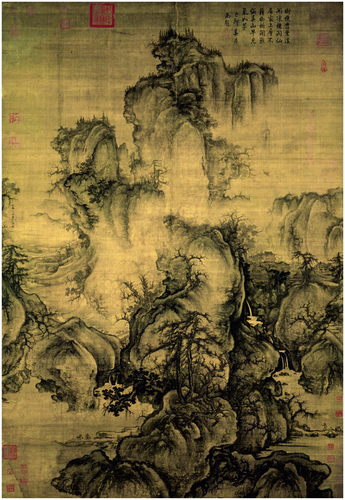
The great shanshui landscape painting tradition of the Song dynasty (960–1279) made famous by eleventh-century painters like Fan Kuan (ca. 950–ca. 1031) and Guo Xi (ca. 1000–ca. 1090) expressed the greater goal of the painters’ Daoist and Buddhist practices. The monumental mountain is sacred, and the divine law of nature dominates humans in an amorphous cycle that follows the seasonal processes of the landscape. Guo Xi wrote about “the ultimate meaning behind the honor which the world accords to landscape painting,” stating, “If this aim is not principal and the landscape is approached with a trivial attitude, it is no different from desecrating a divine vista and polluting the clear wind.”53 Even the viewing of shanshui painting is held to the highest standard for paying respect to the landscape and to nature overall. Guo Xi went further in his explanation of the associations between humans and nature, articulating a relationship that he tried to emulate through painting: “A mountain has water as blood, foliage as hair, haze and clouds as its spirit and character. Thus, a mountain gains life through water, its external beauty through vegetation and its elegant charm through haze and clouds…The arteries of the high mountain run low…Rocks are nature’s bones and, with bones value is placed on being strong and well covered, not poking through the surface. Water is nature’s blood and, with blood, value is placed on its circulating and not congealing.”54 Guo Xi’s vivid description of the body of the mountain shares the same physiological elements of the body of humans: both are portrayed as living organisms. Even today, when looking at a reproduction of Guo Xi’s opus Early Spring (1072), the semi-monochromatic ink painting depicting rocks as nature’s bones, water as blood—circulating not congealing—appears exactly like his description of the human characteristics of the landscape. Compatible with this eleventh-century conceptualization, art historian Ping Foong suggests, from his twenty-first century vantage point, that “the massive central mountain formation in Early Spring almost moves like a living organism, as if along a random path, the underlying composition is lucidly planned.”55 Instead of the human-as-nature concept, however, Guo Xi foregrounds a nature-as-human sensibility, articulating a reversal of the conventional engagement. No longer the dominant conception of the human-first mindset, this reversal changes the dynamics of power. The Confucian ideal for humility is clear: When humans are confronted with monumental nature and the lifeforce of the mountain, the correct response is submissive respect and self-effacement.
Guo Xi’s representation of the body of nature reflects the way in which artists strove to depict the Daoist emphasis on spiritual harmony between living things, a key element of the painting aesthetic in the shanshuihua tradition. As defined by Qi Li, “Yijing emerges in the interstices between human beings and the natural world on myriad levels: spirit, mind, body, senses.”56 Ma renews the yijing insight through the contemporary practice of performance, serving as an innovation of the aesthetic through staging the actual human body; however, the artist’s placement of his figure in the landscape is the focal point, the human-as-nature rather than Guo Xi’s emphasis on nature-as-human. Ma’s staging of the artist’s body is a reminder that although humans have succeeded in dominating nature, they are still an entity of nature in the post-colonial, post-Mao, even hyper-industrial circumstances of contemporary urban China.
In summary, Ma’s Fen-Ma Liuming Walking the Great Wall and Chen’s Farewell Poem were both presented during a critical moment of change in China. While the performance medium—live art, body art—was always meant to mark the temporal moment through foregrounding the live human body in a specific time-based context, these performances also engaged the living landscape in meaningful ways. Body art provides a way to personify China’s grand artistic traditions: concepts of shanshui mountains and streams, alongside the folklore of Chinese opera. Most of China’s grand rituals and aesthetic expressions were created to serve the emperor and the dynastic court, but as I have noted, Siu Leung Li’s study reveals that opera often functioned to disrupt feudal inequities and to protest on behalf of the lower classes: “The significance of the characteristic of performing…goes even further in problematizing relations of power. It is this unstable process that makes the theatre a cultural practice highly dangerous to the powered hierarchy and a possible transforming agency in society for the disempowered.”57 The dangerous role of performance in both Chen and Ma’s conceptualism at the end of the twentieth century cannot be denied, both artworks having been performed during a time when contemporary art often served as a veiled form of activism.58
Farewell Poem uniquely records the existential moment of China’s cultural demolition and cultural displacement. Citing Chen Kaige’s movie, Chen documents the tragedy by remembering the death of opera during the Cultural Revolution to grieve the loss of her hometown of Wanxian. According to the priorities of China’s new industrial economy, the idea that nature is expendable was obviated by the “taming” of the Yangtze in the process of building the Three Gorges Dam. And while the performance Walking the Great Wall manifested the long-held tradition of reflecting nature in Chinese art, Ma’s queer figure in the landscape was a reminder that the shanshui expression was part of the patriarchal order reconciling Confucian, Daoist, and Buddhist thought. But Ma’s trans-traditional performance intervenes in the specific heteronormative judgments of Confucianism; at the same time it renews the quest for Daoist “human-as-nature” harmony. Through nonbinary trans thinking, both artists reveal the disparities and disjunctions inherent in Chinese philosophical thought—Confucian patriarchal rules coexist with Daoist/Buddhist ideals—in a balancing act between amorphous conceptions of the feminine and the masculine for human and nonhuman life. Trans reflects the fluidity of human-nonhuman coexistence, relinquishing the binaries associated with identifications of human, gender, and sexuality.
By performing artistic identities, Chen and Ma express for Chinese ideals of ecofeminism, and their mutual artistic practice in environmental advocacy is their conceptual embodiment with mountain and stream landscapes. This is not to visualize a new form of identity, but to renew a preindustrial cosmological relationship with nature endemic to most cultures. Returning to earlier conceptions of human and nature kinships, the trans-traditional concept aligns with the advocacy for anti-colonial knowledge. Trans in this context refers to a nonconformist destabilizing of entrenched modernist ideologies, those that have supplanted and covered over entangled histories of China’s philosophical and cosmological ideals. Ultimately, these ideals are the moral principles that preceded colonialist-capitalist industrialization.
Perhaps the most significant contribution of Chen’s Farewell Poem and Ma’s Fen-Ma Liuming Walking the Great Wall was the way in which both performances visualized this human-nonhuman connection. By staging their bodies in the landscapes of the Great Wall and Wanxian’s demolition, both artists illustrated the artificiality of the binary opposition between humans and nature. Their queered viewpoint has the potential to bring decoloniality into the concept of the human, now shaped by the Anthropocene’s “geology of mankind.”59 But, ultimately, the artists intervened into the hegemony of Western knowledge while also adopting Western contemporary art practices to develop an innovative, trans-traditional model for ecofeminism, queer, and ecological aesthetics. The artists have demonstrated the way in which shared global methodologies for addressing environmental problems do not necessarily emanate from modern systems of science, technology, or industrial capitalism.
My thanks to Chen Qiulin, Xiaoyang Lei, Zhao Liang, and Ma Liuming, in addition to the Institute of Advanced Studies, Loughborough University, for support in the development of this essay.
Jane Chin Davidson researches performance and contemporary art, often focusing on diasporic Chinese identities in relation to ecofeminism, environmentalism, activism, and global exhibitions. Recent books include A Companion to Contemporary Art in a Global Framework, co-edited with Amelia Jones (Wiley, 2024), and Staging Art and Chineseness: The Politics of Trans/Nationalism and Global Expositions (Manchester University Press, 2022). She is a professor of Art History/Global Cultures at California State University, San Bernardino [CSUSB, 5500 University Parkway, San Bernardino, CA 92407, [email protected]]
- “China is the world’s factory, more than ever,” The Economist, September 8, 2021. ↩
- Qian Zhijian, “Performing Bodies: Zhang Huan, Ma Liuming, and Performance Art in China,” Art Journal 58, no. 2 (Summer 1999): 75. Throughout this article, I use the title of Ma’s work as cited in Qian’s essay: Fen-Ma Liuming Walking the Great Wall. The shorter title, Fen-Ma Liuming Walks the Great Wall, is often given for this work. ↩
- Ma Liuming, Fen-Ma Liuming Walks the Great Wall, Beijing, 14 July 1998, filmed by Zhao Liang, accessed January 8, 2026. ↩
- On the complexities of the Great Wall’s construction, see Britannica Editors, “Great Wall of China,” Encyclopedia Britannica, December 31, 2025. ↩
- The geological dating attributed to the Anthropocene is premised on the activities of the human species since the industrial revolution of the late eighteenth century; it is thought to have confirmed the origins of global warming and climate change. Under this theory, humans are considered as distinct from nature; see Paul J. Crutzen, “Geology of Mankind,” Nature 415, no. 23 (January 3, 2002). ↩
- Adam Smith, The Wealth of Nations: An Inquiry into the Nature and Causes (1776), accessed January 8, 2026, globalgreyebooks.com, 410. Smith overtly states that Columbus’s intended appropriation of gold in the Indies, among the nations the explorer considered savage and barbarous, was justified by “the pious purpose of converting them to Christianity which sanctified the injustice of the project.” Smith is credited for devising liberal capitalism and ideal solutions for “poor” countries, although he did not agree with some of the ethics of colonialism. ↩
- See for instance, Jing Liu, “Daoist Ecofeminism as a New Democracy: An Analysis of Patriarchy in Contemporary China and a Tentative Solution,” Hypatia 37, no. 2 (Fall 2022): 276–92. ↩
- For instance, Franco “Bifo” Berardi provides an update to the global development of colonialism to capitalism, for instance, in relation to Gaza and the West Bank, and the invasion of Ukraine: “The history of colonialism is a history of land predation. Historically, it targeted resource-rich places to fulfil the needs of Western accumulation. Millions of men and women were exploited and subjected to colonial rule or deported to the territories of the colonizing power”; Franco “Bifo” Berardi, “Hyper-colonialism and Semio-capitalism,” e-flux Notes, October 9, 2024. ↩
- Sheldon H. Lu, Chinese Modernity and Global Biopolitics: Studies in Literature and Visual Culture (University of Hawai‘i Press, 2007), 77–78. ↩
- See Maurice Meisner, Mao’s China and After: A History of the People’s Republic (Free Press, 1999), 313. ↩
- Yuhui Li, “Women’s Movement and Change of Women’s Status in China,” Journal of International Women’s Studies 1, no. 1 (2000): 30. ↩
- Teng Ying-ch’ao, “The Women’s Movement in New China,” Chinese Studies in History 5, issue 2–3 (1971): 88. ↩
- John W. Engel, “Marriage in the People’s Republic of China: Analysis of a New Law,” Journal of Marriage and Family 46, no. 4 (November 1984): 957. ↩
- See Alexandra Stevenson and Zixu Wang, “Battling Violence and Censors, Women in China Become ‘Invisible and Absent,’” New York Times, September 6, 2022. ↩
- Xu Bing, “Counter-Monument,” in Transience: Chinese Experimental Art at the End of the Twentieth Century, Wu Hung, ed. (University of Chicago Press, 2005), 33. ↩
- See Susan Stryker, “Transgender Studies: Queer Theory’s Evil Twin,” GLQ: A Journal of Lesbian and Gay Studies 10, no. 2 (2004): 212. ↩
- I am using the terms “queering” and “trans” in this essay in keeping with the interventionist definition articulated by Yolanda Martínez-San Miguel and Sarah Tobias, who discuss how nonbinary, “trans activism and Trans Studies can transform existing norms and structures as well as the disciplines”; Yolanda Martínez-San Miguel and Sarah Tobias, Trans Studies: The Challenge to Hetero/Homo Normativities (Rutgers University Press, 2016), 11. While the authors explain that the “relationship between Queer and Trans Studies has been and is still complicated” (6), I adopt their use of nonbinary as an intervention for change that crosses gender and sexuality. Ma’s feminine identified face and otherwise male body points to this fluidity of gender and sexuality exchange. ↩
- Email correspondence between the author and Quen Qiulin, September 2024–March 2025. Many thanks to Xiaoyang Lei and 千高原艺术空间 A Thousand Plateaus Art Space for their insights. ↩
- Among other documentarians, filmmaker Chen Zhong and photographer Yang Yi were avidly recording the development; see Andrea Hsu, “Artist Documents the Final Days of a Chinese City,” NPR, July 29, 2008. See also Monica Merlin’s interview with Chen Qiulin, “Chen Qiulin 陈秋林,” Tate Gallery, London, November 25, 2013. ↩
- Nectar Gan, “China’s Three Gorges Dam is one of the largest ever created. Was it worth it?,” CNN Style, July 31, 2020. As Gan recounts, “More than 158 people have died or gone missing, 3.67 million residents have been displaced and 54.8 million people have been affected, causing a devastating 144 billion yuan ($20.5 billion) in economic losses.” ↩
- Siu Leung Li, Cross-Dressing in Chinese Opera (HKU Press, 2003), 72. ↩
- Ibid. ↩
- Ibid., 73. ↩
- See Carol Martin, “Brecht, Feminism, and Chinese Theatre,” TDR (1988–) 43, no. 4 (Winter 1999): 83. See also my discussion of opera artist Mei Lanfang (1894–1961) in Jane Chin Davidson, Staging Art and Chineseness: The Politics of Trans/Nationalism and Global Expositions (Manchester University Press, 2022), Chapter 2, “Patty Chang and the Transnational Cinematic Subject of Chineseness” (esp. 78). ↩
- Leung Li, Cross-Dressing, 73. ↩
- Ibid., 73. Lee’s modern version of the “Hegemon-King” narrative was set in the first half of the twentieth century, spanning the Japanese Occupation (1931–45) to the Communist Revolution (1949). ↩
- Ibid., 76. ↩
- Patrick E. Tyler, “China’s Censors Issue a Warning,” New York Times, September 4, 1993, See also Nicholas D. Kristof, “China Bans One of its Own Films; Cannes Film Festival Gave it Top Prize,” New York Times (August 4, 1993). ↩
- Leung Li, Cross-Dressing, 2. ↩
- See Guang Lu, Modern Revolutionary Beijing Opera: Context, Contents, and Conflicts (PhD diss., Kent State University, 1997). ↩
- Liu, “Daoist Ecofeminism,” 282. She cites from Jiang Qing’s speech, “Only Confucianism Can Settle Modern Women.” ↩
- Zhu Xi 朱熹, The Original Meaning of the “Yijing”: Commentary on the “Scripture of Change,” trans. and ed. Joseph A. Adler (Columbia University Press, 2019), 3:8a. The Yijing is one of the canonical Wujing (Five Classics) of Confucianism, which predates the life of Confucius (551–479 BCE). ↩
- Ibid., 3:8a. ↩
- Cited in Wei Qingqi, “The Way of the Yin: The Chinese Construction of Ecofeminism in a Cross-Cultural Context,” Interdisciplinary Studies in Literature and Environment 21, no. 4 (Autumn 2014): 750. ↩
- Ning Wang, “Global in the Local: Ecocriticism in China,” Interdisciplinary Studies in Literature and Environment 21.4 (Autumn 2014): 743. ↩
- Ibid., 751. ↩
- Ibid., 753. ↩
- Wang, “Global in the Local”: 743. ↩
- Crutzen, “Geology of Mankind,” 23. ↩
- Smith, The Wealth of Nations, 410. Smith overtly stated that Columbus’s intended appropriation of gold in the Indies, among the nations he considered as savage and barbarous, was justified by “the pious purpose of converting them to Christianity [which ↩
- Wang, “Global in the Local,” 740. To be accurate, Jing Liu explains there is an aspect of tian ren he yi unity that was also a heteronormative Confucian principle, one that “set the ground for gender and hierarchical oppressions”; see Liu, “Daoist Ecofeminism,” 282. ↩
- Jane Chin Davidson, “Performance Art, Performativity, and Environmentalism in the Capitalocene,” in Oxford Research Encyclopedia of Literature, February 25, 2019. ↩
- Marie-Paule Ha, “Double Trouble: Doing Gender in Hong Kong,” Signs 34, no. 2 (Winter 2009): 429. ↩
- Lao Tzu, Tao Te Ching, trans. D. C. Lau (Penguin, 1963), 82. ↩
- Mengyuan Qiu, Qing Pei, and Ziyuan Lin, “The Geography of Religions: Comparing Buddhist and Taoist Sacred Mountains in China,” Geographical Research 61, no. 1 (2023): 60. ↩
- Wang, “Global in the Local,” 743. ↩
- Ma Liuming, Fen-Ma Liuming Walks the Great Wall, July 14, 1998, filmed by Zhao Liang, accessed January 9, 2026. The viewer follows closely behind the artist who climbs up the steep rocky terrain amidst the windy conditions in this mountainous area of the Great Wall chosen for his performance. The angle of the video presents the viewer with a choreographed sense of precariousness and vulnerability. Mountains hold deep historical and cultural significance in China because they are thought to be closer to the heavens, where the spirits are thought to reside. Recently the Chinese Government officially recognized forty-six mountains as sacred in order to protect the twenty-three mountains dedicated to Daoism and the twenty-three to Buddhism.[49.Qiu, et al., “The Geography of Religions,” 60. ↩
- Qian, “Performing Bodies,” 75. ↩
- Lu, Chinese Modernity, 77. ↩
- Fanren Zeng, Introduction to Ecological Aesthetics (Springer, 2019), 359. ↩
- For instance, see Justin E. H. Smith, Nature, Human Nature, and Human Difference (Princeton University Press, 2015), 18. Smith explains there was a “dichotomy between two basic varieties of people: the people of reason and the people of nature, so to speak. This is where the role of philosophy in the history of the concept of race is particularly important.” For Smith, the project of modernity was “conceived as central to the identity of Europeans and generally conceived as nontransferable and unshareable with non-Europeans.”
↩ - Donna J. Haraway, Staying with the Trouble: Making Kin in the Chthulucene (Duke University Press, 2016), 2. ↩
- Early Chinese Texts on Painting, Susan Bush and Hsio-yen Shih, eds. (Harvard University Press, 1985), 151. ↩
- Ibid., 167. ↩
- Ping Foong, “Guo Xi’s Intimate Landscapes and the Case of Old Trees, Level Distance,” Metropolitan Museum Journal 35 (2000): 91. ↩
- Qi Li and John Ryan, “Nature, Engagement, Empathy: Yijing as a Chinese Ecological Aesthetics,” Environmental Values 26, no. 3 (June 2017): 344. ↩
- Leung Li, Cross-Dressing, 3. ↩
- See Wu Hung, Exhibiting Experimental Art in China (University of Chicago Press, 2000). On the radical function of 1960s performance art in the United States, see Alan Kaprow, The Blurring of Art and Life, ed. Jeff Kelley (University of California Press, 1993). ↩
- Crutzen, “Geology of Mankind.” ↩