
Art Journal Open bids farewell to Grace Aneiza Ali, its Editor-in-Chief of the last three years. During her tenure, she brought a curatorial lens to the work of editorship—widening the journal’s geographies and voices, activating its archive, and treating the digital page as an expansion of exhibition walls. The journal is better for her leadership of it.
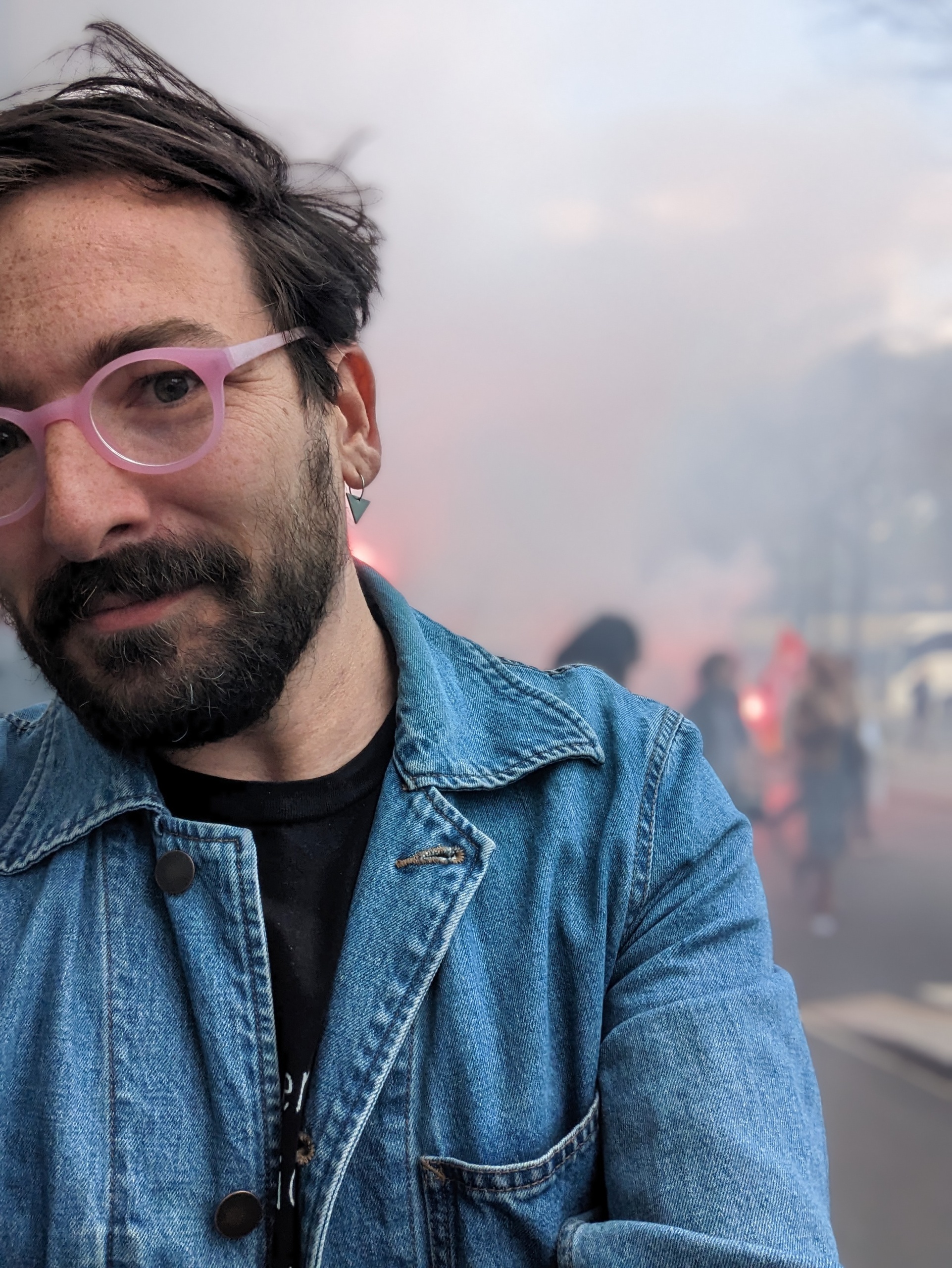
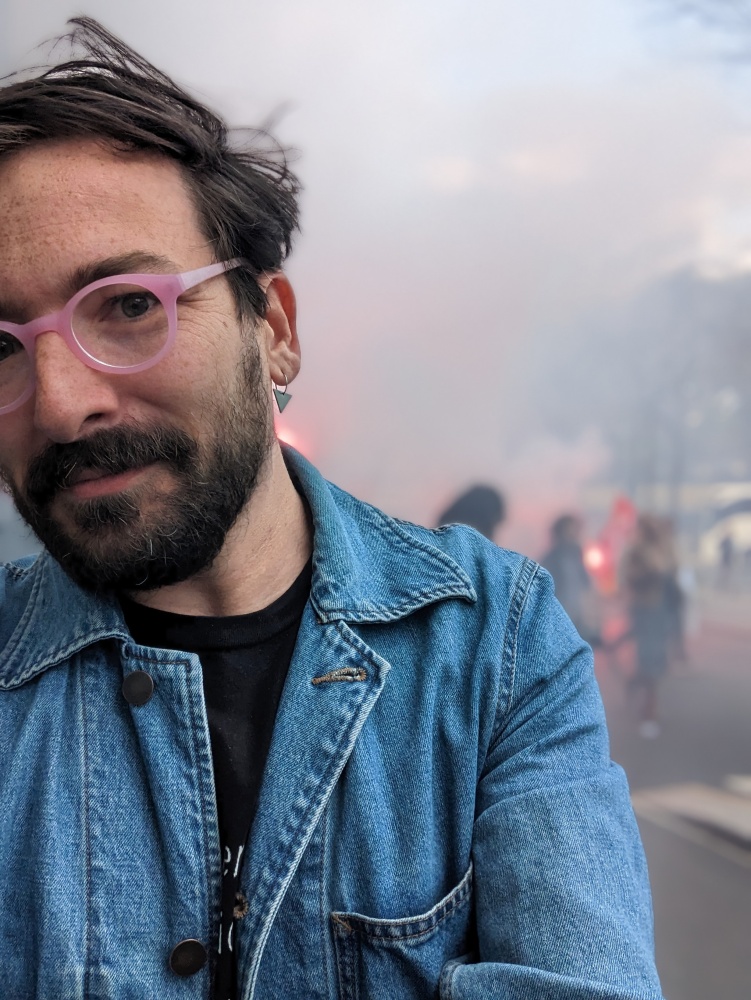
We are delighted to introduce readers to AJO‘s new Editor-in-Chief, Andy Campbell, Associate Professor of Critical Studies at the USC Roski School of Art and Design, where he teaches in the MA Curatorial Practices and the Public Sphere program. An art historian, critic, and curator, his work foregrounds LGBTQ communities and their archives as wellsprings for histories of art and design. He is the author of Bound Together: Leather, Sex, Archives, and Contemporary Art (Manchester University Press, 2020) and Queer X Design (Black Dog & Leventhal, 2019), and co-editor, with Amelia Jones, of Queer Communion: Ron Athey (Intellect, 2020), named one of the Best Art Books of 2020 by the New York Times. His criticism appears in Artforum, Aperture, X-TRA, and GLQ, among other venues.
Much of his subject matter—performance, the body, ritual, the ephemeral life of communities—resists the fixity of the page. He is at work on a survey exhibition of the Los Angeles–based artist Susan Silton, entitled Susan Silton: Diving into the Wreck (with a forthcoming catalog published by Inventory Press), as well as an academic book-length study, tentatively titled Poverty and Practice, grounding a discussion of the manifold ways poverty circumscribes artistic practice in the United States with the lives and works of Beverly Buchanan, Harmony Hammond, Laura Aguilar, and Emmi Whitehorse.
In the conversation that follows, the two editors pass the baton between them: they talk about what it means to curate a publication rather than merely edit one; about gathering as a curatorial ethic and hanging out as an intellectual one; about the exhaustion of critique and what might be built in its place; about the archive and the repertoire, and the long afterlife of a published thing; and about a field that has lost the public’s trust, and what it might take to extend the hand.
Grace Aneiza Ali: You come to Art Journal Open as a trifecta: art historian, critic, curator. Did those arrive one by one, or all at once? And how do you see them as a constellation, supporting each other?
Andy Campbell: Art historian came first, and that came early, in a high school AP art history class that I really connected to. I tell a story to my students about encountering a crucifixion as a Jewish kid growing up in Texas and not quite knowing why all of Christ’s friends were at the feet of the cross, not actually helping him down. Being baffled by that, just visually. The Christian kids had seen that kind of symbology all of their life, but I hadn’t. Luckily, I had an amazing teacher who helped me and the rest of the class understand that representation is different from actuality—that thinking about how things are positioned by an artist is really important. That just broke my brain open in really useful ways.
I thought art history was the logical path through college and grad school. But while I was working on that, I became much more interested in what artists were producing at the moment, and that’s when my criticism really started—thinking about criticism as the first draft of something like art history. Curatorial work came around the same time. My thesis project at the Allen Memorial Art Museum in Oberlin, Ohio, was essentially a curatorial intervention, so understanding curatorial work as a direct way of making meaning with art.
Those three things all live together for me. Art history is talking to a field of other historians; it’s about what we use as particular kinds of evidence, when, and who we rely on. Criticism is about being attentive to a present, understanding what art is doing in a moment. And curatorial practice is about making meaning directly—with artists, alongside artists, but also sometimes, and interestingly, in contra to artists. These might seem like tidy boundaries, but in fact, each abuts and incurs on the others in useful, generative ways.
GAA: When you’re in the classroom, in the hands-on projects in your curatorial program, how acutely are you thinking, this is who we’re handing the field to?
AC: All the time. People come in with their idea of what curatorial practice is, or should be, and I feel like it’s my role to help them expand those horizons of possibility, so that they can find a better set of placements in that field. There are people who come in who only think about curatorial work as the institutional curator. Curatorial efforts can be independently organized, can look or feel like “programming” and “education,” and can be deeply and pragmatically invested in artist legacies and archives—to name but a few expansions on we might conceive of curatorial work.
GAA: How do you bring that curatorial lens into the work of editorship?
AC: Editorship is analogous but not coterminous with curatorial work: crafting, guiding, allowing, and being receptive to things that are not created by you; working with people to realize something that is of their own ambition. They’re natural companions, in a way, and shaped by their own internal antagonisms, mechanisms, and precarities. They’re different, but they pull on a similar set of skills, which is about support, being receptive to heterogeneity, and meeting the particular challenges of a “now” in both practice (process) and outcomes.
I hope we’re beyond that time where an editor-in-chief is solely an authoritarian figure (the Miranda Priestly of it all!), but is also a supportive figure—in the way that a curator can be a supportive figure at times, or an author figure at times. But I want to turn the question back on you. How did you answer it?
GAA: I have a mission statement as a curator. I tell my students in my curatorial practice classes: define for yourself a curatorial mission statement. In MFA programs, artists have to shape their artist statements. I always found it fascinating that we don’t ask curators to shape their curatorial statements. So I have one, and at the heart of it is to gather: to gather people, to gather work, to gather ideas, to gather conversations—and then to step away from the gathering. Meaning I am not controlling or heavy-handed in what comes out of it. A synonym for me as a curator is to gather.
And there are times when you need to push an artist, get them out of their comfort zone, or just stay the course with them. Writers and scholars have a lot more in common with artists than they themselves even know. All three of those roles are often quite solitary. It’s the artist and the canvas, the writer and the page, the scholar and the archive. What I’ve found working with our authors is that they crave that editorial engagement in the same way an artist craves curatorial engagement—someone to push against them with those ideas, and at the same time someone to confirm and reinforce them. The same ethos that an artist and a curator build together applies to an editor and an author.
AC: This is true of advising, too. When I’m advising someone, my goal is not to make a mini-me. My goal is to support that person in whatever their goal and mission is: affirming when there needs to be extra support, saying, “yes, this is useful and necessary,” and asking key questions where I feel like things could use strengthening. But it’s never to come out the other end with someone who looks like me, talks like me, writes like me, moves in the world like me. That’s certainly not how I want to be approached by an editor, or by a mentor. That’s ideally a curatorial ethos, too.
GAA: The vehicle of Art Journal Open is language. Art history, criticism, and curatorial work each demand a different register. How do you approach those differences?
AC: I’m generally interested in people who forge their own path. The writing I find most interesting is not necessarily coming from art historical journals, our own at CAA included. For so long art history as a field has been incredibly Eurocentric, male dominant, and with a generally conservative point of view—not politically conservative, maybe, but conservative in terms of preserving a sense of a coherent field. So . . . perhaps unsurprisingly . . . people have gone to area studies, they’ve gone to cultural studies, they’ve gone to visual studies. Some of the most interesting art historical writing I am reading is in these disciplinary houses and journals (in and out of academia).
I like when writers push against the language of art history as an understood style of analysis. And I want to welcome poetry and poetic language, to welcome autotheory and various modes of address. These are really key in some of the major tectonic shifts in the way curatorial practice has operated in the last thirty, forty years, but also, I would argue, in the way that art history has operated. So I’m much more interested in people who want to write the way that they write, but have something to say to the field of art history, or to art and design in general. I love people who write in a register that is not fully recognizable as art historical writing at first. I find my brain electrified by that work, and by thinking about the possibility of what would happen if art history built a bigger tent for all kinds of approaches.
GAA: As an editor, I’ve found myself using the word critique less, and instead using the word engagement. My interest is not how someone critiques a text or an exhibition or an art object. I’m interested in how one enters in, encounters, engages the thing. Not in awe—awe isn’t what it means to enter something. But there is an openness in a question of engagement that critique sometimes closes down.
AC: I think that’s right. A guiding text I assign graduate students, especially when they first enter, is Rita Felski’s The Limits of Critique, which is about pushing against this idea that our first role should always be to tear something apart—against a hermeneutics of suspicion. It’s important to acknowledge that there are other ways of engaging.
There are these minoritized ways of being in conversation and in dialogue with each other. You use the word gather. On its surface it might seem to be about making the invitation and people showing up, but actually it’s so much more about what is possible in the conversation that might exist between people. Josh Franco, who’s now the executive director of the US Latinx Art Forum, put me on to an idea that comes from María Lugones: the idea of hanging out—this thing that appears to be about convivial spirit, but is in fact the place where we generate some of our most important ideas about ourselves, the world, each other. Hanging out as a mode of being with.
One thing I inherited through my own schooling, or was asked to inherit, was this kind of expectation of being torn to shreds. The idea that one has to be so thoroughly decimated to find oneself. There are innumerable ways of getting to what one wants to do in the world other than being eviscerated by one’s peers. The generation we’re a part of, but also the generation coming after us, are so uninterested in that. Not because we or they are fragile, not because we or they can’t take it, but because we and they see other possibilities. It’s not that there’s no place for disagreement, or for criticism; it’s that it’s in balance with other modes of being and address.
GAA: This is exactly the conversation we’ve been having in our editorial board meetings about peer review: how unkind it’s become. Our very specific, intentional, purposeful role as editors is to rein that in, and to create an ethos in which peer review can be kind, gracious, full of grace, generous—and at the same time equally rigorous.
AC: There is a pedagogical function to peer review. I often talk about teaching—and I think this is true of curating, and also of editing—as a prophetic mode: you’re bringing a world into being that you really want to see with others. That’s directly taken from the way bell hooks writes about teaching and pedagogy. To invest in what is prophetic about this, rather than in what makes one feel important and another person small. That’s just not the approach. I feel no compunction to hide this in any way: people whose livelihood or sense of self depends on that way of being in the world—meaning the aggrandizement of the self to the diminishment of everyone else—I would prefer them to not contact me at all. I have no patience for that approach; miss me with it.
GAA: We both hold a heart space for archives—and AJO‘s own archive is abundant. Your scholarship treats LGBTQ communities and their archives as “wellsprings for histories of art and design,” and that work has always struck me as heart work. What does an archival sensibility offer the work of editing—and how might it shape what the journal gathers and keeps?
AC: When you’re dealing with any kind of minoritized community, it’s not only about what exists in the record that we may call an archive. It’s important, first, to be specific about which archives we’re tapping—but let’s use the figuration of “the archive” for this more general conversation. And then it’s also important to look beyond that, to what Diana Taylor would call the repertoire: what’s kept in the body, what’s kept between people, what’s kept in community, what might not show up on paper in collections, what a bureaucratic administration of an archive could never account for. There has to be a commitment to both—and, I would argue, a concomitant push to continuously expand the remit and avenues of support and reach for both.
For me it is a heart space, because it is a space of activation, both intellectual and political—for myself included, but also for students who I take to archives, for colleagues that I share archival material with. It can be something that makes people feel close to another in a way that is profound and really difficult to describe outside of relationships with people who are living right now. It’s a way of bringing that heat to the work that we do, and stakes, to be quite honest.
One thing that I’m definitely wanting to continue that you implemented is pulling out things from AJO‘s own archive of published material to sit alongside new things that are being uploaded into this ongoing project. And it taps into something quite current. When you look at big music services—Apple Music, Spotify—they’ll have the trending now tracks, and oftentimes a lot of those will be things that were made twenty, thirty, forty years ago. They’re being recycled and used in social media, and new generations of people are finding them. A great example is Kate Bush’s “Running Up That Hill.” That signals that there’s a life outside of the initial life that we imagine for the things that we commission or that we edit. It’s something art historians have been attentive to for a long time—the social lives of objects extending past their initial contexts.
GAA: What is your vision for Art Journal Open? Where could it go that it hasn’t yet gone?
AC: It’s really about how I build upon what is already here in a way that extends its line. We are right now, and have been for a while, in a place where public understanding and trust in what we do is really low. We are seen as remote and elite and unfriendly towards the concerns of everyday people. And that’s not true. It’s a societal place that we find ourselves in.
So what is most exciting to me about AJO is that it is a public-facing, open access publication that people can access from their laptops, from their phones, from any place where they can get an internet connection. That is the most fundamental thing about this platform: it is open, and it is an open channel to some of the most interesting discussions, ideas, relationships that are defining art, art historical, curatorial, design production today.
There has to be a fundamental why for everything that we publish. With each thing that is published on AJO, if it was the first thing someone ever saw, I want to know that it would be a welcome invitation into this space. It doesn’t have to be a welcome invitation to everybody, but it has to welcome people into the fold. For people that work with me as an editor, I will always bring up that question: who are you welcoming in with this work? What is this work doing to expand the field of possibility for what it is that we do, and to communicate its value outward?
That loss of trust is a problem both of our own making and external to us. Part of understanding how to rebuild it is understanding what parts of it were intrinsic to the way that we thought we needed to behave as a field, as a discipline, the ways we needed to write, the ways we needed to validate or invalidate certain kinds of narratives. There’s a piece of that that has to be inward looking and retrospective. And some of it is totally external to us, and we can’t do anything about that but extend the hand, extend the hand, extend the hand.
In that vein of making our work meaningful to a broad base, I’m paying attention to how art historians and academics of all stripes are communicating via short-form video about their work, methods, projects. Good examples, I think, are Huey Copeland’s mini-lessons on how to look while considering the contexts of looking, and Ellen Lupton’s social media videos on design language and theory (and in the case of the linked reel, grammar!). I am also very much interested in the ecosystem of regional art publications. (Burnaway is my lodestar in this regard!). It was in such publications and alternative news weeklies that I got my start as a critic, so I think some of the most exciting art writing happens in these spaces. What I like about this publication—and it’s true of most journals—is that it’s a baton relay. It is about different people taking responsibility for what art and design history and practice could look like, and it is in the aggregate of that process that AJO’s true potential is actually realized. Neither you nor I could do that alone. That’s against this great man theory of progress, that one person can change the world. No—we work together, we work in coalition, we let someone else rest while someone else takes up the task. It’s not one person that shifts the way that things are done; it’s multiple people over time.
GAA: Your forthcoming study looks at how poverty circumscribes artistic practice in the US, through Beverly Buchanan, Harmony Hammond, Laura Aguilar, and Emmi Whitehorse. What questions of access, justice, or material precarity do you hope to bring into the journal’s pages?
AC: To dovetail on the last answer . . . this is the reason to helm an open-access publication! In this way some of the conversations amongst artists, art historians, and our kith might become more available. In regards to my work on poverty, I acknowledge it’s a tough word, as it contains within it a social damnation—and this is one of the reasons I’m interested in using it instead of terms like precarity. To my mind that means it also carries coalitional possibility, as evidenced by the Poor People’s Campaign—Martin Luther King Jr.’s final initiative, and one that has been taken up again in recent years. What begins for me with a group of protestors camping out on the National Mall in Washington DC, continues through the small (and sometimes large) decisions artists make when working from within poverty. This is not specific to the artist’s I’ve chosen to focus on [all Baby Boomer generation artists], but to artists and cultural workers of all kinds. This project is still very much in development, so I’m reticent to say much more . . . other than it’s been a cooking for years now . . .
GAA: And finally, what are your arts-related recommendations at the moment?
AC: Because I’m working on a survey exhibition of Susan Silton’s work that will open in the Fall, I’ve recently reread the books that she’ll be using in the next two iterations of her participatory installation, In everything there is the trace: Octavia Butler’s Parable of the Sower and Toni Morrison’s The Bluest Eye (Namwalli Serpell’s spellbinding On Morrison was by my side on this go around with The Bluest Eye and helped me to understand why so much that is written on Morrison skirts around actual readings and interpretations of her books!).
Everything else I’m taking in as I can. The new LACMA building and install—I have thoughts . . . but I’m still parsing my way through them. Mainly, I’m thinking about Peter Zumthor’s new galleries in relation to Bruce Goff’s 1988 Pavilion for Japanese Art on the same museum campus. There was a marvellous exhibition that just came down at the ONE Archives at the USC Libraries entitled NEED ME, or, (de)mystifying the myth of the modern primitive (curated by Quetzal Arévalo), which looked at the efflorescence of tattooing and piercing practices—especially on the West Coast—within queer communities. That exhibition was expertly handled, and got me thinking especially about handcrafted piercing jewelry. I also read, for the first time, Fear Reverence Terror by Carlo Ginzburg (an anthology of academic pieces) as a kind of self-imposed in memoriam activity. (The Cheese and the Worms is a book I always return to, uncoincidentally, and often in tandem with Sylvia Federici’s Caliban and the Witch.) I found the chapters on the “Lord Kitchner Wants You” poster by Alfred Leete and Picasso’s Guernica useful examples of what focused, yet broad-minded work can look like. Also recently completed on my summer reading list were: Amal El-Mohtar’s Seasons of Glass and Iron; Mary Capello’s Lecture, Maura Modeyo’s SAPPHO TERROR; Chris Lee’s Immutable: Designing History; Leon J. Hilton’s Counter-Cartographies: Neurodivergence and the Errancies of Performance; and Jenn Sichel’s fabulous book on Gene Swenson and Jill Johnston. This summer I’m doing a couple of independent studies with graduate students, which is always an opportunity for me to learn new things—this time about Disneyland and Pippa Garner.
Musically, the Red Hot Org’s soul-altering TRANSA compilation has been on near constant repeat at home since 2025. I’ve been returning to Ya Tseen’s last album as well (which, art nerds, is the father-gifted nom de scène of Nicholas Galanin–yes, that Nicholas Galanin). I’m also eagerly awaiting Meshell Ndegeocello’s new record of duet covers. (I mean, Ndegeocello and ANOHNI accompanying one another on Sonny and Cher’s “I Got You Babe”? My queer heart explodeth!).
Finally, an artist I find myself coming back to is Rei Naito—who is too-little known outside of Japan. I really appreciate her model of exhibition making, and the precision with which she deals with space. On the rare occasion I’ve seen one of her projects I have been stunned several times over. A few years ago, my boyfriend and I purchased a small sculpture in the form of a jar, which is to be filled with water (poured to the point of surface tension) and a single, many-petaled, light-colored flower. The work requires tending, care, and attention. It has become a reason to put down the phone, to get out of my head, and to form a relationship with a local florist that has been in operation for over fifty years. Outside of this immediate experience, I live through the documentation of her work—especially her recent exhibition at the Tokyo National Museum. It would be a dream to realize an exhibition of her work in the US.